Chernobyl after 40 Years

Photo courtesy tnhelearning.edu.
Chernobyl Nuclear Energy Plant as it looks today.
On April 26, 2026, less than six months from now, the world will mark the 40th anniversary of the world’s worst nuclear disaster (in the relatively short history of nuclear power), at Chernobyl, Ukraine, then part of the Soviet Union. This incident, while lacking the explosive power of Little Boy, (the nuclear bomb dropped on Hiroshima, Japan, on August 6, 1945), it released 400 times the amount of radiation of a type more long-lived than the nuclear bomb.
In its initial high concentrations, the radiation was devastating. Twenty-eight workers, of 4,000 exposed, lost their lives to radiation sickness, one very painful way to die. Within a short time, another 4,000 people had contracted thyroid cancer, but only eight, all children, died. To the west of the plant, a huge conifer forest turned red and died, earning it the nickname, Red Forest. Lots of wildlife, particularly animals living in the soil, died in droves and livestock were sickened.
The contamination forced the immediate evacuation of 115,000 people, who were told to just bring what they could carry and then they would be allowed to come back for the rest. Of course, that part never happened, and today visitors (yes, you can visit some areas now) see life as it was on that fateful day.
Over the course of time, 300,000 people were evacuated and an exclusionary zone was created. This zone has undergone several boundary modifications, but as a whole still remains uninhabitable. The center area around the facility (about 250 square miles) may not be occupiable by humans for centuries to come.
How big is this exclusionary area? Well, it is actually two areas, the Chernobyl Exclusionary Zone—the CEZ—officially named the Chernobyl Nuclear Power Plant Zone of Alienation—in Ukraine, and the Polesie State Radioecological Reserve adjacent to the CEZ, but in Belarus. Combined, they equal 1,711 square miles, larger than Rhode Island and about half the size of Yellowstone National Park.
The crazy thing is, after nearly 40 years with no maintenance, the abandoned cities and towns are not barren moonscapes, but are re-wilding. Grasses, forbs, vines, shrubs, and trees are re-taking the streets, yards, parks, and playgrounds, with over 1,250 species of plant life vying for the space.
Does this sound like the nuclear wasteland that we see in the Armageddon-type movies? Not even close. And that is the strange thing. Certainly, plants and animals died in abundance during the first weeks of exposure after the accident. At that time, the radioactivity was extremely high, but as the dust literally settled, life is finding a way (thank you Jurassic Park).
That is not to say that the radiation has magically disappeared. When the Russian Army invaded Ukraine in February 2022, they quickly captured the Chernobyl nuclear power plant. Fearing bullets and shrapnel more than radiation, troops dug defensive trenches inside the highest-ranking exclusion area putting them in direct contact with highly contaminated soil. By the time they were ousted by Ukrainian forces several weeks later, Newsweek Magazine reported that many of the Russian soldiers were being treated for radiation poisoning. Even if they survive, their chances of developing cancer in their futures just skyrocketed.
So, what about the wildlife? They did not get to evacuate, nor did they get medical treatment. They had no way to escape the full effect of the worst nuclear disaster in the history of the world. Have they survived or thrived? Do they develop debilitating mutations or cancers? Have they changed genetically? More on that next time.
Help Idaho Wildlife
When we traveled across the state in October 2017, we visited most of the Idaho Department of Fish and Game wildlife management areas. Most of the vehicles we saw using the wildlife management areas did not have wildlife plates. Buying wildlife plates is a great way for non-hunters and hunters alike to support wildlife-based recreation like birding.
C'mon folks, let's help Idaho's wildlife by proudly buying and displaying a wildlife license plate on each of our vehicles!
See below for information on Idaho plates. Most states have wildlife plates so if you live outside Idaho, check with your state's wildlife department or vehicle licensing division for availability of state wildlife plates where you live.
And tell them that you heard about it from Nature-track.com!
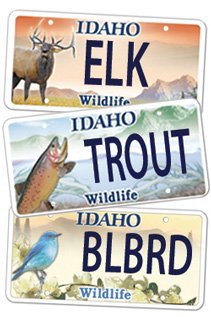
Wildlife License Plates
Great news! as of 2024, there are three NEW designs for license plates. They still are bluebird, cutthroat trout and elk, but they are beautiful.
Idaho Wildlife license plates provide essential funding that benefits the great diversity of native plants and wildlife that are not hunted, fished or trapped—over 10,000 species or 98% of Idaho’s species diversity. Game species that share the same habitats (such as elk, deer, antelope, sage-grouse, salmon, trout) also benefit from these specialty plates.
No state tax dollars are provided for wildlife diversity, conservation education and recreation programs. Neither are any revenues from the sale of hunting or fishing licenses spent on nongame species. Instead, these species depend on direct donations, federal grants, fundraising initiatives—and the Idaho Wildlife license plates.
Both my vehicles have Bluebird Plates. I prefer the bluebird because the nongame program gets 70 percent of the money from bluebird plates, but only 60 percent of the money from elk and trout plates - 10 percent of the money from elk plates supports wildlife disease monitoring and testing programs (to benefit the livestock industry) and 10 percent from cutthroat plates supports non-motorized boat access.
Incidentally, in 2014, the Idaho Legislature denied the Department of Fish and Game the ability to add new plates or even to change the name of the elk and cutthroat plates (very specific) to wildlife and fish plates, a move that would have allowed for changing images occasionally and generating more revenue. It would seem that they believe that we Idahoans don't want a well funded wildlife program.
I think it is time we let the Legislature know that Idahoan support wildlife funding and that we would like to see these generic plates come to fruition.
"WOW. What a phenomenal piece you wrote. You are amazing." Jennifer Jackson
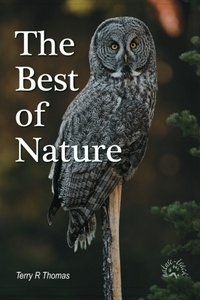
That is embarrassing, but actually a fairly typical response to my nature essays. Since The Best of Nature is created from the very best of 16 years of these nature essays published weekly in the Idaho Falls Post Register (online readership 70,000), it is a fine read. It covers a wide variety of topics including humorous glimpses of nature, philosophy, natural history, and conservation. Readers praise the style, breadth of subject matter and my ability to communicate complex and emotional topics in a relaxed and understandable manner.
Everyone can find something to love in this book. From teenagers to octogenarians, from the coffee shop to the school room, these nature essays are widely read and enjoyed.
Some of the essays here are my personal favorites, others seemed to strike a chord with readers. Most have an important message or lesson that will resonate with you. They are written with a goal to simultaneously entertain and educate about the wonderful workings of nature. Some will make you laugh out loud and others will bring a tear to the eye and warm your heart.
Readers Write:
"You hit a home run with your article on, Big Questions in Nature. It should be required reading for everyone who has lost touch with nature...great job!" Joe Chapman
"We enjoyed your column, Bloom Where Planted. Some of the best writing yet. The Post Register is fortunate to have your weekly columns." Lou Griffin.
To read more and to order a copy, click here or get the Kindle version
Copies are also available at:
Post Register
Island Park Builders Supply (upstairs)
Barnes and Noble in Idaho Falls
Harriman State Park, Island Park
Museum of Idaho
Valley Books, Jackson Wyoming
Avocet Corner Bookstore, Bear River National Wildlife Refuge, Brigham City, Utah
Craters of the Moon National Monument Bookstore, Arco, Idaho