Paint in the Forest
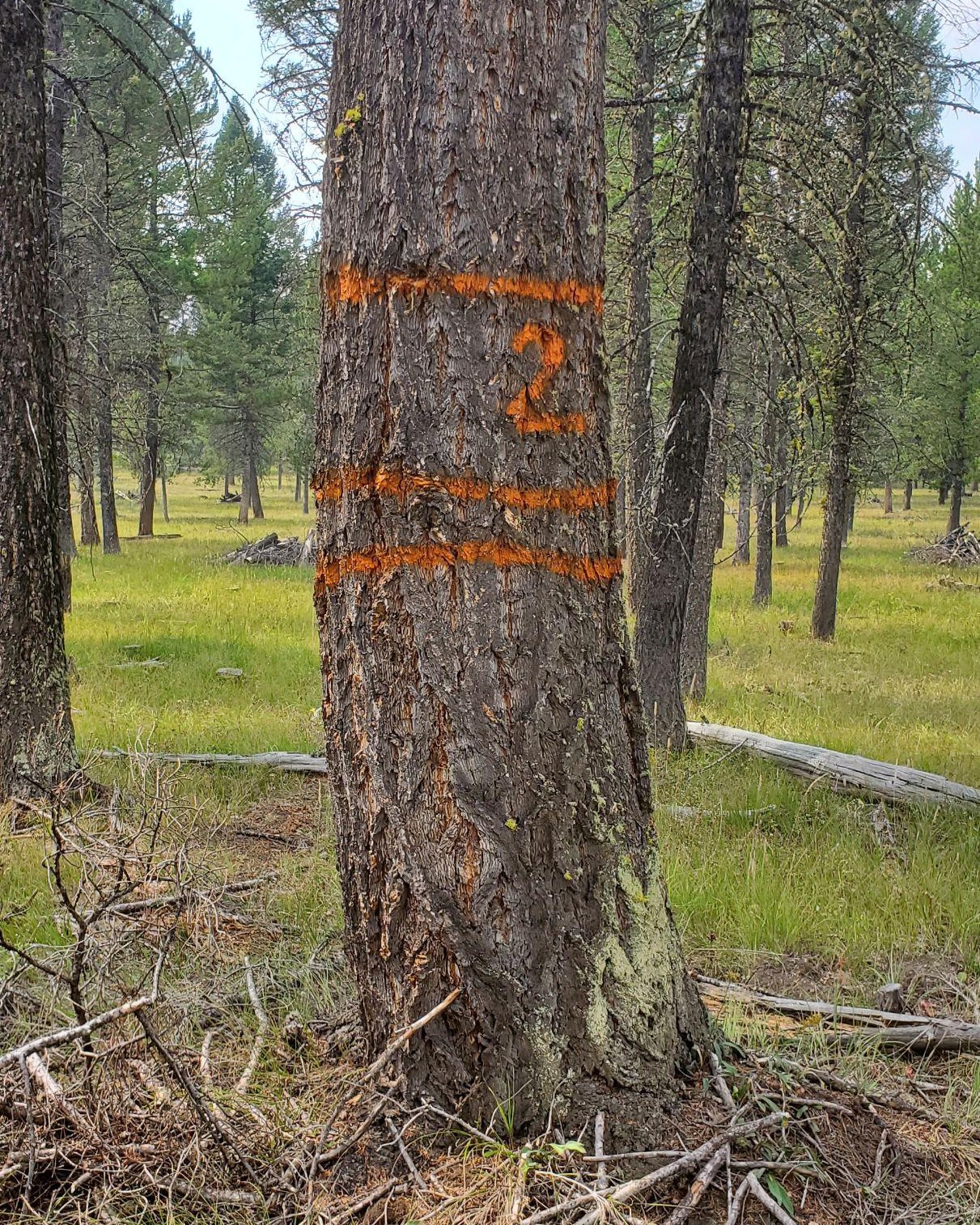
©Terry R. Thomas/www.nature-track.com
This tree was marked as a tree to be left uncut, as denoted by the orange paint, in a recent sale in Island Park.
Wander around the woods very long and you will see some weird markings. They may be blue, red, yellow, orange, white, green, black, or even pink, and are always on the bark of trees. Are our forests invaded by aliens? Is this Sasquatch’s way of communicating? Do the colors have some other meaning?
It turns out that the odd markings we see in the forests are intentional markings from land management agencies, primarily, U.S. Forest Service, Bureau of Land Management, and state of Idaho Department of Lands. These colors are used to mark areas that are to be harvested and each color has a specific meaning to the foresters and harvest crews.
Both BLM and Forest Service use the same protocols when marking timber to be harvested. I visited with Heather Cossiart at the Ashton office of the Forest Service to find out how to interpret these colors.
A timber sale must be marked for the contractors to know where the boundaries are and which trees are protected from harvest (such as wildlife trees that provide exceptional nesting habitat). There are specific colors for different jobs and the code is spelled out in the contract with the harvesting contractor.
If everything is normal, the chart below indicates which colors are to be used (Forest Service Handbook).
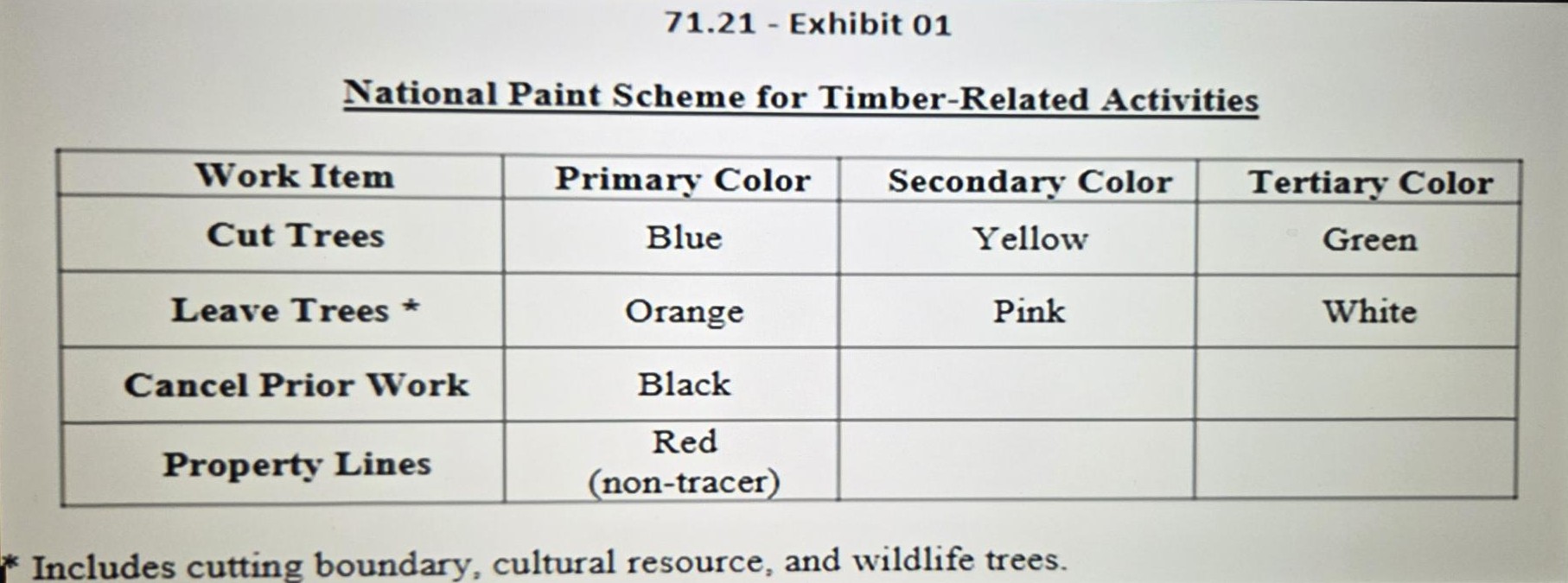
That seems straight forward. However, the secondary and tertiary colors come into play when, for instance, a new and different contract overlaps with an old one that was previously marked, but not harvested for some reason. For example, to avoid mistakes, blue may be replaced with yellow (secondary) or even green if there is already blue and yellow paint on the site. Thus, blue in this instance, means nothing to the contractors, it is just a remnant from the past.
Speaking of the past, another reason for the secondary/tertiary colors is that at one time blue marked leave trees and orange marked harvest trees, just the opposite from today’s colors.
How the trees are marked is also key to this harvest coding process. Heather said, “the way the trees are marked matters as well. When we are marking boundary, we do one vertical line facing inside the unit, and then either a dot or a shorter line on both sides of the trees pointing in the direction of the next boundary tree. When marking trees interior of the unit as either leave tree or cut tree we paint a full band around the tree so it is easily seen during harvest activities.” So, the color combines with the marking method. A tree inside the harvest unit that is marked with blue paint all the way around is a tree bound for the mill.
Timber harvest is less common in much of Eastern Idaho than it once was. However, painted trees are still a common sight. Understanding the color system helps to make sense of what happened or is about to happen in a given area.
Help Idaho Wildlife
When we traveled across the state in October 2017, we visited most of the Idaho Department of Fish and Game wildlife management areas. Most of the vehicles we saw using the wildlife management areas did not have wildlife plates. Buying wildlife plates is a great way for non-hunters and hunters alike to support wildlife-based recreation like birding.
C'mon folks, let's help Idaho's wildlife by proudly buying and displaying a wildlife license plate on each of our vehicles!
See below for information on Idaho plates. Most states have wildlife plates so if you live outside Idaho, check with your state's wildlife department or vehicle licensing division for availability of state wildlife plates where you live.
And tell them that you heard about it from Nature-track.com!
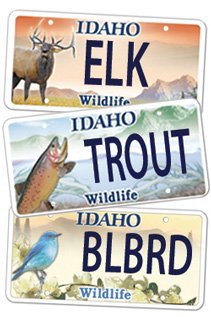
Wildlife License Plates
Great news! as of 2024, there are three NEW designs for license plates. They still are bluebird, cutthroat trout and elk, but they are beautiful.
Idaho Wildlife license plates provide essential funding that benefits the great diversity of native plants and wildlife that are not hunted, fished or trapped—over 10,000 species or 98% of Idaho’s species diversity. Game species that share the same habitats (such as elk, deer, antelope, sage-grouse, salmon, trout) also benefit from these specialty plates.
No state tax dollars are provided for wildlife diversity, conservation education and recreation programs. Neither are any revenues from the sale of hunting or fishing licenses spent on nongame species. Instead, these species depend on direct donations, federal grants, fundraising initiatives—and the Idaho Wildlife license plates.
Both my vehicles have Bluebird Plates. I prefer the bluebird because the nongame program gets 70 percent of the money from bluebird plates, but only 60 percent of the money from elk and trout plates - 10 percent of the money from elk plates supports wildlife disease monitoring and testing programs (to benefit the livestock industry) and 10 percent from cutthroat plates supports non-motorized boat access.
Incidentally, in 2014, the Idaho Legislature denied the Department of Fish and Game the ability to add new plates or even to change the name of the elk and cutthroat plates (very specific) to wildlife and fish plates, a move that would have allowed for changing images occasionally and generating more revenue. It would seem that they believe that we Idahoans don't want a well funded wildlife program.
I think it is time we let the Legislature know that Idahoan support wildlife funding and that we would like to see these generic plates come to fruition.
"WOW. What a phenomenal piece you wrote. You are amazing." Jennifer Jackson
That is embarrassing, but actually a fairly typical response to my nature essays. Since The Best of Nature is created from the very best of 16 years of these nature essays published weekly in the Idaho Falls Post Register (online readership 70,000), it is a fine read. It covers a wide variety of topics including humorous glimpses of nature, philosophy, natural history, and conservation. Readers praise the style, breadth of subject matter and my ability to communicate complex and emotional topics in a relaxed and understandable manner.
Everyone can find something to love in this book. From teenagers to octogenarians, from the coffee shop to the school room, these nature essays are widely read and enjoyed.
Some of the essays here are my personal favorites, others seemed to strike a chord with readers. Most have an important message or lesson that will resonate with you. They are written with a goal to simultaneously entertain and educate about the wonderful workings of nature. Some will make you laugh out loud and others will bring a tear to the eye and warm your heart.
Readers Write:
"You hit a home run with your article on, Big Questions in Nature. It should be required reading for everyone who has lost touch with nature...great job!" Joe Chapman
"We enjoyed your column, Bloom Where Planted. Some of the best writing yet. The Post Register is fortunate to have your weekly columns." Lou Griffin.
To read more and to order a copy, click here or get the Kindle version
Copies are also available at:
Post Register
Island Park Builders Supply (upstairs)
Barnes and Noble in Idaho Falls
Harriman State Park, Island Park
Museum of Idaho
Valley Books, Jackson Wyoming
Avocet Corner Bookstore, Bear River National Wildlife Refuge, Brigham City, Utah
Craters of the Moon National Monument Bookstore, Arco, Idaho