Life After Dark Part 2
Copyright Nature-track.com/TerryRThomas
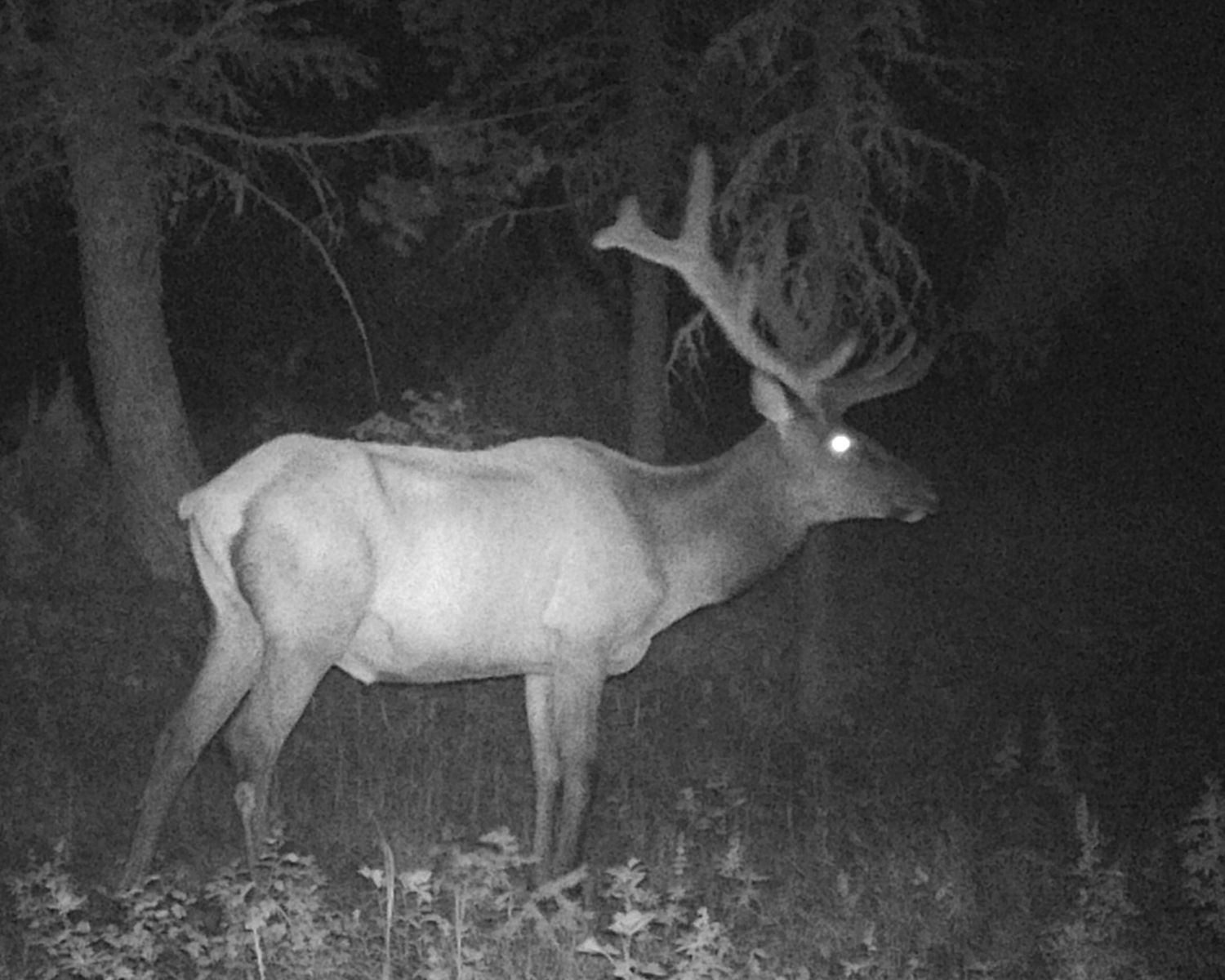
This trail camera photo clearly shows the reflectance of the tapetum lucidum even in infrared light.
The scene we saw early one morning on the plains of the Serengeti of Tanzania, told a story of nighttime slaughter. A pride of about eight lions had encountered a herd of wildebeest and with great skill the lions had dispatched over half a dozen of the horned beasts. When we arrived, the lions had already eaten their fill and were relaxing amid the carcasses.
Both lions and wildebeests can be active during the day, but both species choose the cover of darkness as well—wildebeests trying to avoid lions and lions trying to make dinner of wildebeests—nighttime works for both. How though, if they are not adapted to full nocturnal life?
The answer lies in the formation in the eye. Many obligate nocturnal animals have huge eyes, large pupils, and lots of rods for gathering more light. Tarsiers, for instance, six-inch long primates, have eyes bigger than their brains, so large, that like owls, they cannot rotate in their sockets. These animals are fully nocturnal so this adaptation makes sense.
There is another unique feature, the tapetum lucidum, a reflective layer at the back of the eye, that reflects light directly back along the light path. This matches the original and reflected light, thus maintaining the sharpness and contrast of the image on the retina and increasing the quantity of light to the retina. In a cat, the tapetum lucidum increases the sensitivity of the cat's vision by 44 percent, allowing the cat to see light that is imperceptible to human eyes. You have seen the tapetum lucidum in action as this is what causes eyes to shine in your headlights in the dark (different from red-eye caused by a camera flash which is just the retinal glow). Eyeshine color can appear orange, yellow, green or blue, depending on the animal.
You might have guessed that humans do not have a tapetum lucidum. Many mammals do, but most primates do not. Members of the cat, dog, cattle, deer, and rabbit families, for instance, all have a tapetum lucidum. Most squirrels do not, but the flying squirrel, a nocturnal obligate, has one along with its oversized eyes. There are some fish and a few birds, owls and kiwis for example, with a tapetum lucidum.
Besides avoiding predators or improving hunting opportunities, which at least on the surface seem to wash each other out, there is another reason to become nocturnal—to escape environmental conditions. This is especially true in desert climates where escaping the heat of the day is critical for conserving water and maintaining body temperature. Kangaroo rats, scorpions, and ring-tailed cats are examples of desert dwellers active at night.
As most hunters can tell you, increasing pressure from humans can also force animals into nighttime activity. Research has shown that nocturnal activity among large mammals (remember the grizzly bears wandering Island Park neighborhoods at night?) may increase by 35 percent or more when human go about their busy lives. This is an attempt on the animals’ part to avoid conflict with its most intolerant neighbor. Long-term disturbances may lower juvenile survival rates and even reproduction, impacting the animal at the population level.
However, there is an upside too. Humans are not going away and if animals can learn to live beside us by simply becoming more nocturnal, that might be a strategy that keeps us playing in the same sandbox—just at different times.
Help Idaho Wildlife
When we traveled across the state in October 2017, we visited most of the Idaho Department of Fish and Game wildlife management areas. Most of the vehicles we saw using the wildlife management areas did not have wildlife plates. Buying wildlife plates is a great way for non-hunters and hunters alike to support wildlife-based recreation like birding.
C'mon folks, let's help Idaho's wildlife by proudly buying and displaying a wildlife license plate on each of our vehicles!
See below for information on Idaho plates. Most states have wildlife plates so if you live outside Idaho, check with your state's wildlife department or vehicle licensing division for availability of state wildlife plates where you live.
And tell them that you heard about it from Nature-track.com!
Wildlife License Plates
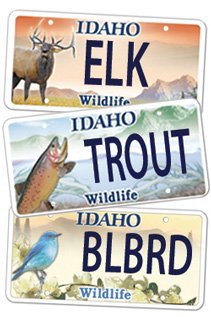
Great news! as of 2024, there are three NEW designs for license plates. They still are bluebird, cutthroat trout and elk, but they are beautiful.
Idaho Wildlife license plates provide essential funding that benefits the great diversity of native plants and wildlife that are not hunted, fished or trapped—over 10,000 species or 98% of Idaho’s species diversity. Game species that share the same habitats (such as elk, deer, antelope, sage-grouse, salmon, trout) also benefit from these specialty plates.
No state tax dollars are provided for wildlife diversity, conservation education and recreation programs. Neither are any revenues from the sale of hunting or fishing licenses spent on nongame species. Instead, these species depend on direct donations, federal grants, fundraising initiatives—and the Idaho Wildlife license plates.
Both my vehicles have Bluebird Plates. I prefer the bluebird because the nongame program gets 70 percent of the money from bluebird plates, but only 60 percent of the money from elk and trout plates - 10 percent of the money from elk plates supports wildlife disease monitoring and testing programs (to benefit the livestock industry) and 10 percent from cutthroat plates supports non-motorized boat access.
Incidentally, in 2014, the Idaho Legislature denied the Department of Fish and Game the ability to add new plates or even to change the name of the elk and cutthroat plates (very specific) to wildlife and fish plates, a move that would have allowed for changing images occasionally and generating more revenue. It would seem that they believe that we Idahoans don't want a well funded wildlife program.
I think it is time we let the Legislature know that Idahoan support wildlife funding and that we would like to see these generic plates come to fruition.
"WOW. What a phenomenal piece you wrote. You are amazing." Jennifer Jackson
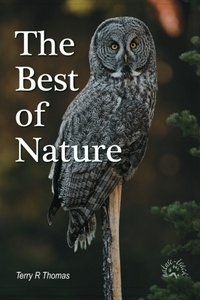
That is embarrassing, but actually a fairly typical response to my nature essays. Since The Best of Nature is created from the very best of 16 years of these nature essays published weekly in the Idaho Falls Post Register (online readership 70,000), it is a fine read. It covers a wide variety of topics including humorous glimpses of nature, philosophy, natural history, and conservation. Readers praise the style, breadth of subject matter and my ability to communicate complex and emotional topics in a relaxed and understandable manner.
Everyone can find something to love in this book. From teenagers to octogenarians, from the coffee shop to the school room, these nature essays are widely read and enjoyed.
Some of the essays here are my personal favorites, others seemed to strike a chord with readers. Most have an important message or lesson that will resonate with you. They are written with a goal to simultaneously entertain and educate about the wonderful workings of nature. Some will make you laugh out loud and others will bring a tear to the eye and warm your heart.
Readers Write:
"You hit a home run with your article on, Big Questions in Nature. It should be required reading for everyone who has lost touch with nature...great job!" Joe Chapman
"We enjoyed your column, Bloom Where Planted. Some of the best writing yet. The Post Register is fortunate to have your weekly columns." Lou Griffin.
To read more and to order a copy, click here or get the Kindle version
Copies are also available at:
Post Register
Island Park Builders Supply (upstairs)
Barnes and Noble in Idaho Falls
Harriman State Park, Island Park
Museum of Idaho
Valley Books, Jackson Wyoming
Avocet Corner Bookstore, Bear River National Wildlife Refuge, Brigham City, Utah
Craters of the Moon National Monument Bookstore, Arco, Idaho