Mosquito Season

©Terry R. Thomas/www.nature-track.com. Photo AI generated.
It’s mosquito season! Can we keep these little bloodsuckers from ruining our outdoor fun?
The time for barbeques, fly fishing, trips to the lake or pool, and hiking/biking is upon us and that means one thing: mosquito season. Fortunately for North Americans, deadly mosquito-borne illnesses are mostly found in tropical areas of the world, so for us, irritation is the biggest threat. We aren’t completely off the hook though. Most states have reported mosquito-borne West Nile virus (a friend of ours died from this), cases of dengue fever occasionally originate in the southern tier of states, and even Zika, a dangerous disease for pregnant women, occasionally shows up. So, it is wise to avoid mosquitoes when possible.
Not getting bitten by mosquitoes is almost a holy grail for outdoor activities, one which my wife and I pursue relentlessly. Cathy seems to be exceptionally attractive to mosquitoes and we take any precautions that we can to reduce her exposure.
Why do some people seem to be mosquito magnets while others can dance naked in a room full of mosquitoes and not get a single bite? The hard truth is that it may not be an attraction issue at all, but rather, a reaction problem. When we are bitten by a mosquito, our bodies react with a release of histamine. The more histamine our bodies send to the affected area, the stronger the reaction. Cathy might just be extra sensitive and release a lot of histamine, and our naked dancer could be bitten just as often, but just doesn’t have the reaction.
However, there seems to be plenty of evidence that about 20 percent of people are “high attractor types” when it comes to mosquitoes. Your deliciousness rating is based on the two ways a mosquito interprets the world—sight and smell.
Probably the number one thing a mosquito targets is carbon dioxide. They even have a specific mouth organ to detect it. We all emit carbon dioxide and that lets the mosquito know a banquet is in the area. However, some people emit more than others, making them more attractive. People who are very active will also emit more C02 drawing mosquitoes like a flame.
One study determined that a person’s skin microbiota also affects the way we smell to a mosquito. We are all covered in microbiota and if our particular community is less diverse (fewer species) than someone else, we will be more attractive to a hungry mosquito.
Mosquitoes are attracted to many types of colognes and perfumes. If you are headed to the neighborhood barbeque, you are better off to forgo the fragrances. Even changing to a scentless soap and shampoo might help.
Finally, mosquitoes seem to be attracted to a certain blood type. If you are O positive like I am, and this is the most common blood type, good luck. Unlike the perfumes and colognes, no one is going to change their blood type.
In the sight department, mosquitoes seem to be attracted to darker colors. This is simply because the darker clothes usually make us stand out better against the background. Light-colored clothing is the best choice.
What about repellents to encourage mosquitoes to seek out unprotected meals? While DEET is still the gold standard against which all other controls are measured, many people (myself included) are reluctant to use this chemical repeatedly on their skin. There are other products out there though that receive mixed reviews. Picaridin is rated as nearly as effective as DEET although I personally disagree. Natural oils, including eucalyptus, peppermint, cedarwood, citronella, and lemongrass are all commonly used in various combinations but must be reapplied often. I found straight eucalyptus to be totally ineffective but perhaps mixed with something else it would improve. There is also permethrin, a compound you spray on your clothes not your skin that is said to be effective even after washing. In fact there is one form of permethrin that you can actually add to your wash for longer term effect.
The sad thing about repellents is that mosquitoes seem to quickly adapt to them and they begin to lose effectiveness after several hours.
There are a number of products, Thermacell™ being one of them, that can repel mosquitoes from an entire area. One called MOZZ Shield™, claims to repel flying insects in a 30-foot diameter for 10 hours on a single charge and does it without chemicals. I might check this one out.
Until I find a final solution, I am going to continue to wear long sleeves and long pants any time I am in mosquito country. I use a lot less repellent and get better results this way.
Help Idaho Wildlife
When we traveled across the state in October 2017, we visited most of the Idaho Department of Fish and Game wildlife management areas. Most of the vehicles we saw using the wildlife management areas did not have wildlife plates. Buying wildlife plates is a great way for non-hunters and hunters alike to support wildlife-based recreation like birding.
C'mon folks, let's help Idaho's wildlife by proudly buying and displaying a wildlife license plate on each of our vehicles!
See below for information on Idaho plates. Most states have wildlife plates so if you live outside Idaho, check with your state's wildlife department or vehicle licensing division for availability of state wildlife plates where you live.
And tell them that you heard about it from Nature-track.com!
Wildlife License Plates
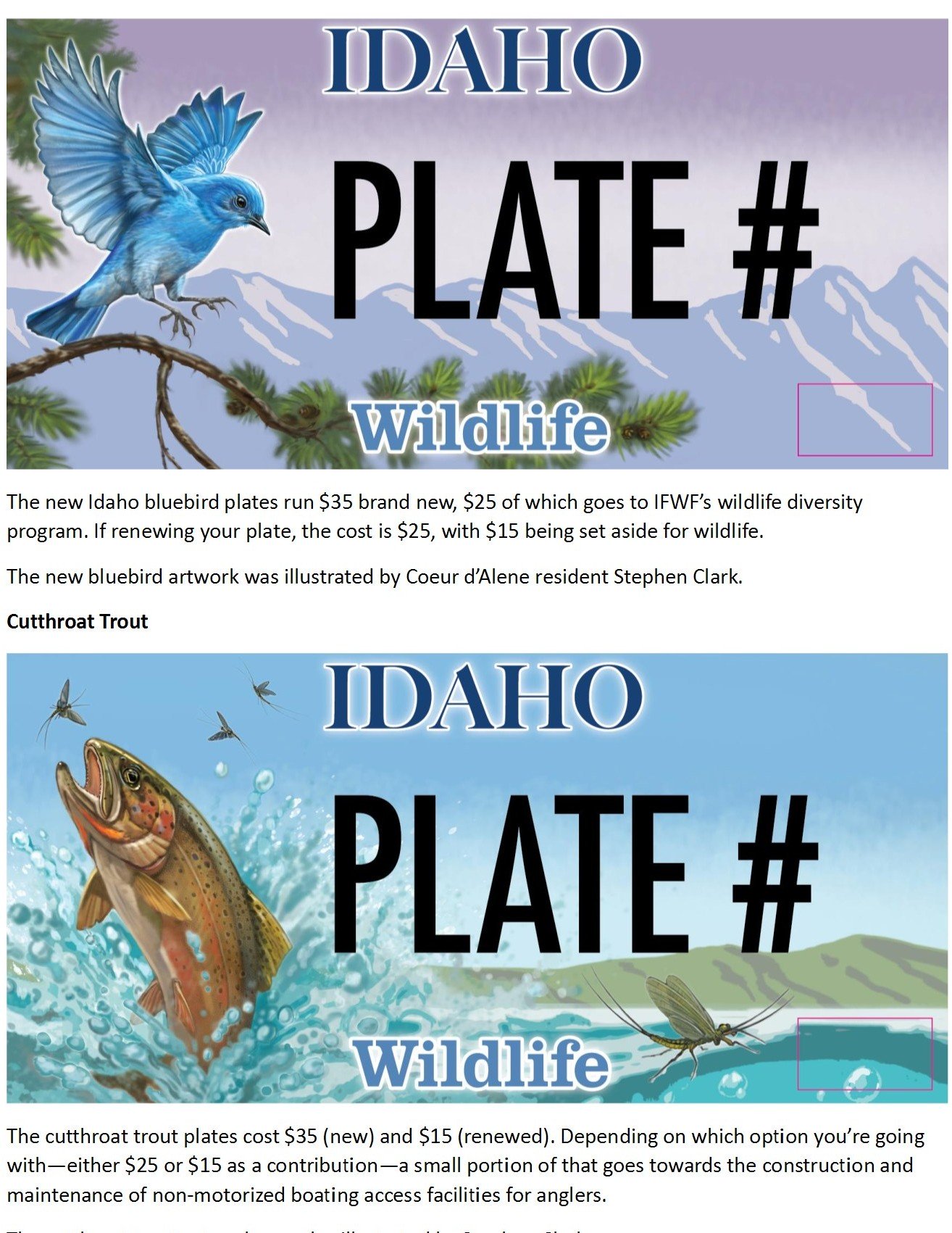
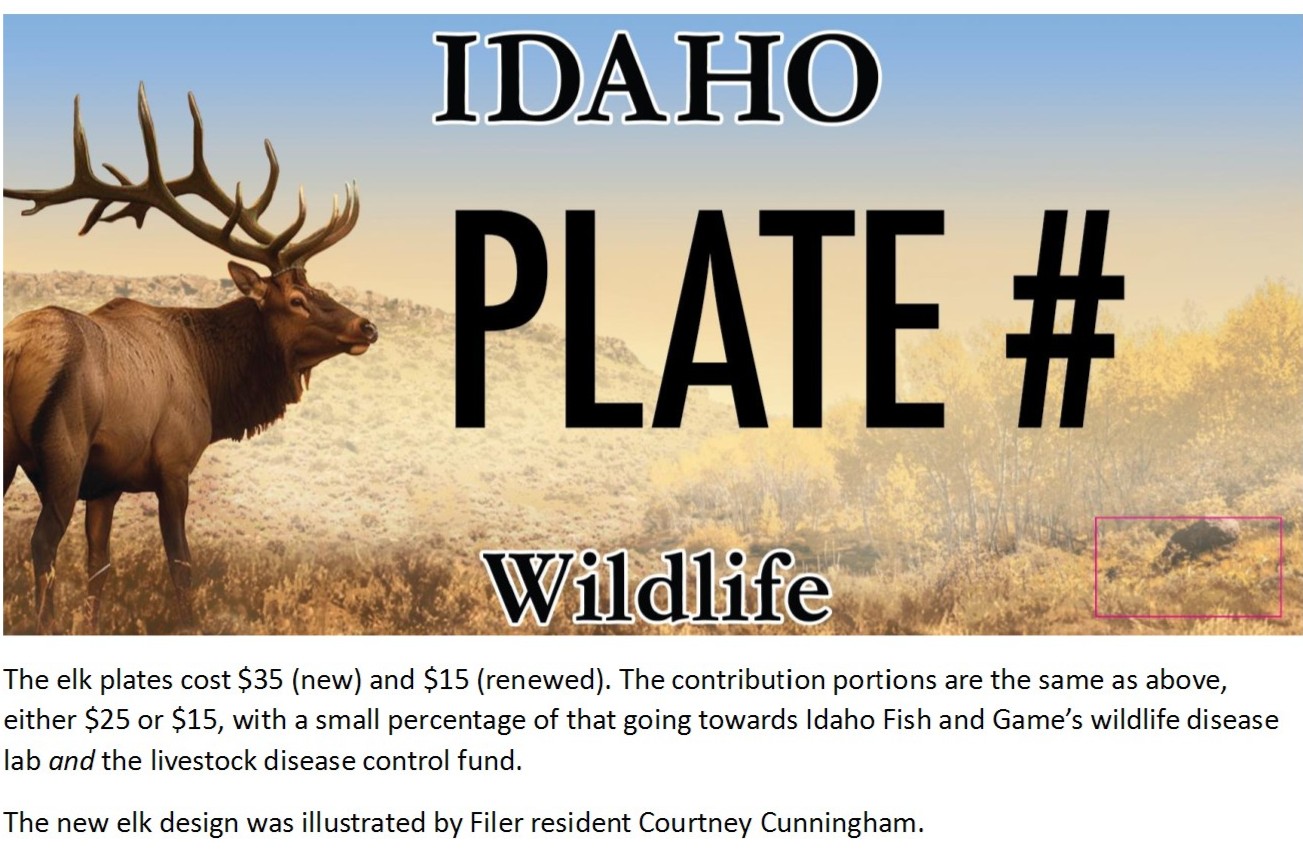
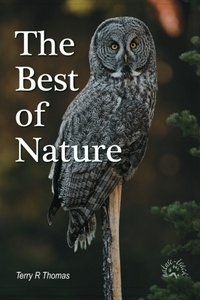
Great news! as of 2024, there are three NEW designs for license plates. They still are bluebird, cutthroat trout and elk, but they are beautiful.
Idaho Wildlife license plates provide essential funding that benefits the great diversity of native plants and wildlife that are not hunted, fished or trapped—over 10,000 species or 98% of Idaho’s species diversity. Game species that share the same habitats (such as elk, deer, antelope, sage-grouse, salmon, trout) also benefit from these specialty plates.
No state tax dollars are provided for wildlife diversity, conservation education and recreation programs. Neither are any revenues from the sale of hunting or fishing licenses spent on nongame species. Instead, these species depend on direct donations, federal grants, fundraising initiatives—and the Idaho Wildlife license plates.
Both my vehicles have Bluebird Plates. I prefer the bluebird because the nongame program gets 70 percent of the money from bluebird plates, but only 60 percent of the money from elk and trout plates - 10 percent of the money from elk plates supports wildlife disease monitoring and testing programs (to benefit the livestock industry) and 10 percent from cutthroat plates supports non-motorized boat access.
Incidentally, in 2014, the Idaho Legislature denied the Department of Fish and Game the ability to add new plates or even to change the name of the elk and cutthroat plates (very specific) to wildlife and fish plates, a move that would have allowed for changing images occasionally and generating more revenue. It would seem that they believe that we Idahoans don't want a well funded wildlife program.
I think it is time we let the Legislature know that Idahoan support wildlife funding and that we would like to see these generic plates come to fruition.
"WOW. What a phenomenal piece you wrote. You are amazing." Jennifer Jackson
That is embarrassing, but actually a fairly typical response to my nature essays. Since The Best of Nature is created from the very best of 16 years of these nature essays published weekly in the Idaho Falls Post Register (online readership 70,000), it is a fine read. It covers a wide variety of topics including humorous glimpses of nature, philosophy, natural history, and conservation. Readers praise the style, breadth of subject matter and my ability to communicate complex and emotional topics in a relaxed and understandable manner.
Everyone can find something to love in this book. From teenagers to octogenarians, from the coffee shop to the school room, these nature essays are widely read and enjoyed.
Some of the essays here are my personal favorites, others seemed to strike a chord with readers. Most have an important message or lesson that will resonate with you. They are written with a goal to simultaneously entertain and educate about the wonderful workings of nature. Some will make you laugh out loud and others will bring a tear to the eye and warm your heart.
Readers Write:
"You hit a home run with your article on, Big Questions in Nature. It should be required reading for everyone who has lost touch with nature...great job!" Joe Chapman
"We enjoyed your column, Bloom Where Planted. Some of the best writing yet. The Post Register is fortunate to have your weekly columns." Lou Griffin.
To read more and to order a copy, click here or get the Kindle version
Copies are also available at:
Post Register
Island Park Builders Supply (upstairs)
Barnes and Noble in Idaho Falls
Harriman State Park, Island Park
Museum of Idaho
Valley Books, Jackson Wyoming
Avocet Corner Bookstore, Bear River National Wildlife Refuge, Brigham City, Utah
Craters of the Moon National Monument Bookstore, Arco, Idaho