Compound Leaves

©Terry R. Thomas/www.nature-track.com
A mountain ash shows its compound oddly pinnate leaves.
In our world, the word, compound, is used for a number of things. First, there is that amazing money multiplier called compound interest. There are compounds comprised of two or more chemicals to become more or different than the separate chemicals. In language, there are compound words, words such as, steamship, which are made from the joining of two different words. Merriam-Webster defines a compound as, “something formed by a union of elements or parts.”
In the plant world though, compound leaves are not the joining of two or more things, but rather, their separation. A compound leaf is a leaf divided into two or more leaflets. There is a common petiole, the stem of a leaf, but then the petiole extends into what is known as a rachis to which the leaflets attach.
There are many types and shapes of compound leaves. Pinnate is one type and the word is derived from the Latin word pinnatus meaning feathered. Pinnately compound leaves do look like the plant equivalent of feathers with a long rachis and paired leaves on each side. Whether it is pinnate or oddly pinnate such as the mountain ash in the photo, depends upon whether or not there is a single terminal leaf at the distal end.
There are leaves that are twice and even thrice pinnate, where the leaflets themselves are divided into leaflets. And there are palmately compound leaves. These leaves indeed look something like a palm with fingers radiating out, although the palm is tiny and the fingers large.
Naturally, botanists, not being satisfied with just this handful of examples, have names for nearly every type of variation, but I’ll spare you more as the names matter less than the why of compound leaves. Clearly, there must be a survival benefit or two to compounding and that is certainly the case.
The primary purpose of a leaf is to conduct photosynthesis and send the energy derived to the heart of the plant. Photosynthesis depends upon direct sunlight. One advantage to compounding is to allow sunlight to filter down to leaves below. A solid leaf casts a shadow that blocks sunshine to anything in its shadow (called self-shading). With compound leaves, sun can filter through the gaps in the leaflets to leaves below, thus increasing photosynthesis. That’s a big deal.
Another advantage to compounding is protecting the leaf from environmental damage. I have, on occasion, found leaves that have been torn off the mother tree by wind or hail. A significant storm can practically denude some trees and then the tree has to expend a tremendous amount of energy to replace these leaves. Compound leaves are better at resisting the forces of nature, their smaller surface area making them more aerodynamic and better able to bend and twist with the wind than larger leaves. Hail can be highly destructive to a large leaf, daggering holes through it or beating it from the tree. Smaller compound leaves are better able to flex, bend, and shed hail. In the event that a leaflet is lost, its sister leaflets can still carry on while it is being replaced.
Finally, compounding can help with thermo-regulation. While it is dangerous for a leaf to be subjected to frost, the same is true for excessive heat which can build up and reduce photosynthesis or cause excessive water loss. Compound leaves allow extra air passage around the leaf facilitating convective cooling of the leaflets.
The amazing ways nature has designed to address stresses and improve efficiency never fail to amaze me. Who would think that a simple design change such as carving up a leaf into smaller leaflets could make such a big difference?
Help Idaho Wildlife
When we traveled across the state in October 2017, we visited most of the Idaho Department of Fish and Game wildlife management areas. Most of the vehicles we saw using the wildlife management areas did not have wildlife plates. Buying wildlife plates is a great way for non-hunters and hunters alike to support wildlife-based recreation like birding.
C'mon folks, let's help Idaho's wildlife by proudly buying and displaying a wildlife license plate on each of our vehicles!
See below for information on Idaho plates. Most states have wildlife plates so if you live outside Idaho, check with your state's wildlife department or vehicle licensing division for availability of state wildlife plates where you live.
And tell them that you heard about it from Nature-track.com!
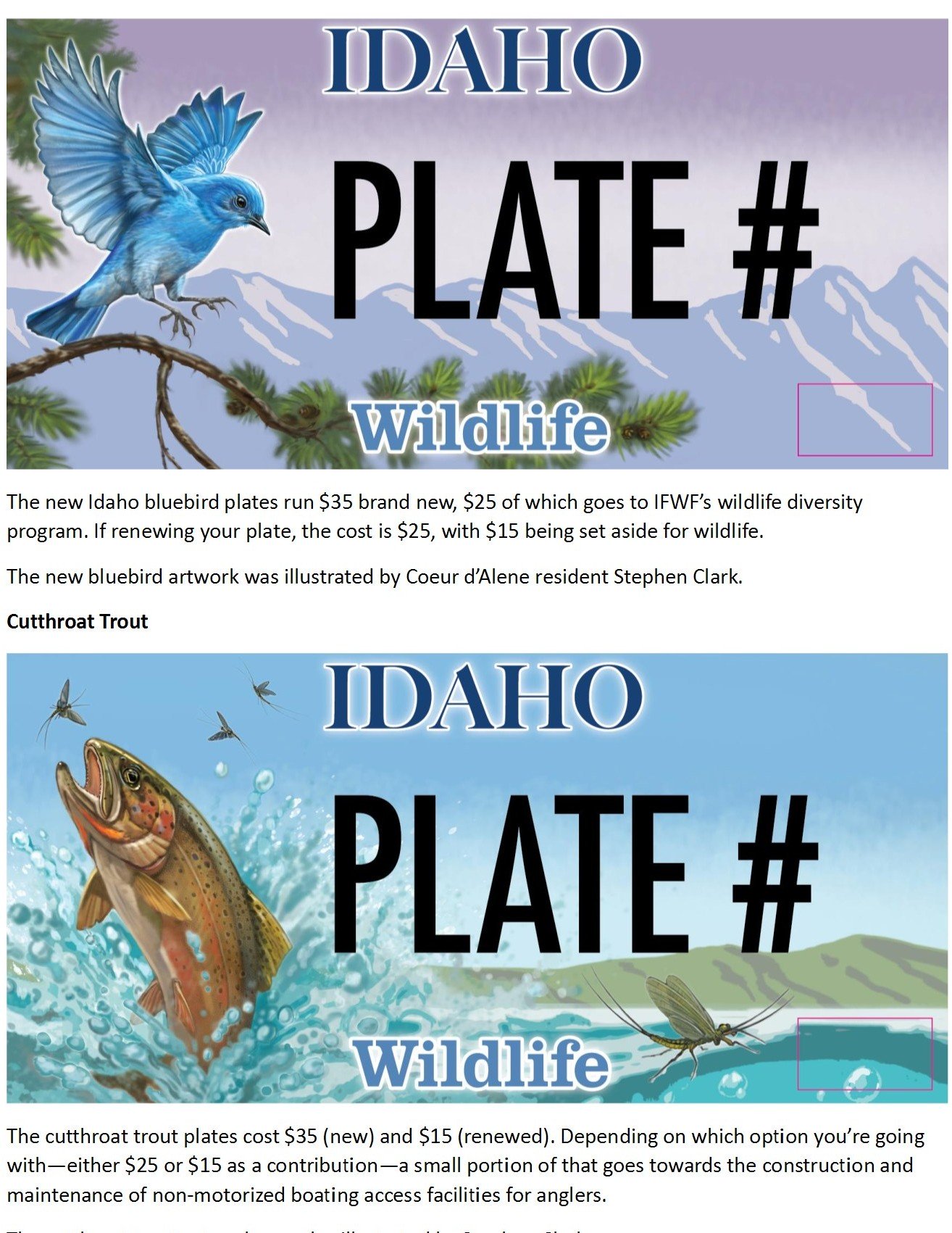
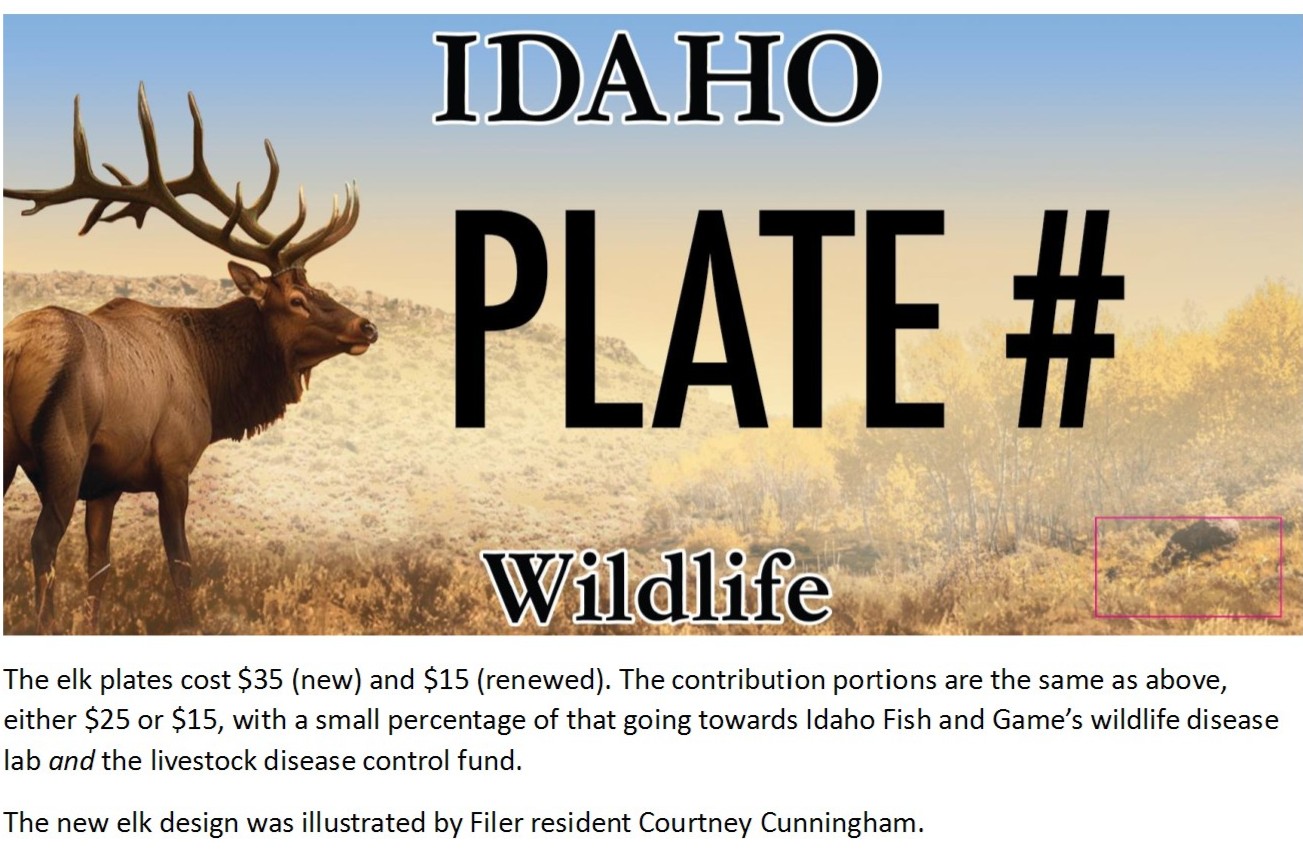
Wildlife License Plates
Great news! as of 2024, there are three NEW designs for license plates. They still are bluebird, cutthroat trout and elk, but they are beautiful.
Idaho Wildlife license plates provide essential funding that benefits the great diversity of native plants and wildlife that are not hunted, fished or trapped—over 10,000 species or 98% of Idaho’s species diversity. Game species that share the same habitats (such as elk, deer, antelope, sage-grouse, salmon, trout) also benefit from these specialty plates.
No state tax dollars are provided for wildlife diversity, conservation education and recreation programs. Neither are any revenues from the sale of hunting or fishing licenses spent on nongame species. Instead, these species depend on direct donations, federal grants, fundraising initiatives—and the Idaho Wildlife license plates.
Both my vehicles have Bluebird Plates. I prefer the bluebird because the nongame program gets 70 percent of the money from bluebird plates, but only 60 percent of the money from elk and trout plates - 10 percent of the money from elk plates supports wildlife disease monitoring and testing programs (to benefit the livestock industry) and 10 percent from cutthroat plates supports non-motorized boat access.
Incidentally, in 2014, the Idaho Legislature denied the Department of Fish and Game the ability to add new plates or even to change the name of the elk and cutthroat plates (very specific) to wildlife and fish plates, a move that would have allowed for changing images occasionally and generating more revenue. It would seem that they believe that we Idahoans don't want a well funded wildlife program.
I think it is time we let the Legislature know that Idahoan support wildlife funding and that we would like to see these generic plates come to fruition.
"WOW. What a phenomenal piece you wrote. You are amazing." Jennifer Jackson
That is embarrassing, but actually a fairly typical response to my nature essays. Since The Best of Nature is created from the very best of 16 years of these nature essays published weekly in the Idaho Falls Post Register (online readership 70,000), it is a fine read. It covers a wide variety of topics including humorous glimpses of nature, philosophy, natural history, and conservation. Readers praise the style, breadth of subject matter and my ability to communicate complex and emotional topics in a relaxed and understandable manner.
Everyone can find something to love in this book. From teenagers to octogenarians, from the coffee shop to the school room, these nature essays are widely read and enjoyed.
Some of the essays here are my personal favorites, others seemed to strike a chord with readers. Most have an important message or lesson that will resonate with you. They are written with a goal to simultaneously entertain and educate about the wonderful workings of nature. Some will make you laugh out loud and others will bring a tear to the eye and warm your heart.
Readers Write:
"You hit a home run with your article on, Big Questions in Nature. It should be required reading for everyone who has lost touch with nature...great job!" Joe Chapman
"We enjoyed your column, Bloom Where Planted. Some of the best writing yet. The Post Register is fortunate to have your weekly columns." Lou Griffin.
To read more and to order a copy, click here or get the Kindle version
Copies are also available at:
Post Register
Island Park Builders Supply (upstairs)
Barnes and Noble in Idaho Falls
Harriman State Park, Island Park
Museum of Idaho
Valley Books, Jackson Wyoming
Avocet Corner Bookstore, Bear River National Wildlife Refuge, Brigham City, Utah
Craters of the Moon National Monument Bookstore, Arco, Idaho