Big Bird

©Terry R. Thomas/www.nature-track.com
The common ostrich is the largest living bird, up to nine feet tall.
I marveled at the big bird wandering within Ngorongoro Crater in Tanzania, Africa. I knew I was looking at the largest bird in the world, a male ostrich standing nearly nine feet tall. He was flightless, but more than made up for that with huge and immensely powerful legs that could propel his 280-pound frame at a top speed of 45 mph and deliver a formidable kick that can kill a lion.
I thought of the ostrich as the biggest and baddest of the birds until I was in a museum in New Zealand and learned of the giant moas, recently extinct (500-600 years ago) bird species that stood up to 12 feet tall and weighed as much as 550 pounds. I looked up at my ceiling, ten feet overhead, and imagined this bird having to duck its head to stand next to me.
That put me on a quest to discover what scientists considered the biggest bird to ever live on this Earth (and leave a fossil record). Madagascar can lay claim to that bird, named, Vorombe titan (“big bird” in Malagasy and Greek), which at nearly 10 feet tall was significantly shorter than the giant moa. However, the largest of these birds, appropriately named elephant birds, may have weighed nearly a ton. These birds became extinct about 1,000 years ago, dying out about 400 years before Columbus made his fateful voyage across the Atlantic, although a governor of Madagascar made reference to them around 1640 as if they still existed in remote areas.
Elephant birds appear to have been found throughout Madagascar and may have been nocturnal like the kiwi of New Zealand. Scientists also speculate that despite their enormous size, they were likely mostly vegetarian. These giants laid eggs with a 2-gallon capacity, enough to hold 12 dozen or more large hen eggs. Since an egg yolk is a single cell, the elephant bird eggs were arguably the largest cells to ever exist on the planet.
Ostriches, moas, and elephant birds are or were part of a group of birds known as ratites. Other ratites include emus, rheas, cassowaries, and kiwis. These birds all share common characteristics such as a long neck, sharp spear-like bill, and stubby wings. Most telling though is the fact that they do not have a keeled sternum for flight muscle attachment, making flight impossible.
Current scientific research has determined that these ratites originated from a small bird that could fly and thus disperse to the various habitats where these species evolved independently—Africa, Australia, New Zealand, South America, and Madagascar. Moas and elephant birds were unique though as they landed on islands and evolved into giants because there were no land predators.
Moas did have a flying predator, the now extinct Haast’s eagle, that was the largest and strongest bird of prey ever known, weighing up to about 40 pounds, with a wingspan of 10 ft. When Polynesians arrived in New Zealand about 1300 years ago, populations of all nine species of moas were considered stable, despite Haast eagle predation. Within 100 years, all moas were extinct and the Haast eagle soon followed.
It is a similar tale for the four species of elephant birds. They thrived for thousands of years, but human presence on Madagascar, which likely began about 10,000 years ago, eventually did them in although it took longer than the moa extinction.
It is sad to think that these huge birds were eliminated from the planet because of unrestricted human pressure, including habitat alteration through forest clearing. However, these people didn’t know any better. The same can’t be said for us.
Help Idaho Wildlife
When we traveled across the state in October 2017, we visited most of the Idaho Department of Fish and Game wildlife management areas. Most of the vehicles we saw using the wildlife management areas did not have wildlife plates. Buying wildlife plates is a great way for non-hunters and hunters alike to support wildlife-based recreation like birding.
C'mon folks, let's help Idaho's wildlife by proudly buying and displaying a wildlife license plate on each of our vehicles!
See below for information on Idaho plates. Most states have wildlife plates so if you live outside Idaho, check with your state's wildlife department or vehicle licensing division for availability of state wildlife plates where you live.
And tell them that you heard about it from Nature-track.com!
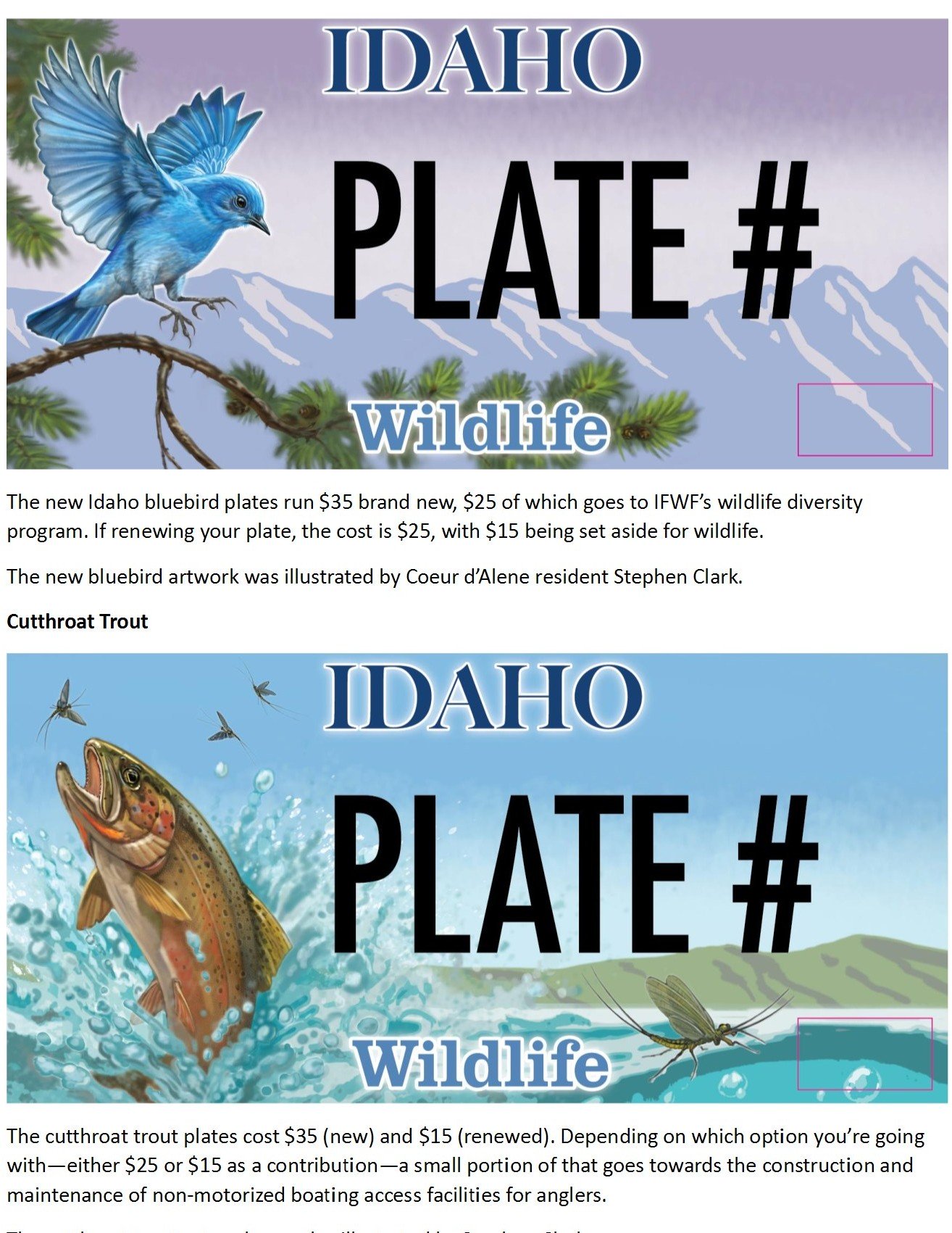
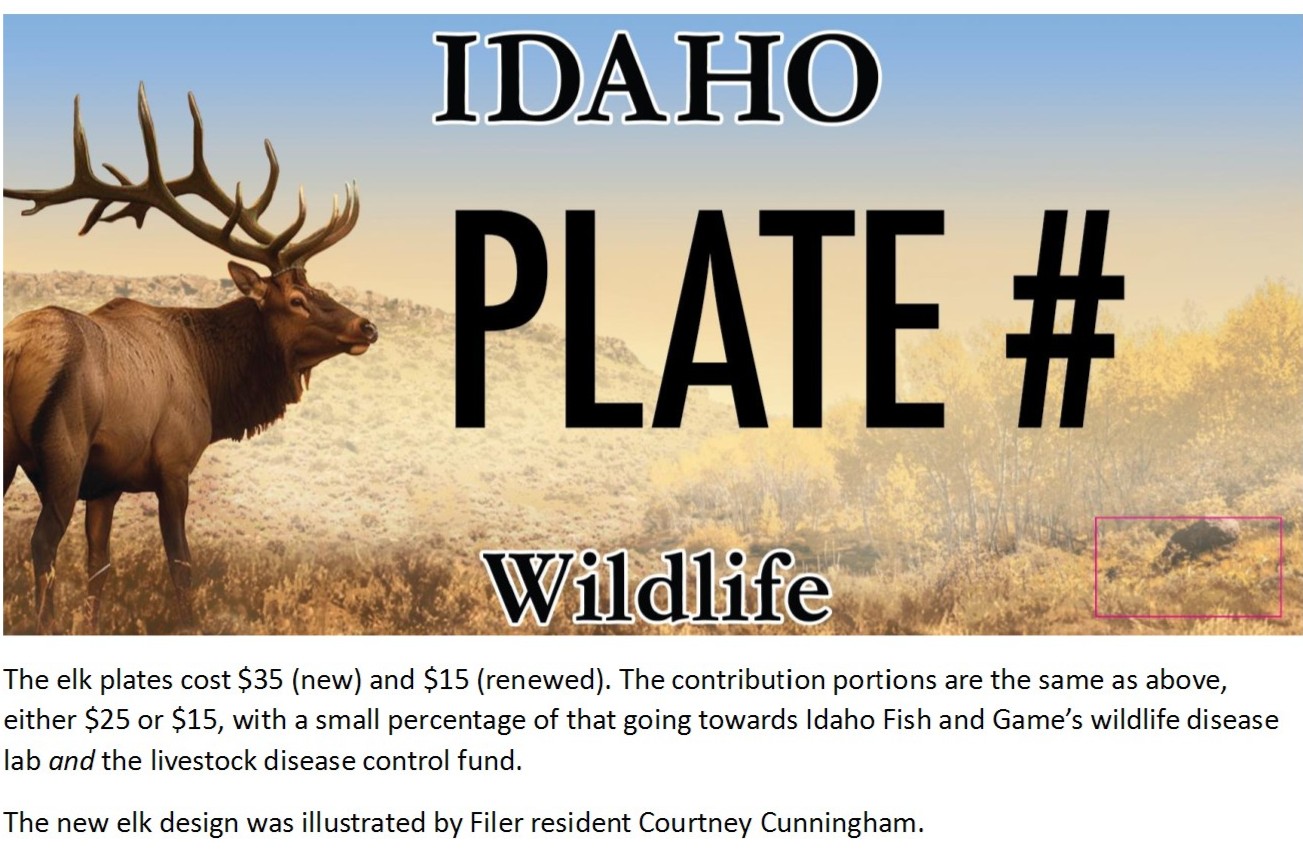
Wildlife License Plates
Great news! as of 2024, there are three NEW designs for license plates. They still are bluebird, cutthroat trout and elk, but they are beautiful.
Idaho Wildlife license plates provide essential funding that benefits the great diversity of native plants and wildlife that are not hunted, fished or trapped—over 10,000 species or 98% of Idaho’s species diversity. Game species that share the same habitats (such as elk, deer, antelope, sage-grouse, salmon, trout) also benefit from these specialty plates.
No state tax dollars are provided for wildlife diversity, conservation education and recreation programs. Neither are any revenues from the sale of hunting or fishing licenses spent on nongame species. Instead, these species depend on direct donations, federal grants, fundraising initiatives—and the Idaho Wildlife license plates.
Both my vehicles have Bluebird Plates. I prefer the bluebird because the nongame program gets 70 percent of the money from bluebird plates, but only 60 percent of the money from elk and trout plates - 10 percent of the money from elk plates supports wildlife disease monitoring and testing programs (to benefit the livestock industry) and 10 percent from cutthroat plates supports non-motorized boat access.
Incidentally, in 2014, the Idaho Legislature denied the Department of Fish and Game the ability to add new plates or even to change the name of the elk and cutthroat plates (very specific) to wildlife and fish plates, a move that would have allowed for changing images occasionally and generating more revenue. It would seem that they believe that we Idahoans don't want a well funded wildlife program.
I think it is time we let the Legislature know that Idahoan support wildlife funding and that we would like to see these generic plates come to fruition.
"WOW. What a phenomenal piece you wrote. You are amazing." Jennifer Jackson
That is embarrassing, but actually a fairly typical response to my nature essays. Since The Best of Nature is created from the very best of 16 years of these nature essays published weekly in the Idaho Falls Post Register (online readership 70,000), it is a fine read. It covers a wide variety of topics including humorous glimpses of nature, philosophy, natural history, and conservation. Readers praise the style, breadth of subject matter and my ability to communicate complex and emotional topics in a relaxed and understandable manner.
Everyone can find something to love in this book. From teenagers to octogenarians, from the coffee shop to the school room, these nature essays are widely read and enjoyed.
Some of the essays here are my personal favorites, others seemed to strike a chord with readers. Most have an important message or lesson that will resonate with you. They are written with a goal to simultaneously entertain and educate about the wonderful workings of nature. Some will make you laugh out loud and others will bring a tear to the eye and warm your heart.
Readers Write:
"You hit a home run with your article on, Big Questions in Nature. It should be required reading for everyone who has lost touch with nature...great job!" Joe Chapman
"We enjoyed your column, Bloom Where Planted. Some of the best writing yet. The Post Register is fortunate to have your weekly columns." Lou Griffin.
To read more and to order a copy, click here or get the Kindle version
Copies are also available at:
Post Register
Island Park Builders Supply (upstairs)
Barnes and Noble in Idaho Falls
Harriman State Park, Island Park
Museum of Idaho
Valley Books, Jackson Wyoming
Avocet Corner Bookstore, Bear River National Wildlife Refuge, Brigham City, Utah
Craters of the Moon National Monument Bookstore, Arco, Idaho