Mustelidae Family
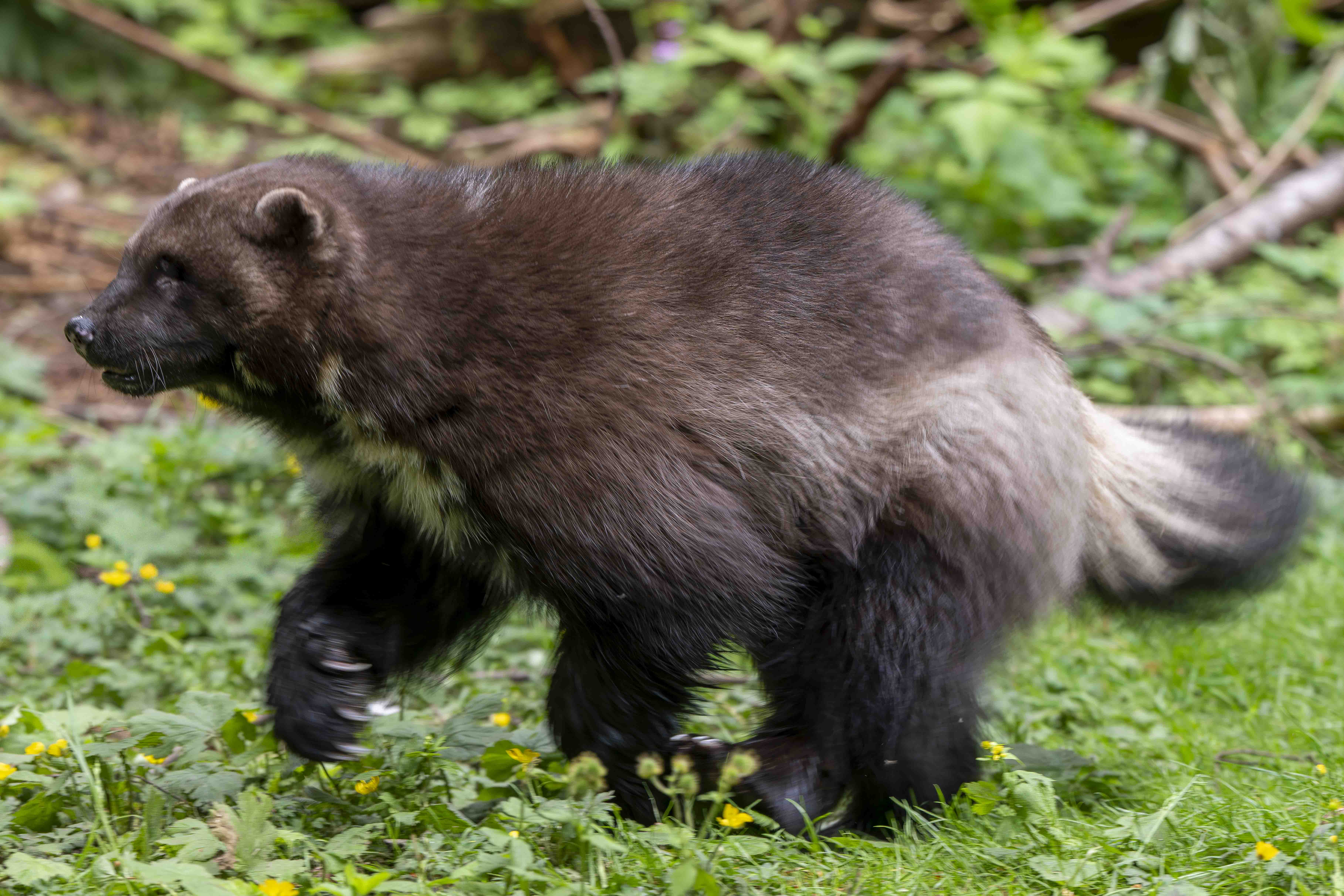
Seeing a wolverine in the wild would be a bucket list item for me. This one is a captive in Washington State.
Something small and white streaked across the snow as I pulled into a friend’s driveway. It stopped at the corner of the woodpile and stood on its hind legs, its long body topped by a triangular head. It was easily identifiable as a short-tailed weasel, often called an ermine when in its white phase. I guess I looked like a pretty big predator because I could not even get the window down before it was securely ensconced within the woodpile.
The short-tailed weasel is the second smallest member of the weasel family, Mustelidae. In North America, this family is comprised of, from smallest to largest, least weasel, short-tailed weasel, long-tailed weasel, black-footed ferret, American mink, American pine marten, fisher, American badger, North American river otter, and wolverine. Mustelids are a diverse group and a globally successful family, the largest family in the order Carnivora, with 66-70 species worldwide including, besides those mentioned above, sea otters, honey badgers, and polecats. Skunks were once considered part of the Mustelidae, but genetic research led to their reclassification into their own family, Mephitidae. One other species, the sea mink, was trapped to extinction in the 1800’s.
What makes them all related? First is body shape. “They are typically small animals with elongated bodies, short legs, short skulls, short, round ears, and thick fur. Mustelids' long, slender body structure is adapted to three main lifestyles: terrestrial, arboreal, and aquatic/semi-aquatic. They exhibit digitigrade or plantigrade locomotion, with five toes on each foot, enabling them to move in different ways (i.e. digging, climbing, swimming). Most mustelids are solitary, nocturnal animals, and are active year-round. Their dense fur, often serving as natural camouflage, undergoes seasonal changes to help them adjust to varying environmental conditions (Wikipedia).”
All but the sea otters have anal scent glands that produce a strong odor. In addition, most mustelids share a common dental formula, written as 3.1.3.1/3.1.3.2. This is interpreted as: 3 incisors, 1 canine, 3 premolars, and 1 molar in the top and 3 incisors, 1 canine, 3 premolars, and 2 molars on the bottom times 2 since this is just one side of the mouth.
This family traces its roots back to a common ancestor that lived 18 million years ago and seems to have closely followed the development of another mammalian order, Rodentia, their favorite prey. As rodents grew and diversified, so did mustelids. Still, as is common in the evolution of predation, it was necessary to find ways to not compete. The size differences and differing lifestyles (arboreal, fossorial, semi-aquatic, aquatic) within the family are ways to avoid competition by partitioning resources. Partitioning means that they develop different ways/times/locations to get food so they don’t directly compete.
For instance, the black-footed ferret is a food specialist. Its future is inextricably tied to prairie dog towns as they are its only prey. Research indicates it takes about 250 prairie dogs to feed a family of ferrets for a year, so within a square mile home range, they need several intact prairie dog towns. Otters and mink target aquatic prey, mostly fish, but hunt differently. Mink are more likely to take other prey as well. I have seen videos of them attacking swans, squirrels, and even captive bald eagles. Both pine marten and fishers take to the trees in arboreal pursuit of their favorite prey, tree squirrels. Badgers target ground squirrels and often dig them out with their powerful claws. Wolverines, growing up to 50 pounds, are large enough to take ungulate calves and fawns when they are young but live largely on carrion much of the winter.
Least, short-tailed, and long-tailed weasels reduce competition by chasing different-sized prey. The long-tailed weasel is the largest and will routinely take squirrels, rabbits and larger birds. Short-tailed weasels focus on chipmunk and mouse-sized prey while the least weasel targets voles when possible. Their diminutive size makes it possible to follow voles inside their tunnels.
I find mustelids so interesting that I would just as soon watch a weasel, pine marten, or mink as I would a wolf or grizzly bear. I would give a lot to see another fisher (I saw one many years ago) or spend a little time photographing a wild wolverine. Chances are not high for either one, but some days it keeps me going.
Help Idaho Wildlife
When we traveled across the state in October 2017, we visited most of the Idaho Department of Fish and Game wildlife management areas. Most of the vehicles we saw using the wildlife management areas did not have wildlife plates. Buying wildlife plates is a great way for non-hunters and hunters alike to support wildlife-based recreation like birding.
C'mon folks, let's help Idaho's wildlife by proudly buying and displaying a wildlife license plate on each of our vehicles!
See below for information on Idaho plates. Most states have wildlife plates so if you live outside Idaho, check with your state's wildlife department or vehicle licensing division for availability of state wildlife plates where you live.
And tell them that you heard about it from Nature-track.com!
Wildlife License Plates
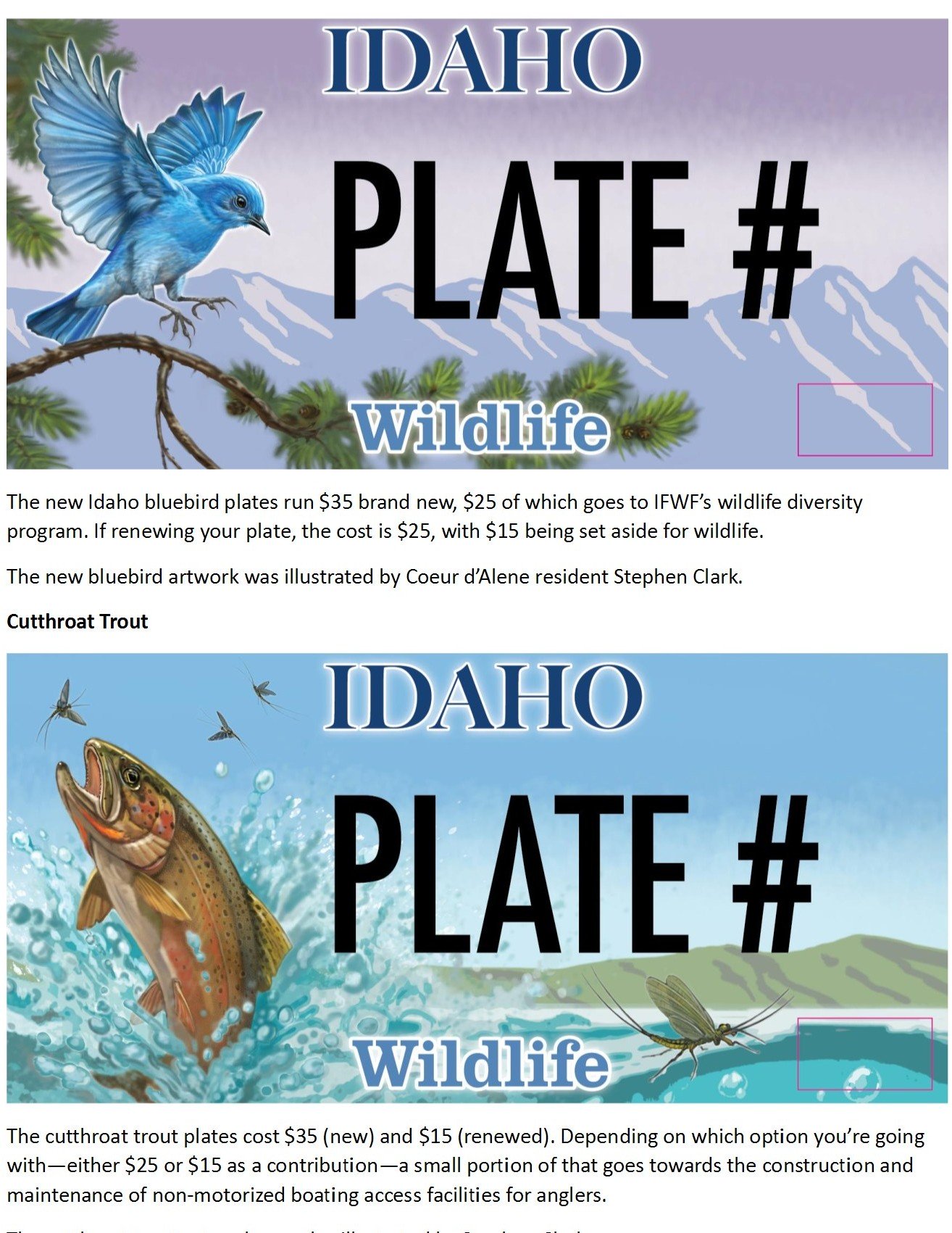
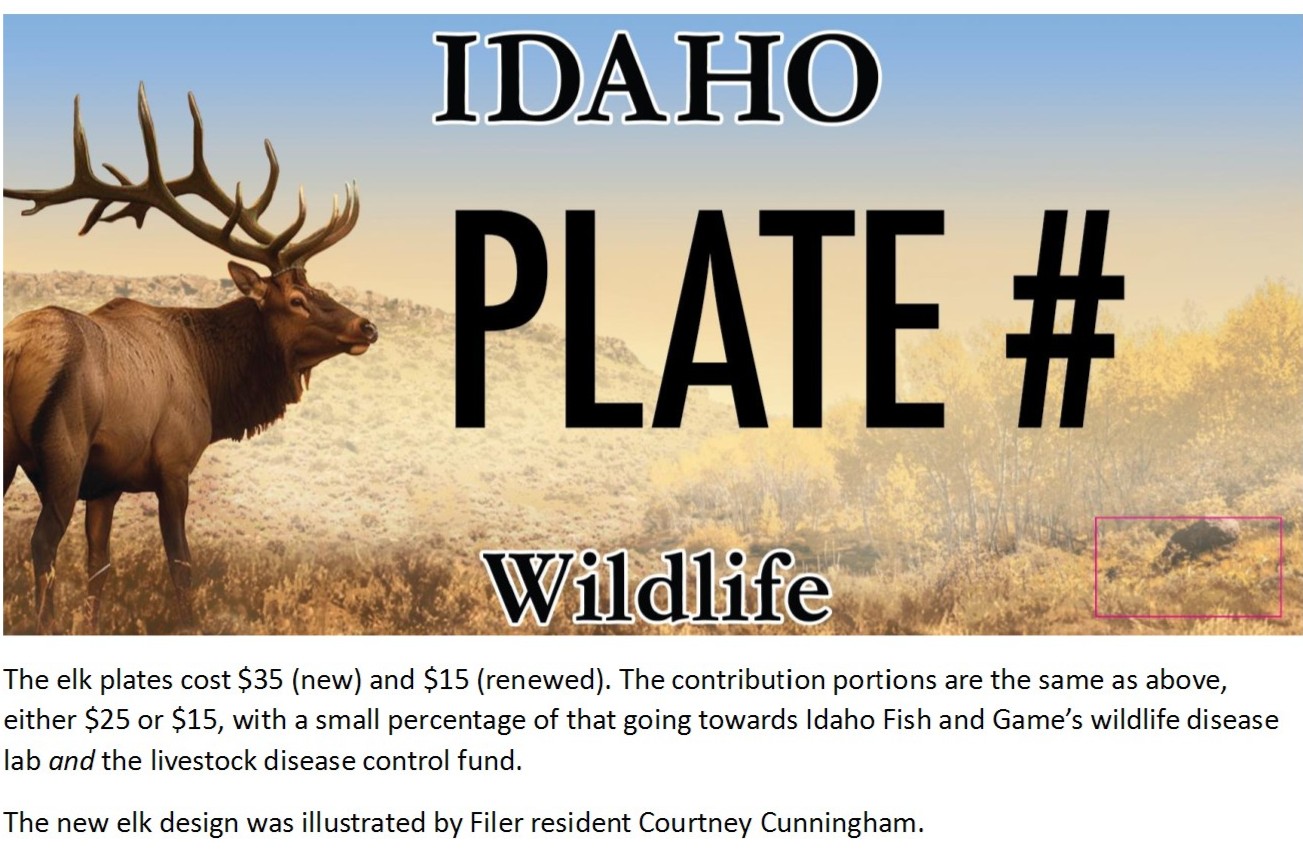
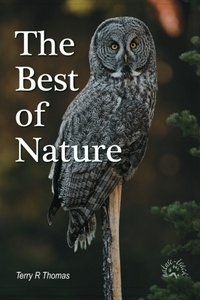
Great news! as of 2024, there are three NEW designs for license plates. They still are bluebird, cutthroat trout and elk, but they are beautiful.
Idaho Wildlife license plates provide essential funding that benefits the great diversity of native plants and wildlife that are not hunted, fished or trapped—over 10,000 species or 98% of Idaho’s species diversity. Game species that share the same habitats (such as elk, deer, antelope, sage-grouse, salmon, trout) also benefit from these specialty plates.
No state tax dollars are provided for wildlife diversity, conservation education and recreation programs. Neither are any revenues from the sale of hunting or fishing licenses spent on nongame species. Instead, these species depend on direct donations, federal grants, fundraising initiatives—and the Idaho Wildlife license plates.
Both my vehicles have Bluebird Plates. I prefer the bluebird because the nongame program gets 70 percent of the money from bluebird plates, but only 60 percent of the money from elk and trout plates - 10 percent of the money from elk plates supports wildlife disease monitoring and testing programs (to benefit the livestock industry) and 10 percent from cutthroat plates supports non-motorized boat access.
Incidentally, in 2014, the Idaho Legislature denied the Department of Fish and Game the ability to add new plates or even to change the name of the elk and cutthroat plates (very specific) to wildlife and fish plates, a move that would have allowed for changing images occasionally and generating more revenue. It would seem that they believe that we Idahoans don't want a well funded wildlife program.
I think it is time we let the Legislature know that Idahoan support wildlife funding and that we would like to see these generic plates come to fruition.
"WOW. What a phenomenal piece you wrote. You are amazing." Jennifer Jackson
That is embarrassing, but actually a fairly typical response to my nature essays. Since The Best of Nature is created from the very best of 16 years of these nature essays published weekly in the Idaho Falls Post Register (online readership 70,000), it is a fine read. It covers a wide variety of topics including humorous glimpses of nature, philosophy, natural history, and conservation. Readers praise the style, breadth of subject matter and my ability to communicate complex and emotional topics in a relaxed and understandable manner.
Everyone can find something to love in this book. From teenagers to octogenarians, from the coffee shop to the school room, these nature essays are widely read and enjoyed.
Some of the essays here are my personal favorites, others seemed to strike a chord with readers. Most have an important message or lesson that will resonate with you. They are written with a goal to simultaneously entertain and educate about the wonderful workings of nature. Some will make you laugh out loud and others will bring a tear to the eye and warm your heart.
Readers Write:
"You hit a home run with your article on, Big Questions in Nature. It should be required reading for everyone who has lost touch with nature...great job!" Joe Chapman
"We enjoyed your column, Bloom Where Planted. Some of the best writing yet. The Post Register is fortunate to have your weekly columns." Lou Griffin.
To read more and to order a copy, click here or get the Kindle version
Copies are also available at:
Post Register
Island Park Builders Supply (upstairs)
Barnes and Noble in Idaho Falls
Harriman State Park, Island Park
Museum of Idaho
Valley Books, Jackson Wyoming
Avocet Corner Bookstore, Bear River National Wildlife Refuge, Brigham City, Utah
Craters of the Moon National Monument Bookstore, Arco, Idaho