Developing a Scientific Mindset

©Terry R. Thomas/www.nature-track.com Image created by AI.
Approaching life with a more scientific mindset can help with decision-making and finding the truth on issues.
Percival Lowell was an American astronomist around the turn of the 20th century. He is recognized as one of the finest astronomists of his day, yet he fell prey to his own confirmation bias and blind spot. In 1877, Giovanni Schiaparelli , an Italian astronomer, observed what he described as "canali," meaning channels or canals, on the surface of Mars. Lowell began to watch the “canals” and became convinced that they were evidence of life on Mars. He began to look for more “evidence” to support his position and ignored anything that did not. He became certain that the canals were built by intelligent life on Mars. It wasn’t until the 1960’s that the concept of “canals” was fully debunked. As a footnote, in the 1990’s an astronomer and an ophthalmologist teamed up and determined that the telescope that Lowell was using projected a faint image of the retina of his eye on the telescope image, likely adding some interesting confusion for Lowell.
Lowell should have known better, but he saw what he wanted to see and built his facts to support it. This was a classic case of confirmation bias. As Julius Caeser is reported to have said, “What we wish, we readily believe, and what we ourselves think, we imagine others think also.”
Taking a more scientific approach to questions can help us to make better decisions. But if a seasoned scientist can become a victim of confirmation bias, do the rest of us have a chance? How can we become a little more scientific in our approach to our thinking process?
Improving our scientific approach to life begins with recognizing our bias blind spots. We are unaware of these until we begin to closely examine how we approach things. Step one is to try to minimize confirmation bias and find our blind spots, recognize that they exist and watch out for them. As Lowell proved, this is a never-ending process.
Trying a scientific approach doesn’t mean that science is always right. Scientists constantly check assumptions. When something seems “obvious”, a real “Duh” moment, that is when you should ask for evidence that supports that assumption. You might be surprised at how often there is no supporting data. For instance, we have been told for years that we use less than 10 percent of our brain power. However, there is actually no data to support that.
When I was researching mule deer for my Master of Science degree, my major professor had a mantra that went something like this: “Decide what it is you are trying to prove and then work like hell to disprove it.” In other words, look for evidence that tends to contradict what you are thinking as an antidote to bias.
For many things there are multiple explanations, it just depends upon perspective. Look for alternative explanations, multiple causes, and different perspectives. Be skeptical and don’t accept things at face value.
Where’s the data? That is the question that really sets scientific thinking apart from “common sense” thinking. A scientist demands to see the data. Sir Arthur Conan Doyle’s Sherlock Holmes said, “It is a capital mistake to theorize before one has data. Insensibly one begins to twist facts to suit theories instead of theories to suit facts.”
In today’s world of AI, search engines, television, and more, it is easy to do research. However, you will need to be very aware of the sources. For instance, if you want a conservative viewpoint, Fox News will be your go to. If you are interested in what the opposing view might be, you will have to look to CBS or another more liberal source. And that leads to a problem with search engines. If you search a topic, your computer is suddenly going to be deluged with similar results, instantly creating a confirmation bias if you follow it. A reputable scientist is always trying to look at both sides. Empirical research systematically collects data from diverse sources and contexts.
Finally, good scientists readily admit that they don’t know everything. Having a little humility about our level of knowledge helps to keep us looking for the truth instead of getting our exercise by jumping to conclusions.
Developing a more scientific approach to life will free us from the tyranny of unsupported reasoning. We can avoid “truths” made that way simply through verbal repetition.
Help Idaho Wildlife
When we traveled across the state in October 2017, we visited most of the Idaho Department of Fish and Game wildlife management areas. Most of the vehicles we saw using the wildlife management areas did not have wildlife plates. Buying wildlife plates is a great way for non-hunters and hunters alike to support wildlife-based recreation like birding.
C'mon folks, let's help Idaho's wildlife by proudly buying and displaying a wildlife license plate on each of our vehicles!
See below for information on Idaho plates. Most states have wildlife plates so if you live outside Idaho, check with your state's wildlife department or vehicle licensing division for availability of state wildlife plates where you live.
And tell them that you heard about it from Nature-track.com!
Wildlife License Plates
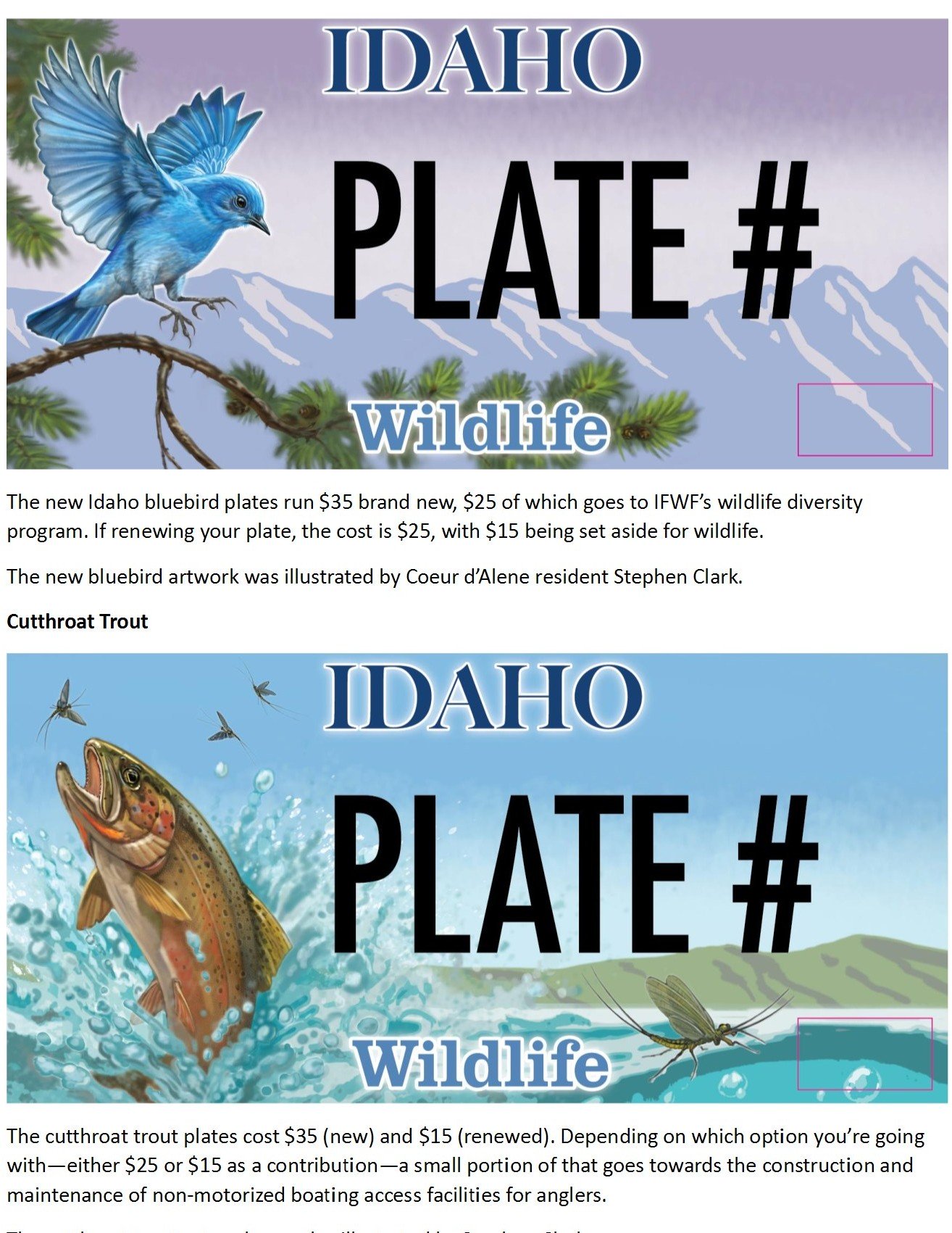
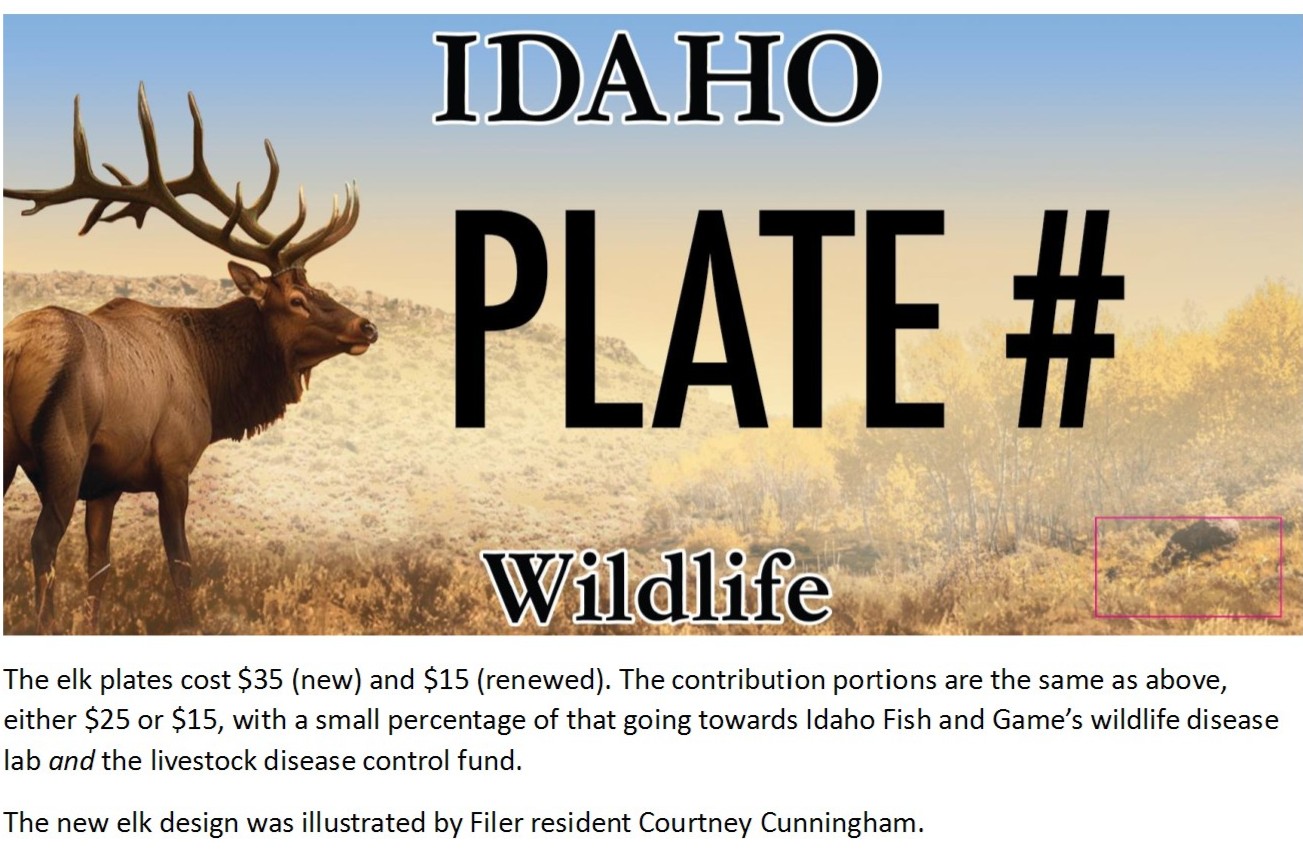
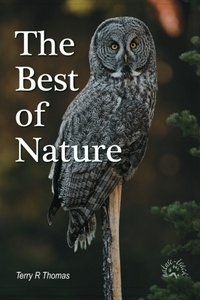
Great news! as of 2024, there are three NEW designs for license plates. They still are bluebird, cutthroat trout and elk, but they are beautiful.
Idaho Wildlife license plates provide essential funding that benefits the great diversity of native plants and wildlife that are not hunted, fished or trapped—over 10,000 species or 98% of Idaho’s species diversity. Game species that share the same habitats (such as elk, deer, antelope, sage-grouse, salmon, trout) also benefit from these specialty plates.
No state tax dollars are provided for wildlife diversity, conservation education and recreation programs. Neither are any revenues from the sale of hunting or fishing licenses spent on nongame species. Instead, these species depend on direct donations, federal grants, fundraising initiatives—and the Idaho Wildlife license plates.
Both my vehicles have Bluebird Plates. I prefer the bluebird because the nongame program gets 70 percent of the money from bluebird plates, but only 60 percent of the money from elk and trout plates - 10 percent of the money from elk plates supports wildlife disease monitoring and testing programs (to benefit the livestock industry) and 10 percent from cutthroat plates supports non-motorized boat access.
Incidentally, in 2014, the Idaho Legislature denied the Department of Fish and Game the ability to add new plates or even to change the name of the elk and cutthroat plates (very specific) to wildlife and fish plates, a move that would have allowed for changing images occasionally and generating more revenue. It would seem that they believe that we Idahoans don't want a well funded wildlife program.
I think it is time we let the Legislature know that Idahoan support wildlife funding and that we would like to see these generic plates come to fruition.
"WOW. What a phenomenal piece you wrote. You are amazing." Jennifer Jackson
That is embarrassing, but actually a fairly typical response to my nature essays. Since The Best of Nature is created from the very best of 16 years of these nature essays published weekly in the Idaho Falls Post Register (online readership 70,000), it is a fine read. It covers a wide variety of topics including humorous glimpses of nature, philosophy, natural history, and conservation. Readers praise the style, breadth of subject matter and my ability to communicate complex and emotional topics in a relaxed and understandable manner.
Everyone can find something to love in this book. From teenagers to octogenarians, from the coffee shop to the school room, these nature essays are widely read and enjoyed.
Some of the essays here are my personal favorites, others seemed to strike a chord with readers. Most have an important message or lesson that will resonate with you. They are written with a goal to simultaneously entertain and educate about the wonderful workings of nature. Some will make you laugh out loud and others will bring a tear to the eye and warm your heart.
Readers Write:
"You hit a home run with your article on, Big Questions in Nature. It should be required reading for everyone who has lost touch with nature...great job!" Joe Chapman
"We enjoyed your column, Bloom Where Planted. Some of the best writing yet. The Post Register is fortunate to have your weekly columns." Lou Griffin.
To read more and to order a copy, click here or get the Kindle version
Copies are also available at:
Post Register
Island Park Builders Supply (upstairs)
Barnes and Noble in Idaho Falls
Harriman State Park, Island Park
Museum of Idaho
Valley Books, Jackson Wyoming
Avocet Corner Bookstore, Bear River National Wildlife Refuge, Brigham City, Utah
Craters of the Moon National Monument Bookstore, Arco, Idaho