Science VS Common Sense

©Terry R. Thomas/www.nature-track.com
Researching the latest information on nest boxes brought me to a discussion on science and common sense.
With bird nesting season just around the corner, I went on a hunt to see what the newest recommendations in building, monitoring, and maintaining birdhouses might be. I stumbled upon an article on Cornell University’s All About Birds website entitled, To Clean or Not to Clean Your Nest Boxes. That was interesting, because I thought that cleaning nest boxes was an accepted principle to keep boxes sanitary and to encourage more use. After all, it seemed like common sense that ectoparasites would build up in the boxes if they were not cleaned out. But the article pointed out that natural cavities, the ones that birds evolved with, do not get cleaned out and sanitized, yet the birds have thrived for eons.
The article went on to cite several scientific studies that demonstrated that cleaning wasn’t always important and sometimes counterproductive. For instance, in North Carolina, research demonstrated that 71 percent of Eastern bluebirds preferred clean boxes, but in Tennessee, “parasitic wasps kill blowfly pupae over the winter; therefore, removing old nesting material may actually compromise this natural process.” Common sense said one thing, but science said another, depending upon location.
We put a lot of stock in common sense, and it serves us well. It is common sense not to touch a hot stove. It is common sense not to use poison ivy as toilet paper, eat toadstools, or irritate a grizzly bear. But we also try to use common sense in describing reality when in fact, reality is not very intuitive. Mark Twain once said, “It ain't what you don't know that gets you into trouble. It's what you know for sure that just ain't so.”
The biggest problem with common sense is that we all suffer from confirmation bias—when trying to explain something, we tend to select evidence that supports our idea and suppress evidence that does not. Think of a criminal trial. Isn’t that exactly what a defense attorney tries to do? She presents a seemingly rational alternative explanation based on “evidence” seen through a particular lens.
Worse still, common sense and confirmation bias are often fueled by emotion. When we want to believe something, we will actively look for evidence to support it, something called motivated reasoning. We start with a conclusion that we like and reason our way to it. Said another way, believing is seeing. Once we have a belief we can then “see” the evidence to support it. Sasquatch, UFOs, and the Flat Earth Society (which has over 500 members) are examples of this.
Enter science. Dr. Amjad Majeed said, and this is really important, “Common sense relies on personal experiences, selective reasoning, and untested beliefs. Science demands systematic observation, empirical testing, control of variables, and critical evaluation.” Another resource stated, “Empirical evidence serves as the foundation for scientific knowledge because it provides objective, verifiable information... Unlike common sense, which relies on personal experience and cultural transmission, empirical research systematically collects data from diverse sources and contexts.” Properly done, scientific research leads to unbiased conclusions. These conclusions are often incomplete, and a good scientist is always the first to admit that there is always a lot more to learn, and sometimes additional research can change the final answer.
The Public Administration Institute stated, “One of the most important contributions of scientific research is its focus on establishing causal relationships rather than mere correlations. Common sense often confuses these two concepts, leading to flawed understanding”. Many years ago, I got a question wrong on a college science exam. As I read the question, my mind read the word, casual when the word actually was causal. Those two reversed letters changed the entire meaning of the question. I understood the principle and answered correctly IF the word had been casual not causal. These two words can accurately describe the difference between science and common sense. Science seeks for a causal relationship meaning one thing leads to another. Common sense uses a casual relationship, correlation, where two things might seem related but may not be.
Next time I will dive into how to develop a better scientific mindset.
Help Idaho Wildlife
When we traveled across the state in October 2017, we visited most of the Idaho Department of Fish and Game wildlife management areas. Most of the vehicles we saw using the wildlife management areas did not have wildlife plates. Buying wildlife plates is a great way for non-hunters and hunters alike to support wildlife-based recreation like birding.
C'mon folks, let's help Idaho's wildlife by proudly buying and displaying a wildlife license plate on each of our vehicles!
See below for information on Idaho plates. Most states have wildlife plates so if you live outside Idaho, check with your state's wildlife department or vehicle licensing division for availability of state wildlife plates where you live.
And tell them that you heard about it from Nature-track.com!
Wildlife License Plates
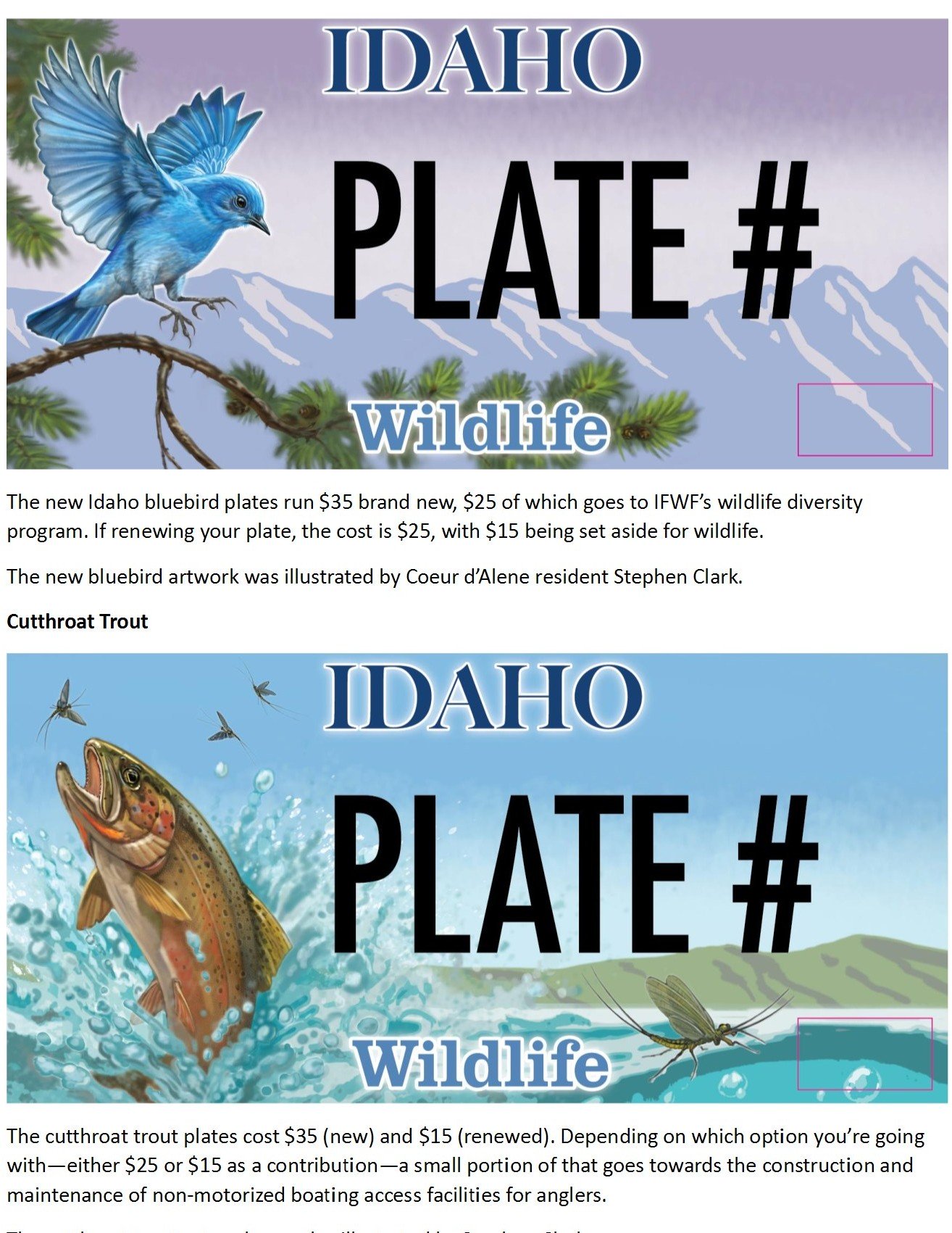
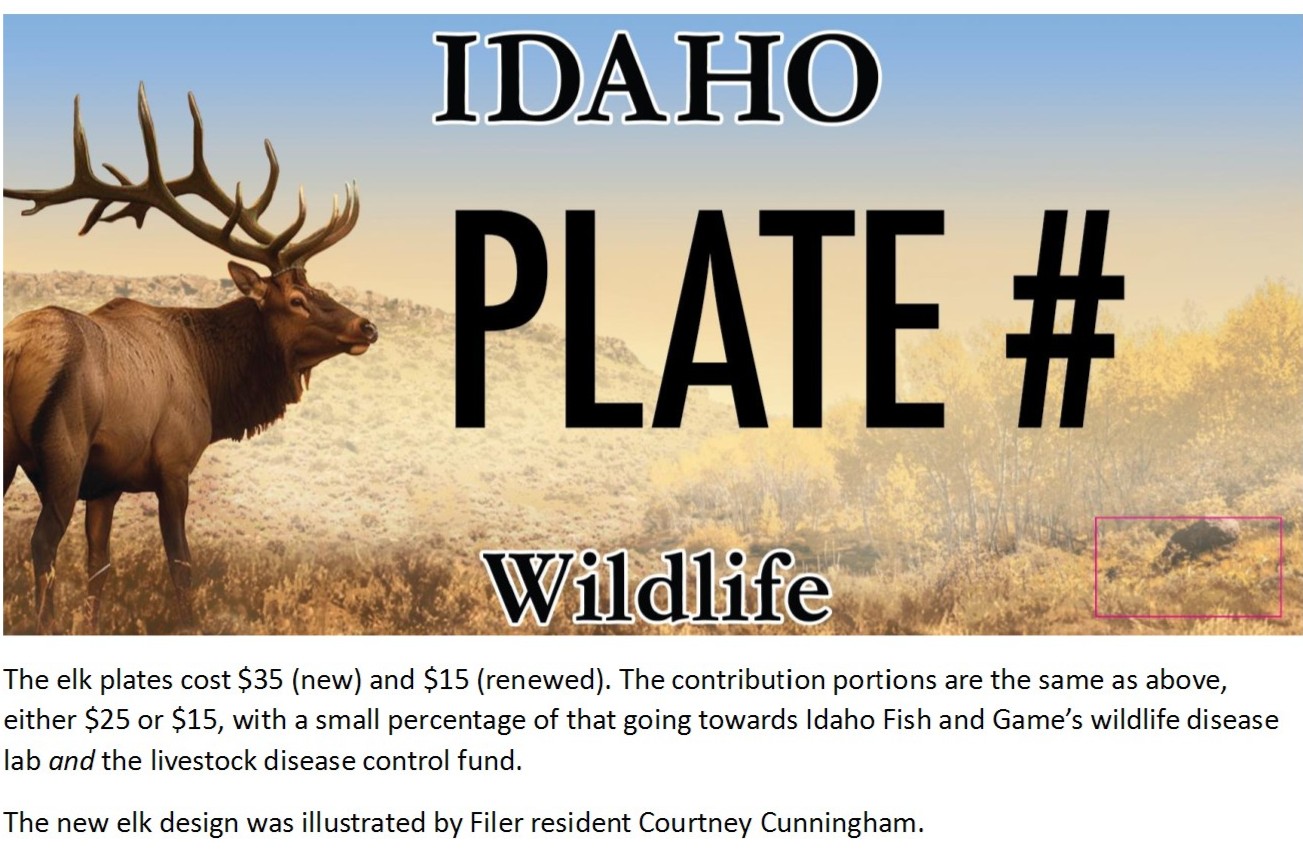
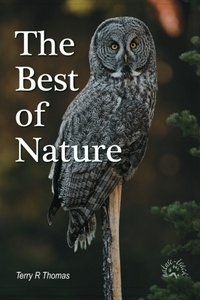
Great news! as of 2024, there are three NEW designs for license plates. They still are bluebird, cutthroat trout and elk, but they are beautiful.
Idaho Wildlife license plates provide essential funding that benefits the great diversity of native plants and wildlife that are not hunted, fished or trapped—over 10,000 species or 98% of Idaho’s species diversity. Game species that share the same habitats (such as elk, deer, antelope, sage-grouse, salmon, trout) also benefit from these specialty plates.
No state tax dollars are provided for wildlife diversity, conservation education and recreation programs. Neither are any revenues from the sale of hunting or fishing licenses spent on nongame species. Instead, these species depend on direct donations, federal grants, fundraising initiatives—and the Idaho Wildlife license plates.
Both my vehicles have Bluebird Plates. I prefer the bluebird because the nongame program gets 70 percent of the money from bluebird plates, but only 60 percent of the money from elk and trout plates - 10 percent of the money from elk plates supports wildlife disease monitoring and testing programs (to benefit the livestock industry) and 10 percent from cutthroat plates supports non-motorized boat access.
Incidentally, in 2014, the Idaho Legislature denied the Department of Fish and Game the ability to add new plates or even to change the name of the elk and cutthroat plates (very specific) to wildlife and fish plates, a move that would have allowed for changing images occasionally and generating more revenue. It would seem that they believe that we Idahoans don't want a well funded wildlife program.
I think it is time we let the Legislature know that Idahoan support wildlife funding and that we would like to see these generic plates come to fruition.
"WOW. What a phenomenal piece you wrote. You are amazing." Jennifer Jackson
That is embarrassing, but actually a fairly typical response to my nature essays. Since The Best of Nature is created from the very best of 16 years of these nature essays published weekly in the Idaho Falls Post Register (online readership 70,000), it is a fine read. It covers a wide variety of topics including humorous glimpses of nature, philosophy, natural history, and conservation. Readers praise the style, breadth of subject matter and my ability to communicate complex and emotional topics in a relaxed and understandable manner.
Everyone can find something to love in this book. From teenagers to octogenarians, from the coffee shop to the school room, these nature essays are widely read and enjoyed.
Some of the essays here are my personal favorites, others seemed to strike a chord with readers. Most have an important message or lesson that will resonate with you. They are written with a goal to simultaneously entertain and educate about the wonderful workings of nature. Some will make you laugh out loud and others will bring a tear to the eye and warm your heart.
Readers Write:
"You hit a home run with your article on, Big Questions in Nature. It should be required reading for everyone who has lost touch with nature...great job!" Joe Chapman
"We enjoyed your column, Bloom Where Planted. Some of the best writing yet. The Post Register is fortunate to have your weekly columns." Lou Griffin.
To read more and to order a copy, click here or get the Kindle version
Copies are also available at:
Post Register
Island Park Builders Supply (upstairs)
Barnes and Noble in Idaho Falls
Harriman State Park, Island Park
Museum of Idaho
Valley Books, Jackson Wyoming
Avocet Corner Bookstore, Bear River National Wildlife Refuge, Brigham City, Utah
Craters of the Moon National Monument Bookstore, Arco, Idaho