Biomes
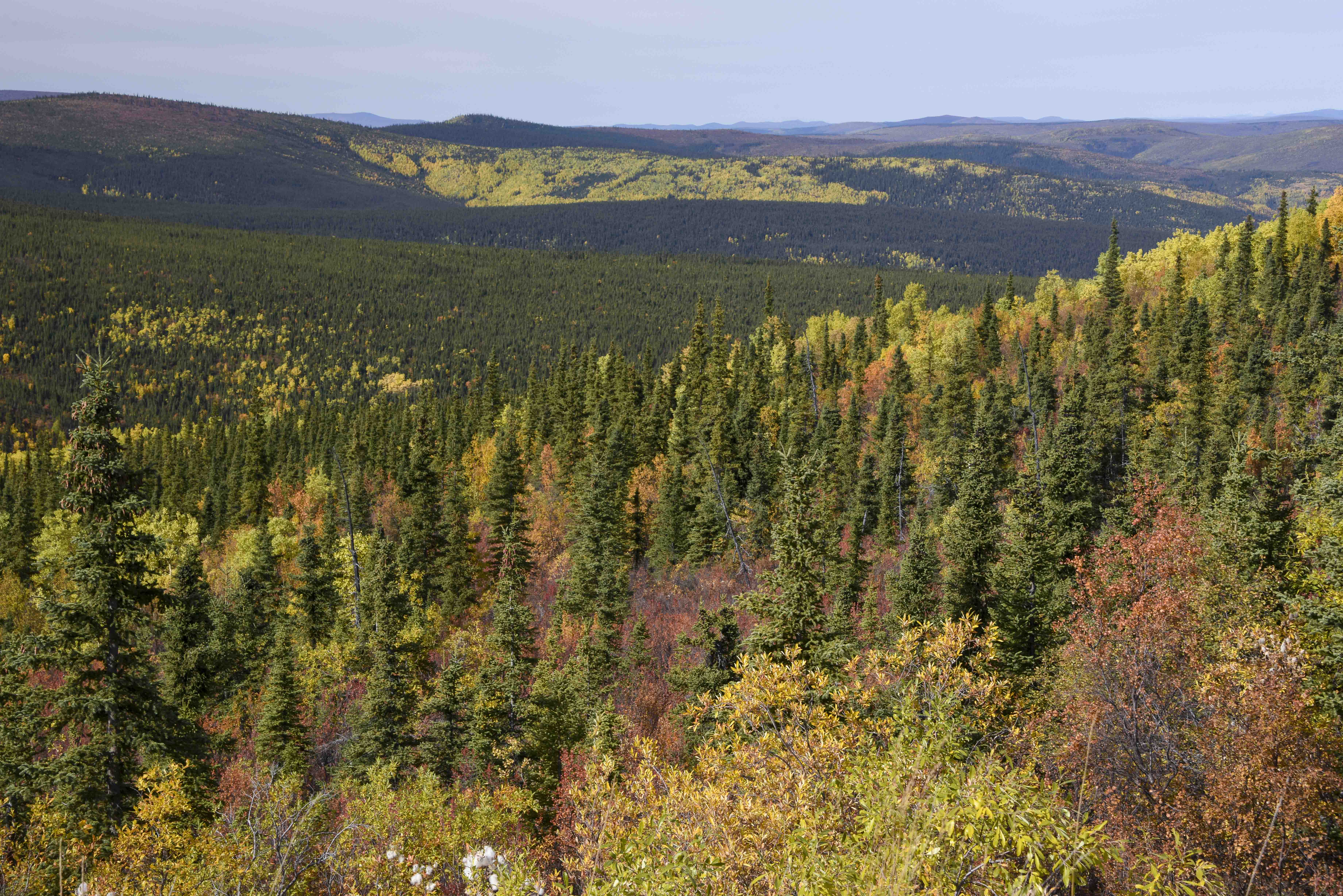
©Terry R. Thomas/www.nature-track.com
The coniferous biome extends across most of Canada, much of Alaska and dips down into the Continental US, but also extends across much of Russia.
A friend of mine once rode his bicycle from the coast of Washington state across the country to Maine. In that long journey he crossed through four different biomes and entered one biome twice, on opposite sides of the country.
Just what is a biome and how is it different from an ecosystem? Are they all just the same thing?
A biome is a large segment of the Earth that shares a specific climate, vegetation, and animal communities. It is shaped by climatic conditions and pays no attention to political boundaries. Perhaps the easiest way to visualize a biome is to consider the oceans and fresh water as two of the world’s biomes. While some scientists believe that biome is a terrestrial concept, most seem to accept oceans as biomes.
My friend started his ride in the temperate rainforest along the coast of Washington. As he rode east, he entered into the coniferous forest (there is a northern subset of this biome often called taiga or boreal forest. Another type, temperate coniferous forests, grows in lower latitudes of North America, Europe, and Asia, in the high elevations of mountains). Outside the forest, he eventually entered the grassland biome and pedaled through that for many days. Eventually, the grasslands gave way to the deciduous forest biome of the eastern US. By the time he entered Maine, he was back into the coniferous forest. Had he kept riding across the ocean biome, he would have re-entered the deciduous forest biome in Europe. Beyond that, he would have re-entered a grassland biome. Staying on an eastward track, he likely would have missed the world’s desert and tundra biomes.
I tend to look for specific boundaries when studying things like this and I quickly found that boundaries between biomes are more like suggestions than specific points or lines. If you look at 50 different maps of world biomes (I did) you will quickly notice that no two are the same. I even asked AI to generate a map of the world’s biomes for me and got a new version I didn’t like very much. So, thinking about biomes conceptually and not as hard and fast locations helps because everyone is going to have a bit of a different idea when it comes to specifics.
So, how does a biome differ from an ecosystem? If you think back to the column I wrote on lumpers and splitters, biomes are a lumper’s dream and splitters will love the ecosystem concept. Biomes are large and generalized. Within biomes are many ecosystems. For instance, within the desert biome of southeast Arizona, are many sky islands. Sky islands are isolated mountain ranges that rise high above the valley (desert) floor.
An ecosystem is smaller and is an area where living and non-living (like geology) things interact. Sky islands, large lakes and wetlands, manmade habitats such as wastewater treatment areas, and more are all ecosystems, but occur within the larger, overarching desert biome that is defined by desert vegetation and low rainfall.
In a nutshell, biomes are broad and defined by climate, vegetation, and geography. What is meant by geography is that tundra is typically found in the farthest northern reaches, coniferous forests are just south of tundra, deciduous forests and grasslands are south of the coniferous forests. Deserts typically span the globe at around 30 degrees north and south of the equator while tropical rainforests tend to surround the equator.
Understanding the idea of the biome helps me when I am contemplating how this Earth is organized. Biomes are the basic building block for understanding ecosystems and why the world is as it is.
Help Idaho Wildlife
When we traveled across the state in October 2017, we visited most of the Idaho Department of Fish and Game wildlife management areas. Most of the vehicles we saw using the wildlife management areas did not have wildlife plates. Buying wildlife plates is a great way for non-hunters and hunters alike to support wildlife-based recreation like birding.
C'mon folks, let's help Idaho's wildlife by proudly buying and displaying a wildlife license plate on each of our vehicles!
See below for information on Idaho plates. Most states have wildlife plates so if you live outside Idaho, check with your state's wildlife department or vehicle licensing division for availability of state wildlife plates where you live.
And tell them that you heard about it from Nature-track.com!
Wildlife License Plates
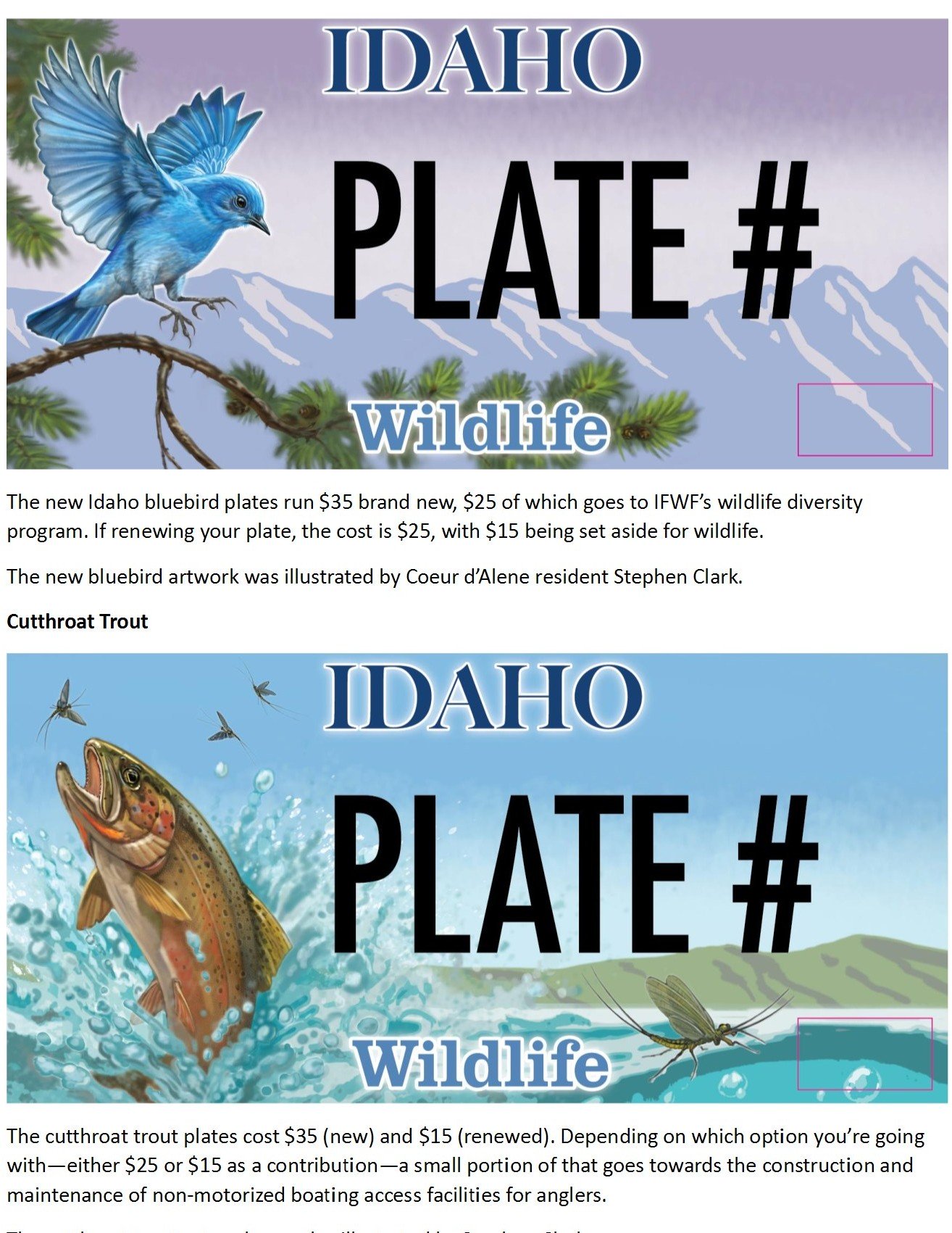
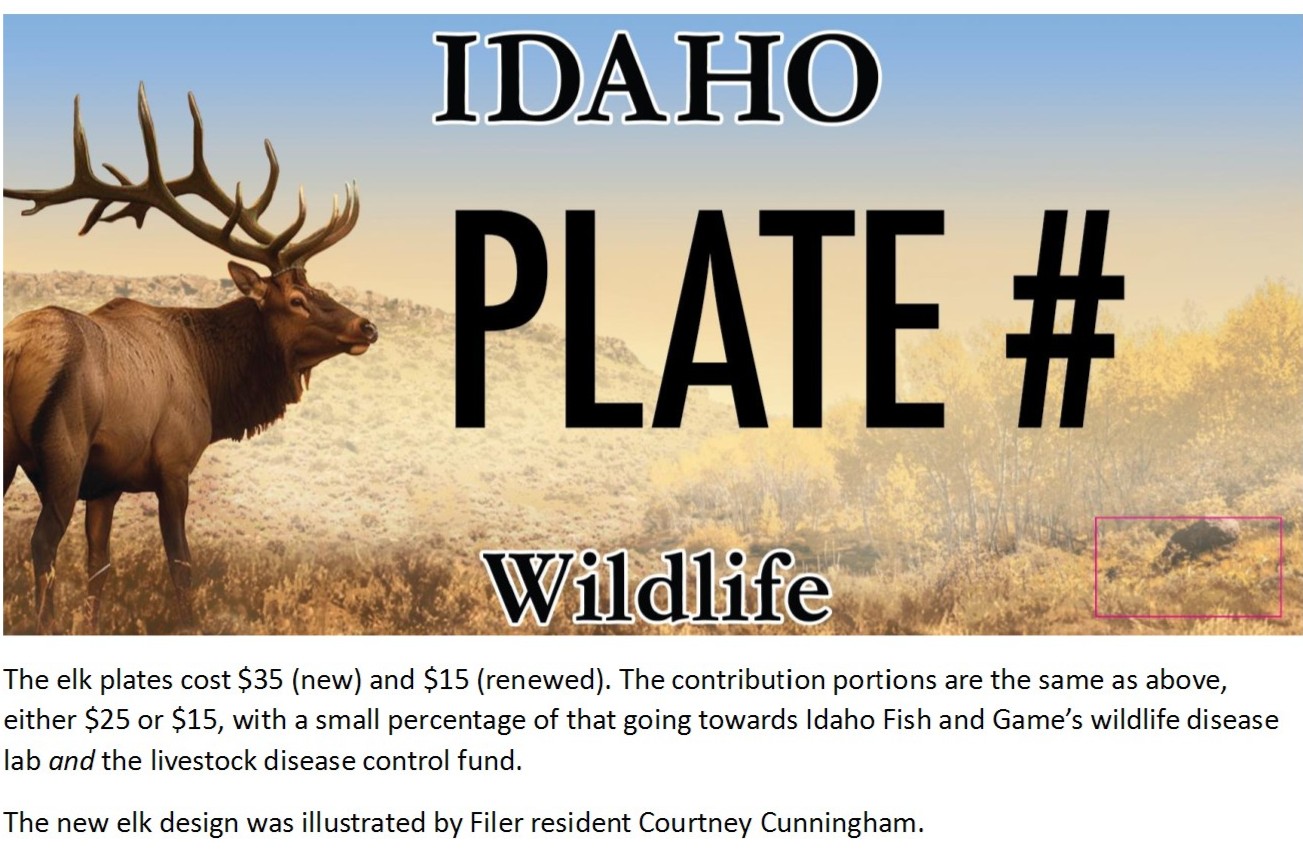
Great news! as of 2024, there are three NEW designs for license plates. They still are bluebird, cutthroat trout and elk, but they are beautiful.
Idaho Wildlife license plates provide essential funding that benefits the great diversity of native plants and wildlife that are not hunted, fished or trapped—over 10,000 species or 98% of Idaho’s species diversity. Game species that share the same habitats (such as elk, deer, antelope, sage-grouse, salmon, trout) also benefit from these specialty plates.
No state tax dollars are provided for wildlife diversity, conservation education and recreation programs. Neither are any revenues from the sale of hunting or fishing licenses spent on nongame species. Instead, these species depend on direct donations, federal grants, fundraising initiatives—and the Idaho Wildlife license plates.
Both my vehicles have Bluebird Plates. I prefer the bluebird because the nongame program gets 70 percent of the money from bluebird plates, but only 60 percent of the money from elk and trout plates - 10 percent of the money from elk plates supports wildlife disease monitoring and testing programs (to benefit the livestock industry) and 10 percent from cutthroat plates supports non-motorized boat access.
Incidentally, in 2014, the Idaho Legislature denied the Department of Fish and Game the ability to add new plates or even to change the name of the elk and cutthroat plates (very specific) to wildlife and fish plates, a move that would have allowed for changing images occasionally and generating more revenue. It would seem that they believe that we Idahoans don't want a well funded wildlife program.
I think it is time we let the Legislature know that Idahoan support wildlife funding and that we would like to see these generic plates come to fruition.
"WOW. What a phenomenal piece you wrote. You are amazing." Jennifer Jackson
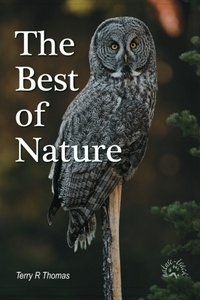
That is embarrassing, but actually a fairly typical response to my nature essays. Since The Best of Nature is created from the very best of 16 years of these nature essays published weekly in the Idaho Falls Post Register (online readership 70,000), it is a fine read. It covers a wide variety of topics including humorous glimpses of nature, philosophy, natural history, and conservation. Readers praise the style, breadth of subject matter and my ability to communicate complex and emotional topics in a relaxed and understandable manner.
Everyone can find something to love in this book. From teenagers to octogenarians, from the coffee shop to the school room, these nature essays are widely read and enjoyed.
Some of the essays here are my personal favorites, others seemed to strike a chord with readers. Most have an important message or lesson that will resonate with you. They are written with a goal to simultaneously entertain and educate about the wonderful workings of nature. Some will make you laugh out loud and others will bring a tear to the eye and warm your heart.
Readers Write:
"You hit a home run with your article on, Big Questions in Nature. It should be required reading for everyone who has lost touch with nature...great job!" Joe Chapman
"We enjoyed your column, Bloom Where Planted. Some of the best writing yet. The Post Register is fortunate to have your weekly columns." Lou Griffin.
To read more and to order a copy, click here or get the Kindle version
Copies are also available at:
Post Register
Island Park Builders Supply (upstairs)
Barnes and Noble in Idaho Falls
Harriman State Park, Island Park
Museum of Idaho
Valley Books, Jackson Wyoming
Avocet Corner Bookstore, Bear River National Wildlife Refuge, Brigham City, Utah
Craters of the Moon National Monument Bookstore, Arco, Idaho