Beeswax
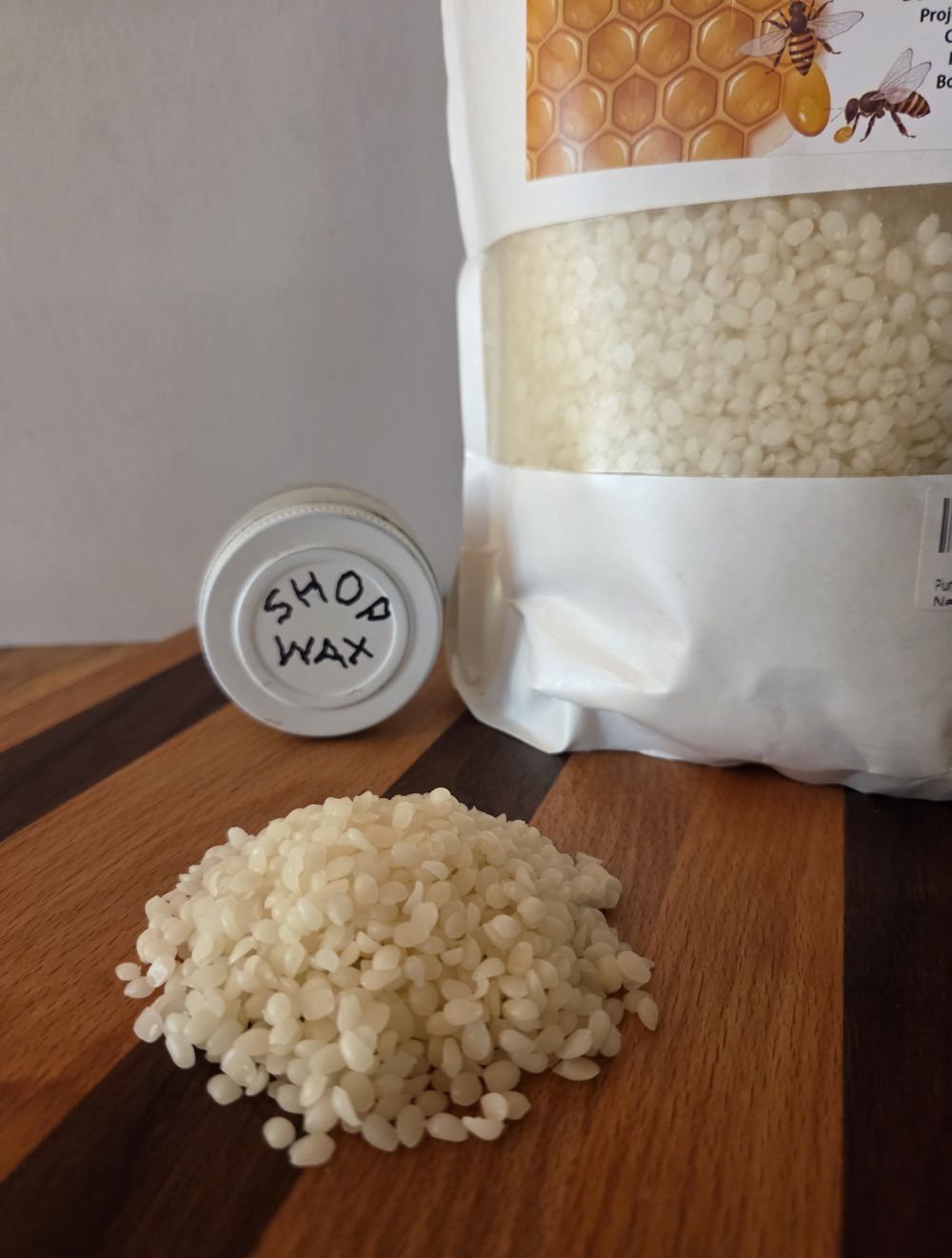
Beeswax is often sold in pellet form. It will be yellow to white in color and should smell like honey.
My daughter-in-law’s nice wooden cutting board, hand-crafted by a teen-aged son, was mistakenly placed in her dishwasher. The result, while predictable, wasn’t good. She handed me the two parts wondering if I could perhaps glue them back together. Certainly, I said, and I will even give it a coat of my special shop wax, the rage of internet influencer woodworker types.
This homemade wax is food safe and I use it routinely to maintain my wife’s cutting board. It is made of just two ingredients: mineral oil and beeswax.
Beeswax is an amazing compound produced by honey bees of the genus Apis. There are lots of jobs in a hive and who does what is largely a matter of age. Young worker bees from 13 to 18 days old, secrete the wax when temperatures inside the hive are between 91 and 97 degrees Fahrenheit. They do this by consuming large amounts of honey, about six to eight pounds of honey to produce a single pound of wax. The sugar from honey is metabolized in the bee’s body and converted into a liquid wax. This wax is secreted through glands in abdominal segments 4-7. Upon exposure to air, the liquid wax hardens into thin flakes.
At first the wax secretion is crystal clear, only taking on color as it is mixed with pollen and other additives. Bees collect this wax and use it to construct the honeycomb where honey is stored and the pupal chambers where the young are raised. Using a hexagonal structure, one pound of wax can store ten pounds of honey.
Chemically, beeswax is a complex lipid mixture containing over 300 organic compounds. It has an approximate chemical formula often cited is C15H31COOC30H61. Approximate because beeswax of different geographic origins, different species of bees, and even the age of the wax has slightly different formulations. Beeswax is largely made of esters, organic chemical compounds formed by the reaction of an acid and an alcohol. Esters typically have sweet fruity or floral scents and are widely used in making flavorings and perfumes.
Beeswax has several characteristics that have made it an extremely useful product for humans for thousands of years. The first characteristic is a consistently low melting point, about 144-149 degrees F, far below the boiling point of water. This low melting point makes it easy to handle for food processing (cheeses are often covered in beeswax), cosmetics, and candle making.
Beeswax is highly plastic. Chemically, that means that it has the ability to be molded into a shape without breaking and it will maintain that shape so long as the temperature stays reasonably cool. At just 86 degrees F. though, beeswax starts to become soft and pliable. This is a very important characteristic to the bees as well. The plasticity allows them to manipulate the wax into the honeycomb.
Solubility is another fascinating trait of beeswax. It is completely impervious to water, making it good for waterproofing leathers and such. It is also non-reactive to most acids, allowing it to be used for such things as metal etching where the metal is covered with beeswax and a design scratched through the wax onto the metal. Acid is then applied and etches the unprotected metal only. Finally, while acids don’t affect it, organic solvents such as benzene, acetone, and xylene, readily dissolve it. That makes it easy to combine beeswax with other waxes, oils, and resins to make cosmetics, furniture finishing and polishing products, and for industrial applications.
Beeswax is a great product to have around the house, but be cautious where you purchase it. I got burned on my first purchase (from China). Although it said it was pure beeswax, it likely had paraffin wax mixed in as it didn’t behave or smell like true beeswax. I suggest looking for beeswax from an American company. Pure beeswax should smell like honey and should have a whitish “bloom” or what looks like a coating of fine dust on the outside at room temperature.
Recipe for cutting board wax: Four parts of mineral oil to one part beeswax. Heat the oil until warm (no warmer than 185 degrees F or the wax will discolor and degrade) and then add the beeswax and allow it to melt. Stir and pour into your container. When it hardens, it will be the consistency of petroleum jelly. Rub it on your cutting board and let it sit for a bit (the longer the better), then buff it dry with a paper towel. Repeat when the board starts to look a bit dry. Avoid the dishwasher!
Help Idaho Wildlife
When we traveled across the state in October 2017, we visited most of the Idaho Department of Fish and Game wildlife management areas. Most of the vehicles we saw using the wildlife management areas did not have wildlife plates. Buying wildlife plates is a great way for non-hunters and hunters alike to support wildlife-based recreation like birding.
C'mon folks, let's help Idaho's wildlife by proudly buying and displaying a wildlife license plate on each of our vehicles!
See below for information on Idaho plates. Most states have wildlife plates so if you live outside Idaho, check with your state's wildlife department or vehicle licensing division for availability of state wildlife plates where you live.
And tell them that you heard about it from Nature-track.com!
Wildlife License Plates
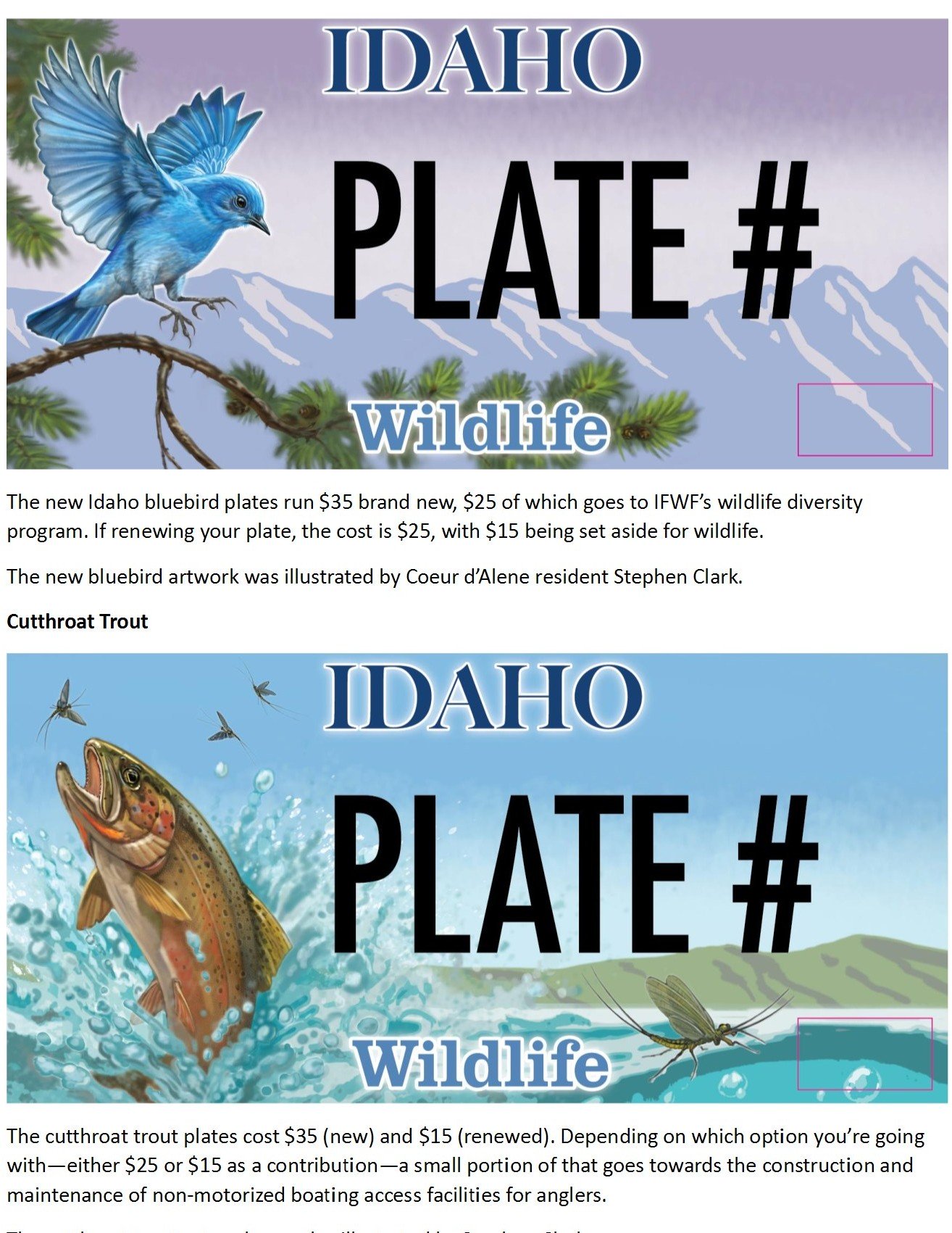
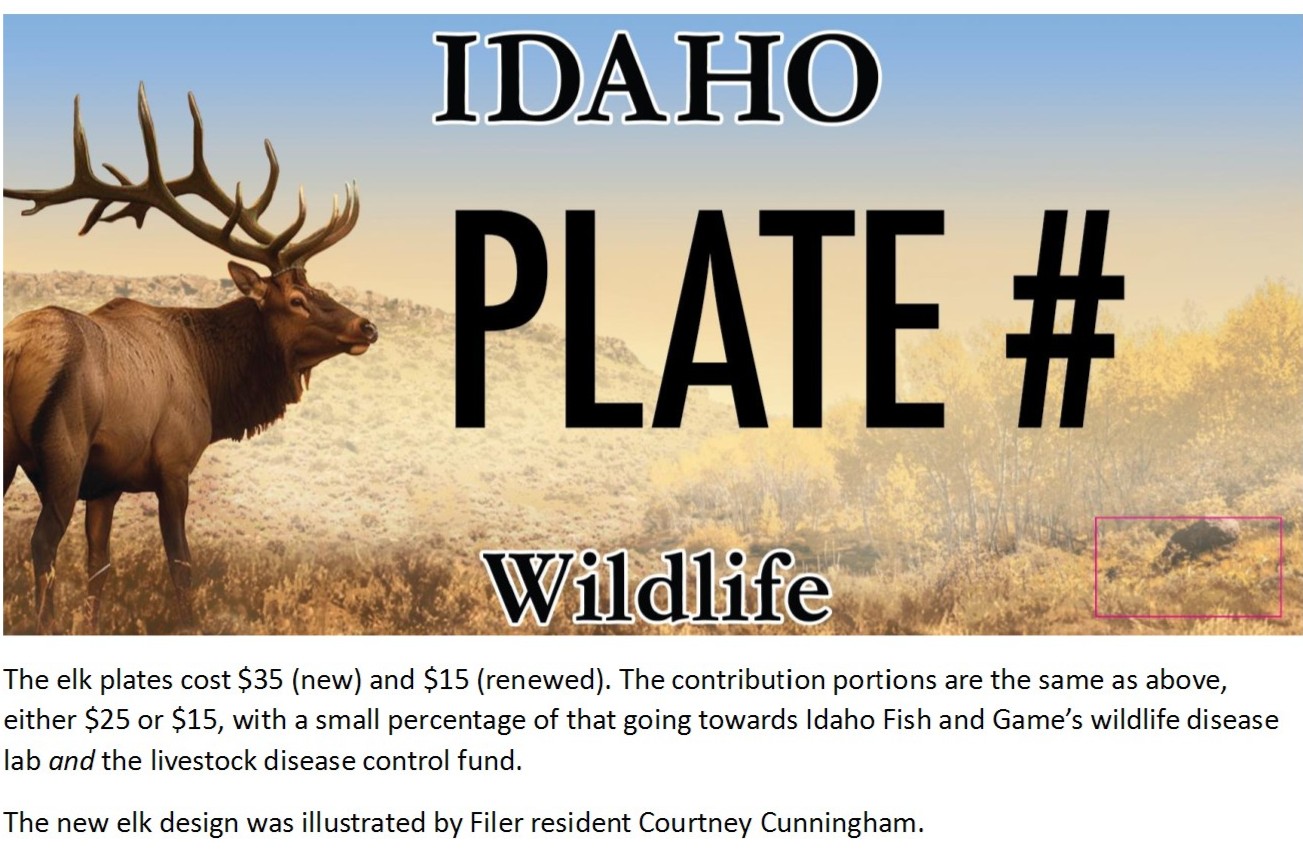
Great news! as of 2024, there are three NEW designs for license plates. They still are bluebird, cutthroat trout and elk, but they are beautiful.
Idaho Wildlife license plates provide essential funding that benefits the great diversity of native plants and wildlife that are not hunted, fished or trapped—over 10,000 species or 98% of Idaho’s species diversity. Game species that share the same habitats (such as elk, deer, antelope, sage-grouse, salmon, trout) also benefit from these specialty plates.
No state tax dollars are provided for wildlife diversity, conservation education and recreation programs. Neither are any revenues from the sale of hunting or fishing licenses spent on nongame species. Instead, these species depend on direct donations, federal grants, fundraising initiatives—and the Idaho Wildlife license plates.
Both my vehicles have Bluebird Plates. I prefer the bluebird because the nongame program gets 70 percent of the money from bluebird plates, but only 60 percent of the money from elk and trout plates - 10 percent of the money from elk plates supports wildlife disease monitoring and testing programs (to benefit the livestock industry) and 10 percent from cutthroat plates supports non-motorized boat access.
Incidentally, in 2014, the Idaho Legislature denied the Department of Fish and Game the ability to add new plates or even to change the name of the elk and cutthroat plates (very specific) to wildlife and fish plates, a move that would have allowed for changing images occasionally and generating more revenue. It would seem that they believe that we Idahoans don't want a well funded wildlife program.
I think it is time we let the Legislature know that Idahoan support wildlife funding and that we would like to see these generic plates come to fruition.
"WOW. What a phenomenal piece you wrote. You are amazing." Jennifer Jackson
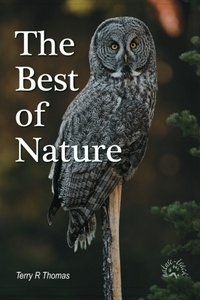
That is embarrassing, but actually a fairly typical response to my nature essays. Since The Best of Nature is created from the very best of 16 years of these nature essays published weekly in the Idaho Falls Post Register (online readership 70,000), it is a fine read. It covers a wide variety of topics including humorous glimpses of nature, philosophy, natural history, and conservation. Readers praise the style, breadth of subject matter and my ability to communicate complex and emotional topics in a relaxed and understandable manner.
Everyone can find something to love in this book. From teenagers to octogenarians, from the coffee shop to the school room, these nature essays are widely read and enjoyed.
Some of the essays here are my personal favorites, others seemed to strike a chord with readers. Most have an important message or lesson that will resonate with you. They are written with a goal to simultaneously entertain and educate about the wonderful workings of nature. Some will make you laugh out loud and others will bring a tear to the eye and warm your heart.
Readers Write:
"You hit a home run with your article on, Big Questions in Nature. It should be required reading for everyone who has lost touch with nature...great job!" Joe Chapman
"We enjoyed your column, Bloom Where Planted. Some of the best writing yet. The Post Register is fortunate to have your weekly columns." Lou Griffin.
To read more and to order a copy, click here or get the Kindle version
Copies are also available at:
Post Register
Island Park Builders Supply (upstairs)
Barnes and Noble in Idaho Falls
Harriman State Park, Island Park
Museum of Idaho
Valley Books, Jackson Wyoming
Avocet Corner Bookstore, Bear River National Wildlife Refuge, Brigham City, Utah
Craters of the Moon National Monument Bookstore, Arco, Idaho