Fairy Slippers
©Terry R. Thomas/www.nature-track.com
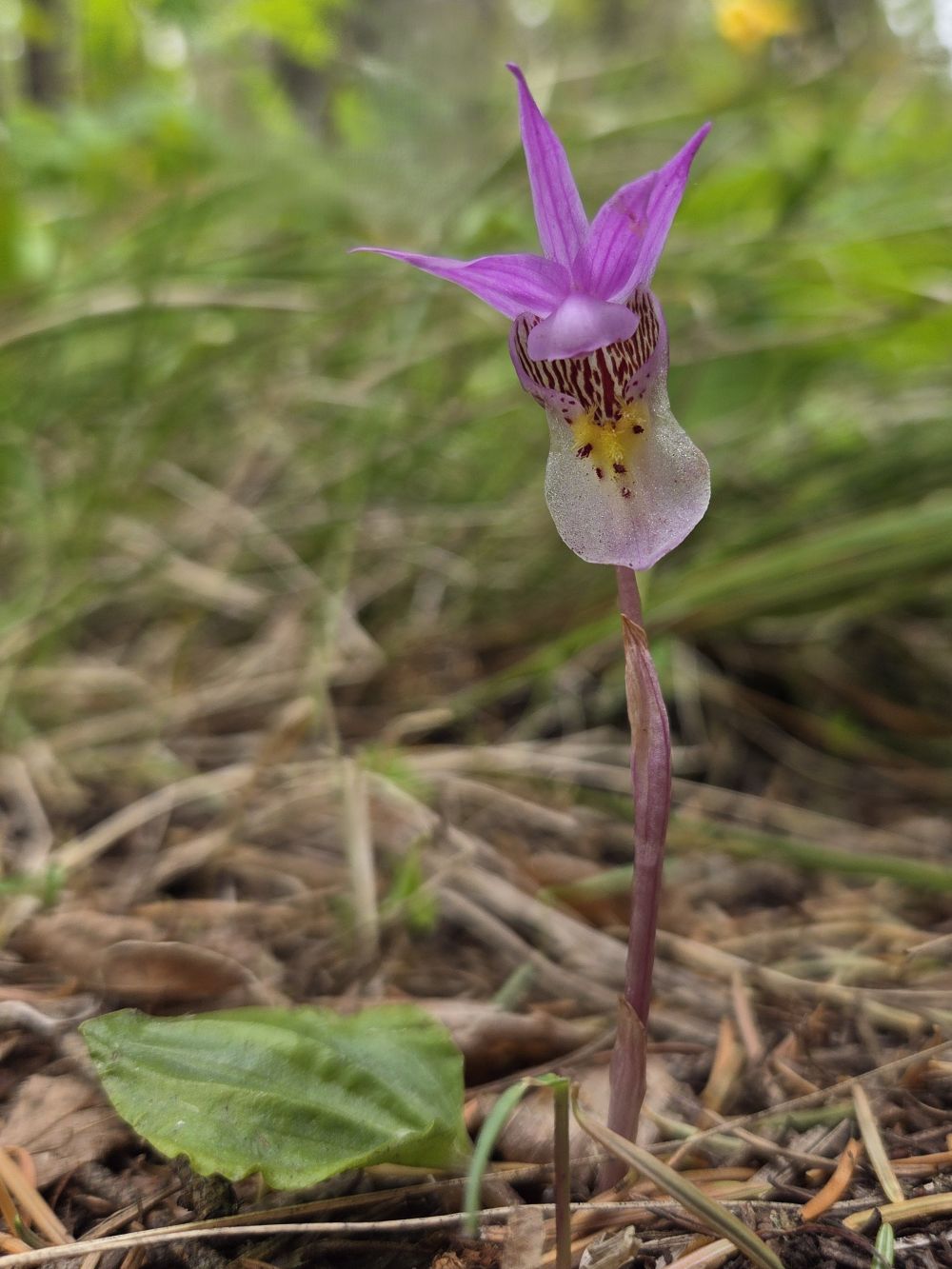
A fairy slipper blooms shortly after the snow melts, producing a beautiful flower on a short stalk.
Wandering through the woods last week, I enjoyed searching for new or interesting things. On this particular day, I found a few sources of fatwood, which is a fire-starting marvel everyone should carry, several cool rocks, and a flower I rarely encounter. The flower was small, close to the ground and stunningly beautiful. It was an orchid named the fairy slipper (also called Venus’s slipper or angel slipper) or Calypso bulbosa.
As orchids usually are, this flower is a little difficult to describe because it is oddly shaped. There is a single flower on top of a short (about four inches) reddish stalk. The lower petal is long and scoop-shaped with a pink to white lip with red-brown stripes and dots and a patch of feathery yellow hairs. The upper petals and sepals are narrow, pointed and pink to purple. The flower is zygomorphic, meaning that the flower can be divided into essentially symmetrical or mirror image halves much like our face can be divided. There is a single ovate leaf at the bottom of the stalk.
Fairy slippers bloom shortly after snow cover melts. That means that depending on your location and elevation you may see them from March through July. That is the easy part. Fairy slippers prefer the cool shady confines of mature forests, particularly Douglas fir in our area, and are seldom found in large groups. Thus, you may do a fair bit of wandering before you encounter one. And according to experts, “The plant relies on specific mycorrhizal fungi for germination and survival, making it highly sensitive to habitat disturbance.”
Most orchids, and the fairy slipper is one of these, are hermaphroditic. Hermaphroditic plants, also called bisexual or perfect plants, have flowers containing both stamens (male organs producing pollen) and pistils (female organs containing ovules) in the same flower. They can self-pollinate this way.
Speaking of pollination, fairy slippers, beautiful as they are, hold a dark secret called deceptive pollination. They don’t produce nectar but they do produce a sweet scent. This scent is enticing enough that pollinators, especially bumblebees, will always check them out, helping in the pollination process without getting their nectar reward. Pollinators only learn through trial and error not to waste time on these plants.
The fairy slipper is a perennial, rising from a corm (solid like a potato, not leafy parts like a bulb). Besides the flower, it produces asexually, sending a new shoot up from the corm after flowering. A new corm will form from this. However, corms are relatively short-lived, only surviving around five years.
The corms are edible and Native Americans routinely ate them. They are said to have a mild, creamy or buttery taste and are rich in carbohydrates. They are best prepared boiled, but young corms can be eaten raw. However, since they are a bit harder to find consistently, they were not a major calorie source.
Although never abundant, the fairy slipper is very widespread. From Canada and the northern half of the United States to Europe, Russia, China, Japan, Mongolia, and Korea, the fairy slipper is known as a circumboreal plant occurring anywhere habitat, including its essential mycorrhizal associate, occurs.
This plant is doing well in some places, but is listed as threatened by five states. This is likely because of continued habitat loss or change. Logging an area, even with a shelterbelt cut that leaves widely spaced trees, can eliminate habitat for this species for many years.
Help Idaho Wildlife
When we traveled across the state in October 2017, we visited most of the Idaho Department of Fish and Game wildlife management areas. Most of the vehicles we saw using the wildlife management areas did not have wildlife plates. Buying wildlife plates is a great way for non-hunters and hunters alike to support wildlife-based recreation like birding.
C'mon folks, let's help Idaho's wildlife by proudly buying and displaying a wildlife license plate on each of our vehicles!
See below for information on Idaho plates. Most states have wildlife plates so if you live outside Idaho, check with your state's wildlife department or vehicle licensing division for availability of state wildlife plates where you live.
And tell them that you heard about it from Nature-track.com!
Wildlife License Plates
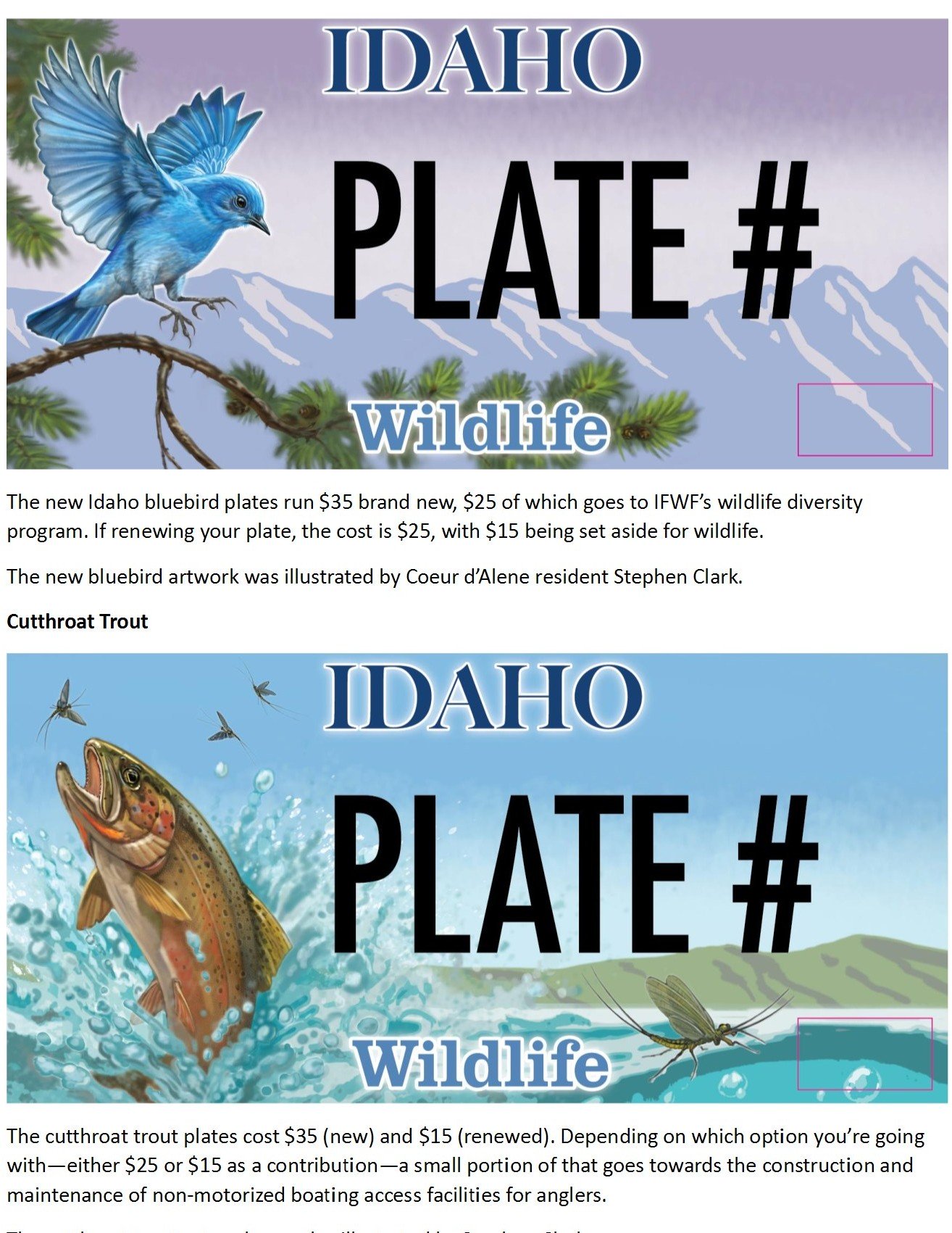
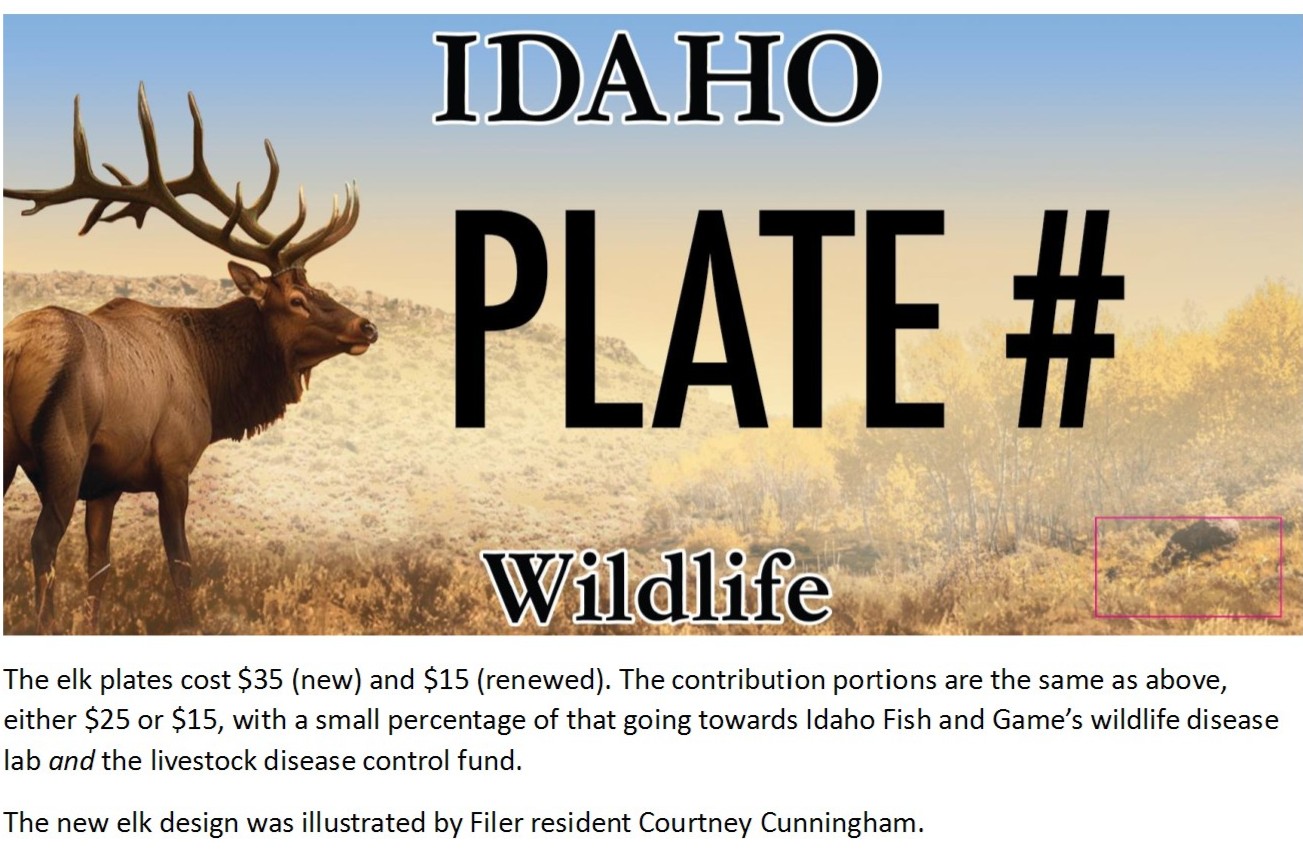
Great news! as of 2024, there are three NEW designs for license plates. They still are bluebird, cutthroat trout and elk, but they are beautiful.
Idaho Wildlife license plates provide essential funding that benefits the great diversity of native plants and wildlife that are not hunted, fished or trapped—over 10,000 species or 98% of Idaho’s species diversity. Game species that share the same habitats (such as elk, deer, antelope, sage-grouse, salmon, trout) also benefit from these specialty plates.
No state tax dollars are provided for wildlife diversity, conservation education and recreation programs. Neither are any revenues from the sale of hunting or fishing licenses spent on nongame species. Instead, these species depend on direct donations, federal grants, fundraising initiatives—and the Idaho Wildlife license plates.
Both my vehicles have Bluebird Plates. I prefer the bluebird because the nongame program gets 70 percent of the money from bluebird plates, but only 60 percent of the money from elk and trout plates - 10 percent of the money from elk plates supports wildlife disease monitoring and testing programs (to benefit the livestock industry) and 10 percent from cutthroat plates supports non-motorized boat access.
Incidentally, in 2014, the Idaho Legislature denied the Department of Fish and Game the ability to add new plates or even to change the name of the elk and cutthroat plates (very specific) to wildlife and fish plates, a move that would have allowed for changing images occasionally and generating more revenue. It would seem that they believe that we Idahoans don't want a well funded wildlife program.
I think it is time we let the Legislature know that Idahoan support wildlife funding and that we would like to see these generic plates come to fruition.
"WOW. What a phenomenal piece you wrote. You are amazing." Jennifer Jackson
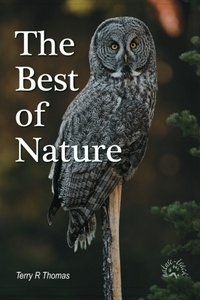
That is embarrassing, but actually a fairly typical response to my nature essays. Since The Best of Nature is created from the very best of 16 years of these nature essays published weekly in the Idaho Falls Post Register (online readership 70,000), it is a fine read. It covers a wide variety of topics including humorous glimpses of nature, philosophy, natural history, and conservation. Readers praise the style, breadth of subject matter and my ability to communicate complex and emotional topics in a relaxed and understandable manner.
Everyone can find something to love in this book. From teenagers to octogenarians, from the coffee shop to the school room, these nature essays are widely read and enjoyed.
Some of the essays here are my personal favorites, others seemed to strike a chord with readers. Most have an important message or lesson that will resonate with you. They are written with a goal to simultaneously entertain and educate about the wonderful workings of nature. Some will make you laugh out loud and others will bring a tear to the eye and warm your heart.
Readers Write:
"You hit a home run with your article on, Big Questions in Nature. It should be required reading for everyone who has lost touch with nature...great job!" Joe Chapman
"We enjoyed your column, Bloom Where Planted. Some of the best writing yet. The Post Register is fortunate to have your weekly columns." Lou Griffin.
To read more and to order a copy, click here or get the Kindle version
Copies are also available at:
Post Register
Island Park Builders Supply (upstairs)
Barnes and Noble in Idaho Falls
Harriman State Park, Island Park
Museum of Idaho
Valley Books, Jackson Wyoming
Avocet Corner Bookstore, Bear River National Wildlife Refuge, Brigham City, Utah
Craters of the Moon National Monument Bookstore, Arco, Idaho