Legacy
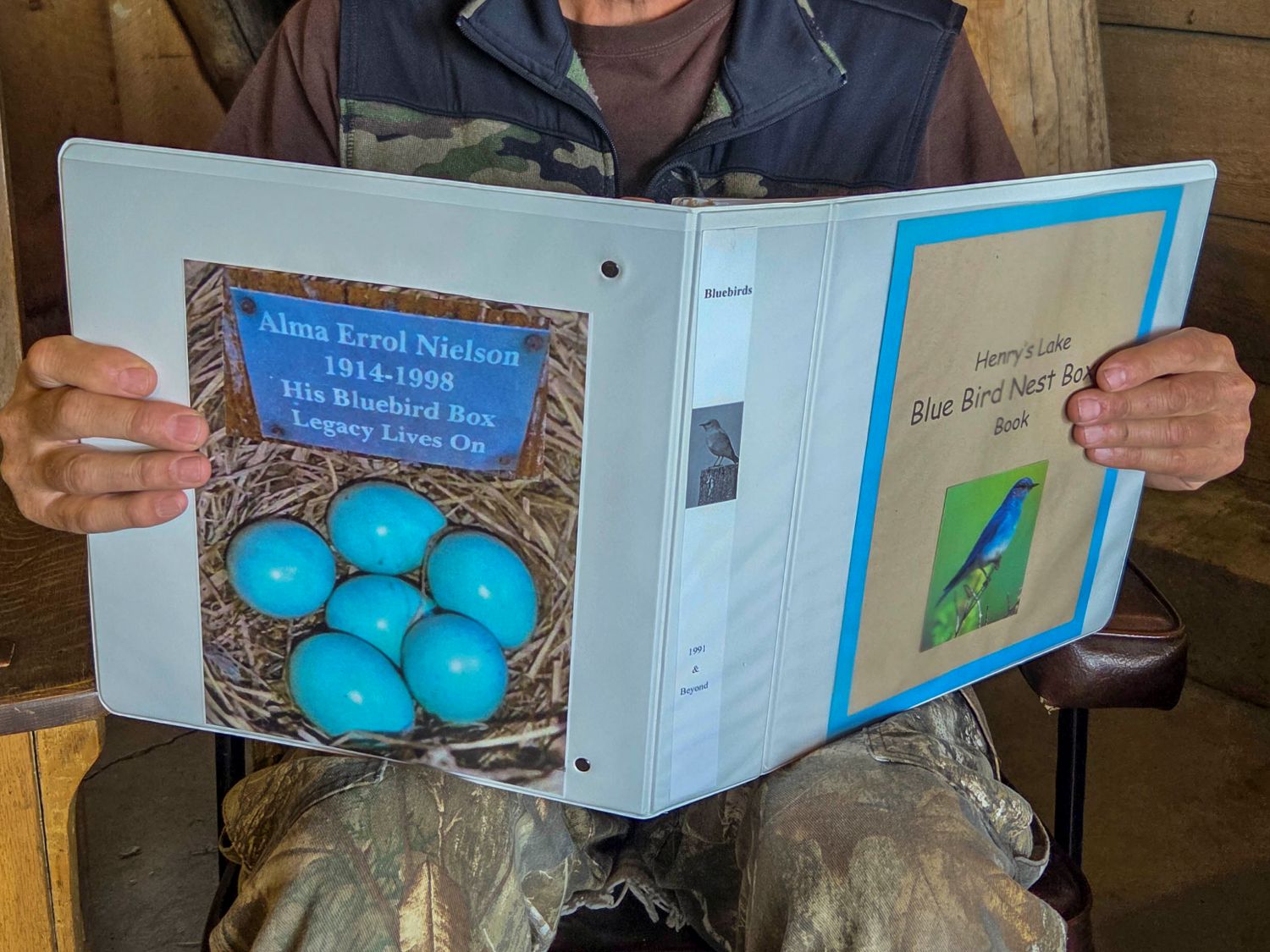
Russell Nielson studies entries in the Henry’s Lake Bluebird data book.
I suppose that everyone wants to leave a legacy, something for which they will be remembered, but more importantly, something that will have made a difference, somewhere, in some realm. Sometimes, the legacy is unintended though, and only recognized well after the originator is gone.
Such was the case with Alma Errol Nielson, an Idaho wildlife biologist who, in the 1960s, built a cabin on Henrys Lake using the Homestead Act (the Act was still available until 1976, 1986 in Alaska). His cabin, built on the shore of the lake, was his getaway, and connected him with one of his great loves, mountain bluebirds.
As I understand the story, he retired in 1978, and in 1991 he decided to start a bluebird nestbox route around the lake to help “his” bluebirds. At one time, he had over 100 numbered boxes and he kept meticulous records of such things as nesting species (tree swallows loved the boxes too), number of eggs and nestlings, and the condition of the boxes over time. Sadly, he passed away in 1998 and for awhile the route went unattended.
Then in 2003, nephew Russell Nielson decided to restore the route. For the past 23 years, he and several other family members and friends have spearheaded this effort they currently maintain a total of 78 boxes and detailed records. They use Errol’s cabin as a base of operations to repair boxes and build replacements when necessary.
But this is a big job for people who don’t live in Island Park and they enlisted the help of the Henry’s Fork Chapter of Master Naturalists. Two ladies from that group accepted the challenge and do the fall monitoring, cleaning, and even some of the repair work.
I met Russell and some of his friends when we were invited to the second annual Bluebird Festival and Dutch oven dinner (Errol was a consummate Dutch oven chef) that they hold at the cabin on the lakeshore. It was a wonderful opportunity to get to know some ardent conservationists. Also present were the two Master Naturalists, Nancy and Kathleen. All told, there were about 14 people in attendance. One involved attendee, Preston Smith, gave a presentation on the website he is preparing for launch later this summer. The website, while still unnamed, will share data about each box (except location), and will contain links to other sites that deal with mountain bluebirds as well as helpful hints for establishing a route. Preston said, “We do this to help bluebird conservation.”
You might ask, what is the point of this exercise? Has it really done any good? To me, much of the value of this project is in the longevity. Many of us put up bird houses and watch them for a year or two and forget them. Those have little lasting value. This project has a 23-year track record and they plan on forever. Physically, the boxes have provided consistent habitat over time, something bluebirds can rely on. The records have also shown some interesting trends. For instance, they have noted that boxes in poor repair generally have less or no production. This year’s data shows that swallows occupy almost 75 percent of the boxes, indicating that improving things for bluebirds may need to include reducing competition. One way to do that is by putting up twin boxes about 20 feet apart. According to the Bluebird Society, bluebirds will occupy one nest and swallows the other as they tolerate different species more than their own at nest boxes. However, this need would never have been demonstrated without the data in the book. The longevity and completeness of the data makes it useful in other ways as well.
Legacy. Bluebirds will never know the name, Alma Errol Nielson, but thanks to his family, his love for them will carry on for years to come, with the next generation of Nielsons already being trained to care for the bluebirds.
Help Idaho Wildlife
When we traveled across the state in October 2017, we visited most of the Idaho Department of Fish and Game wildlife management areas. Most of the vehicles we saw using the wildlife management areas did not have wildlife plates. Buying wildlife plates is a great way for non-hunters and hunters alike to support wildlife-based recreation like birding.
C'mon folks, let's help Idaho's wildlife by proudly buying and displaying a wildlife license plate on each of our vehicles!
See below for information on Idaho plates. Most states have wildlife plates so if you live outside Idaho, check with your state's wildlife department or vehicle licensing division for availability of state wildlife plates where you live.
And tell them that you heard about it from Nature-track.com!
Wildlife License Plates
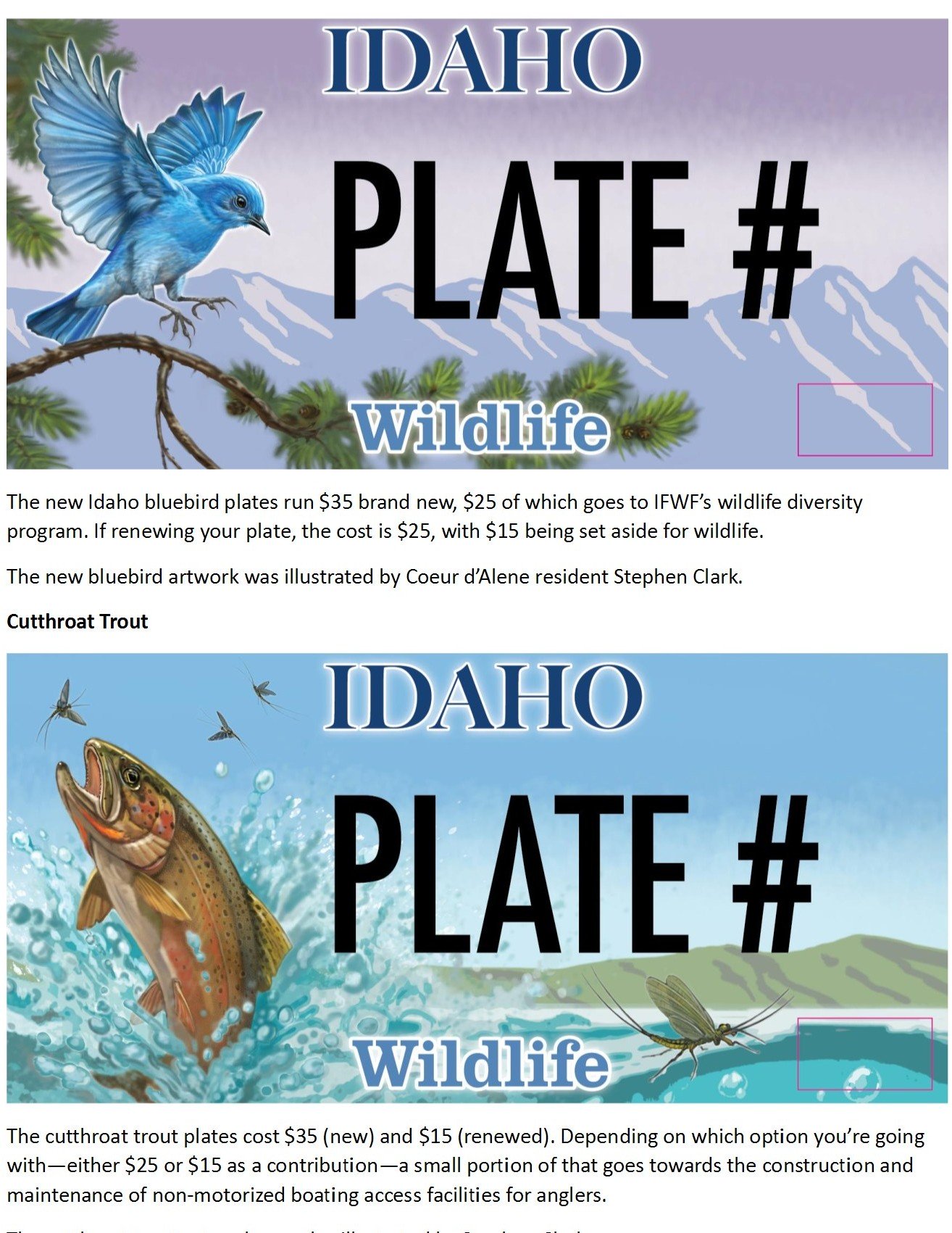
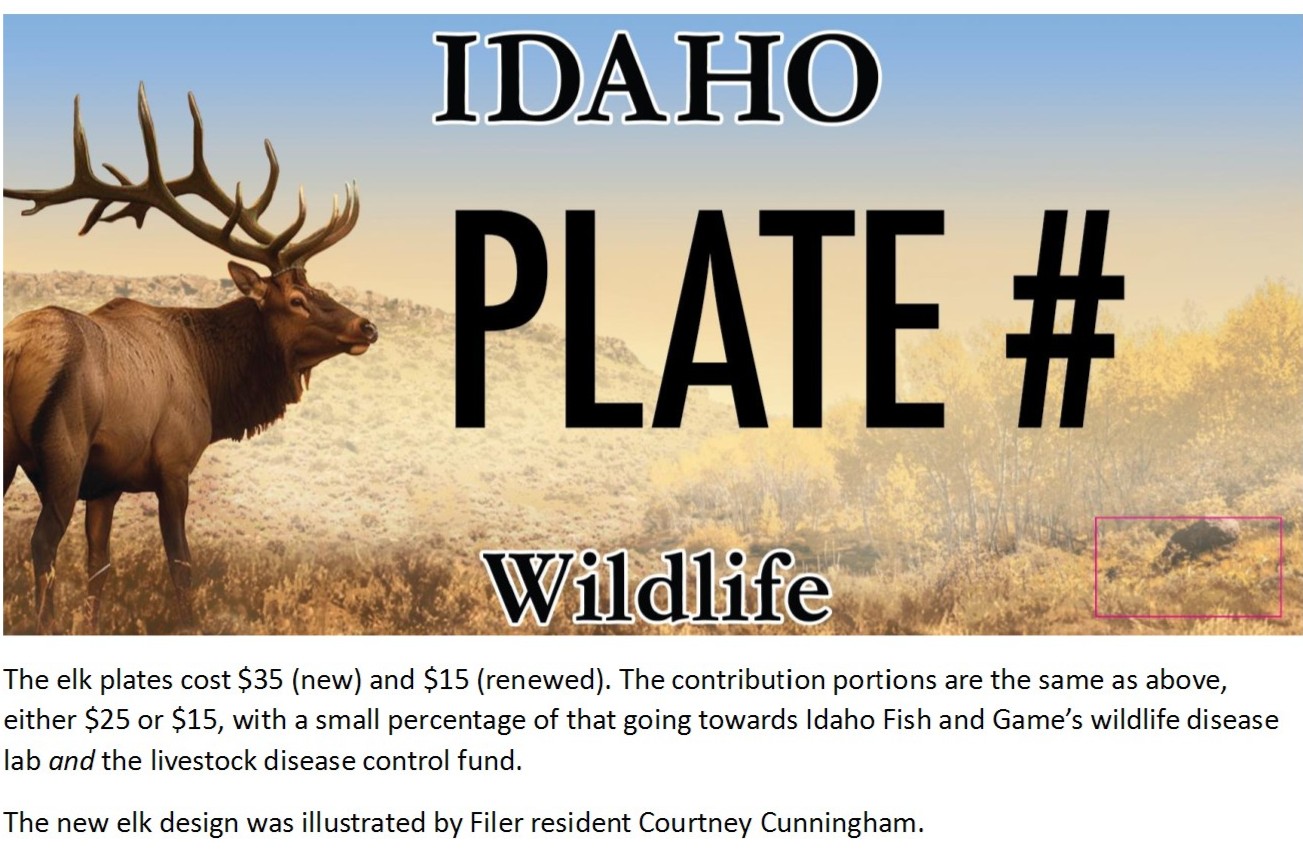
Great news! as of 2024, there are three NEW designs for license plates. They still are bluebird, cutthroat trout and elk, but they are beautiful.
Idaho Wildlife license plates provide essential funding that benefits the great diversity of native plants and wildlife that are not hunted, fished or trapped—over 10,000 species or 98% of Idaho’s species diversity. Game species that share the same habitats (such as elk, deer, antelope, sage-grouse, salmon, trout) also benefit from these specialty plates.
No state tax dollars are provided for wildlife diversity, conservation education and recreation programs. Neither are any revenues from the sale of hunting or fishing licenses spent on nongame species. Instead, these species depend on direct donations, federal grants, fundraising initiatives—and the Idaho Wildlife license plates.
Both my vehicles have Bluebird Plates. I prefer the bluebird because the nongame program gets 70 percent of the money from bluebird plates, but only 60 percent of the money from elk and trout plates - 10 percent of the money from elk plates supports wildlife disease monitoring and testing programs (to benefit the livestock industry) and 10 percent from cutthroat plates supports non-motorized boat access.
Incidentally, in 2014, the Idaho Legislature denied the Department of Fish and Game the ability to add new plates or even to change the name of the elk and cutthroat plates (very specific) to wildlife and fish plates, a move that would have allowed for changing images occasionally and generating more revenue. It would seem that they believe that we Idahoans don't want a well funded wildlife program.
I think it is time we let the Legislature know that Idahoan support wildlife funding and that we would like to see these generic plates come to fruition.
"WOW. What a phenomenal piece you wrote. You are amazing." Jennifer Jackson
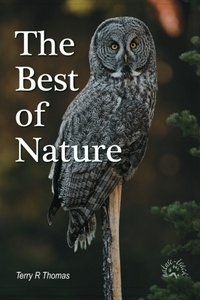
That is embarrassing, but actually a fairly typical response to my nature essays. Since The Best of Nature is created from the very best of 16 years of these nature essays published weekly in the Idaho Falls Post Register (online readership 70,000), it is a fine read. It covers a wide variety of topics including humorous glimpses of nature, philosophy, natural history, and conservation. Readers praise the style, breadth of subject matter and my ability to communicate complex and emotional topics in a relaxed and understandable manner.
Everyone can find something to love in this book. From teenagers to octogenarians, from the coffee shop to the school room, these nature essays are widely read and enjoyed.
Some of the essays here are my personal favorites, others seemed to strike a chord with readers. Most have an important message or lesson that will resonate with you. They are written with a goal to simultaneously entertain and educate about the wonderful workings of nature. Some will make you laugh out loud and others will bring a tear to the eye and warm your heart.
Readers Write:
"You hit a home run with your article on, Big Questions in Nature. It should be required reading for everyone who has lost touch with nature...great job!" Joe Chapman
"We enjoyed your column, Bloom Where Planted. Some of the best writing yet. The Post Register is fortunate to have your weekly columns." Lou Griffin.
To read more and to order a copy, click here or get the Kindle version
Copies are also available at:
Post Register
Island Park Builders Supply (upstairs)
Barnes and Noble in Idaho Falls
Harriman State Park, Island Park
Museum of Idaho
Valley Books, Jackson Wyoming
Avocet Corner Bookstore, Bear River National Wildlife Refuge, Brigham City, Utah
Craters of the Moon National Monument Bookstore, Arco, Idaho