Solutions for the Great Salt Lake
©Terry R. Thomas/www.nature-track.com
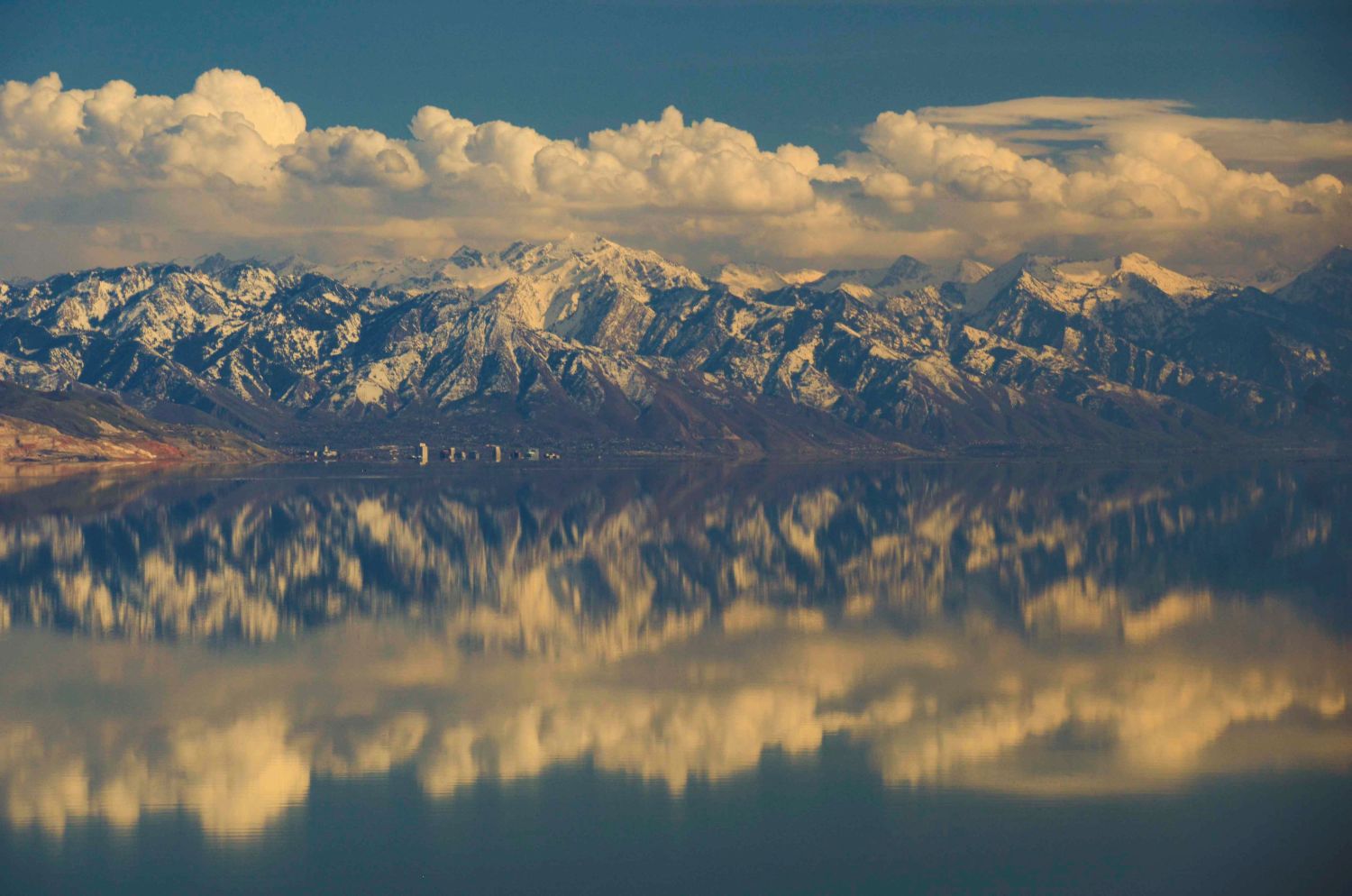
Great Salt Lake as it was in 2013 at an elevation of 4,197 asl. This is one foot shy of the goal of maintaining the lake at 4,198.
The Great Salt Lake is short on salty water, but just 550 miles away is an entire Pacific Ocean of the brine. Why not just ship some of that to Utah, and voila! Problem solved! That was actually a serious proposal officially considered by the Utah Legislature in 2022. Research determined though that it would cost $100 billion to build and $300 million annually to operate (just in power costs) as well as require 400 megawatts of energy each year, about 11 percent of Utah’s current annual energy consumption and create greenhouse emissions equivalent of 200,000 cars. And that was for the most optimistic fictitious scenario with no mountains or other obstacles to circumvent and delivering only a third of the recommended water needs. “Researchers concluded the idea was ‘a distraction’ from more practical water conservation and management measures (NBC).” Utah’s Great Salt Lake Commissioner has clarified that the Pacific Ocean pipeline is not among the state’s current viable options.
So, what are the viable options? Back to the podcast that started this series of columns. The two experts agreed that water conservation is going to be the key. No one knows exactly what that will look like, but it will be expensive because no one is expected to just give up water rights.
However, the Church of Jesus Christ of Latter-day Saints has set the bar on that. In 2023 the church made a permanent donation of 5,700 water shares, about 20,000 acre-feet or 8.1 billion gallons (the largest water donation in Utah history) to the Great Salt Lake. This water was previously used for agriculture and will now be perpetually delivered to the lake. This donation was worth around $6 million. The church followed this up in 2025 with a lease of 4,000 to 7,400 additional acre-feet of water. I have heard several people suggest that this is insufficient and just posturing, but my thought is that it far exceeds what the rest of the watershed has donated to this point. So, it is a big deal. This is a shared problem and the solution will be a shared solution too.
“The 23-million-acre watershed is divided into four main basins, with the Bear, Jordan, and Weber watersheds contributing almost all surface water inflow. Irrigated agriculture covers 1.4 million acres or 6% of the watershed. 63% of this agricultural land occurs in Utah, 31% in Idaho, 5% in Wyoming, and 1% in Nevada. Urban development covers 0.7 million acres or 3% of the watershed area, with 93% occurring in Utah.” Within these bounds, water conservation, purchase of water rights, and removal of the invasive grass, phragmites (estimated to consume 100,000 acre-feet of water annually) are the key strategies.
Water conservation will include changing the way urban populations use water including reducing over-watering, reducing turf (lawn) to essential areas only (no grassy parking strips or other non-functional areas), and encouraging xeriscaping over bluegrass.
For agriculture and industry, purchase of water rights will be huge, as will helping farmers conserve water without reducing production, i.e., improved water efficiency.
On the management end, repair and replacement of failing infrastructure will help to improve water delivery, reduce water loses, and open new areas.
All of this is expensive though. As stated at the beginning of this series, it could cost from $6-10 billion. While much of that can come from taxes and grants, to a large degree, these take time to establish and often come with strings. A pot of money that allows managers to act quickly on opportunities is also essential. And that is where we come in. It is easy to donate to the restoration of the Great Salt Lake. Just go to the website, Great Salt Lake Rising gslrising.org and click on the Take Action button and scroll down to the Donate Now. That is what I did and it was simple. You can also visit Great Salt Lake Water Trust at www.gslwatertrust.org and go to the Donation button on the far right.
Michael Cohen, a senior associate with the Pacific Institute, a research foundation that focuses on water issues, told NBC News, “There’s been a lot of shift in thinking throughout the West in terms of water conservation, living within people’s means and the idea of limits—we can’t just use whatever we want.” Hopefully, we are going to learn that lesson from the Great Salt Lake and save this irreplaceable resource.
Help Idaho Wildlife
When we traveled across the state in October 2017, we visited most of the Idaho Department of Fish and Game wildlife management areas. Most of the vehicles we saw using the wildlife management areas did not have wildlife plates. Buying wildlife plates is a great way for non-hunters and hunters alike to support wildlife-based recreation like birding.
C'mon folks, let's help Idaho's wildlife by proudly buying and displaying a wildlife license plate on each of our vehicles!
See below for information on Idaho plates. Most states have wildlife plates so if you live outside Idaho, check with your state's wildlife department or vehicle licensing division for availability of state wildlife plates where you live.
And tell them that you heard about it from Nature-track.com!
Wildlife License Plates
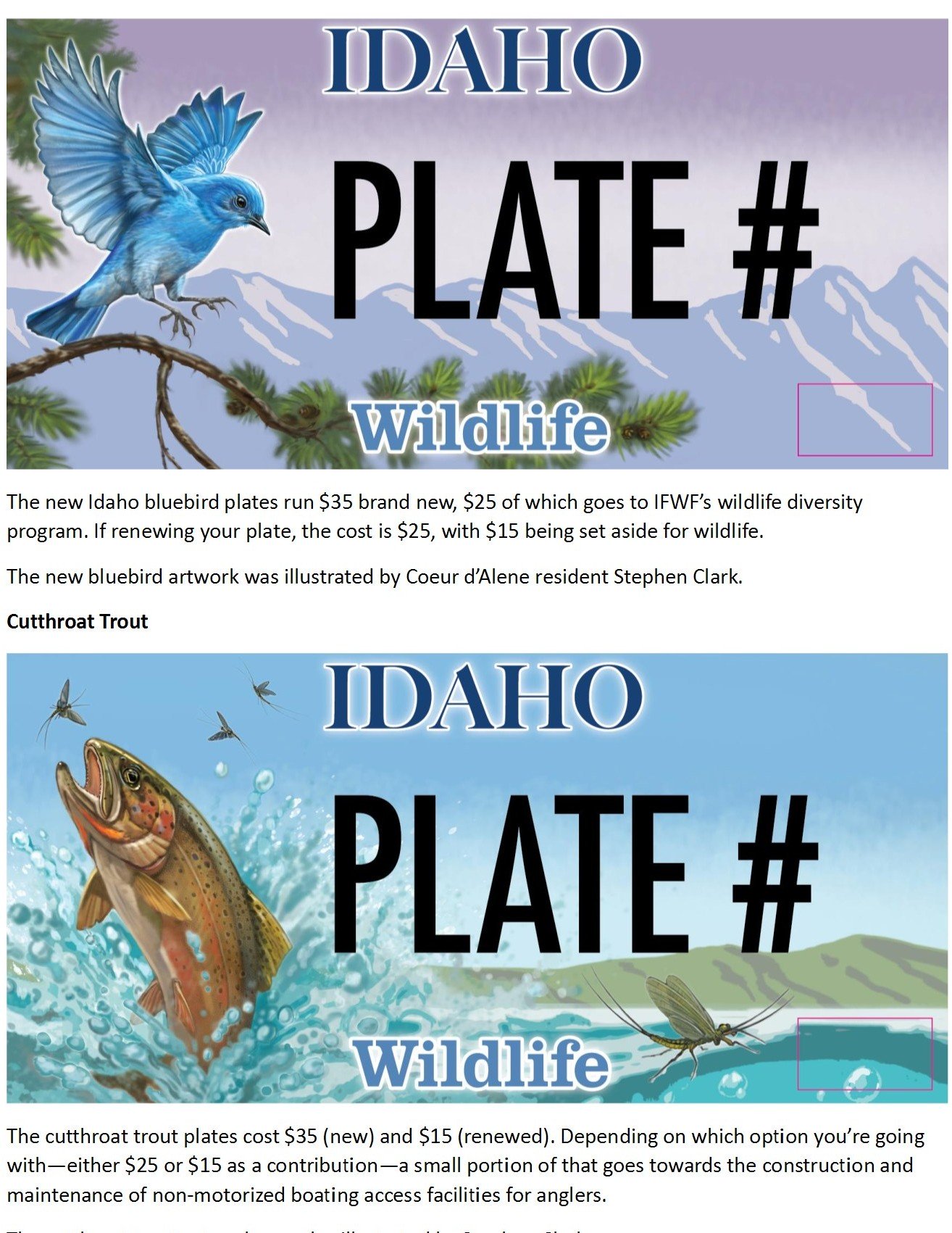
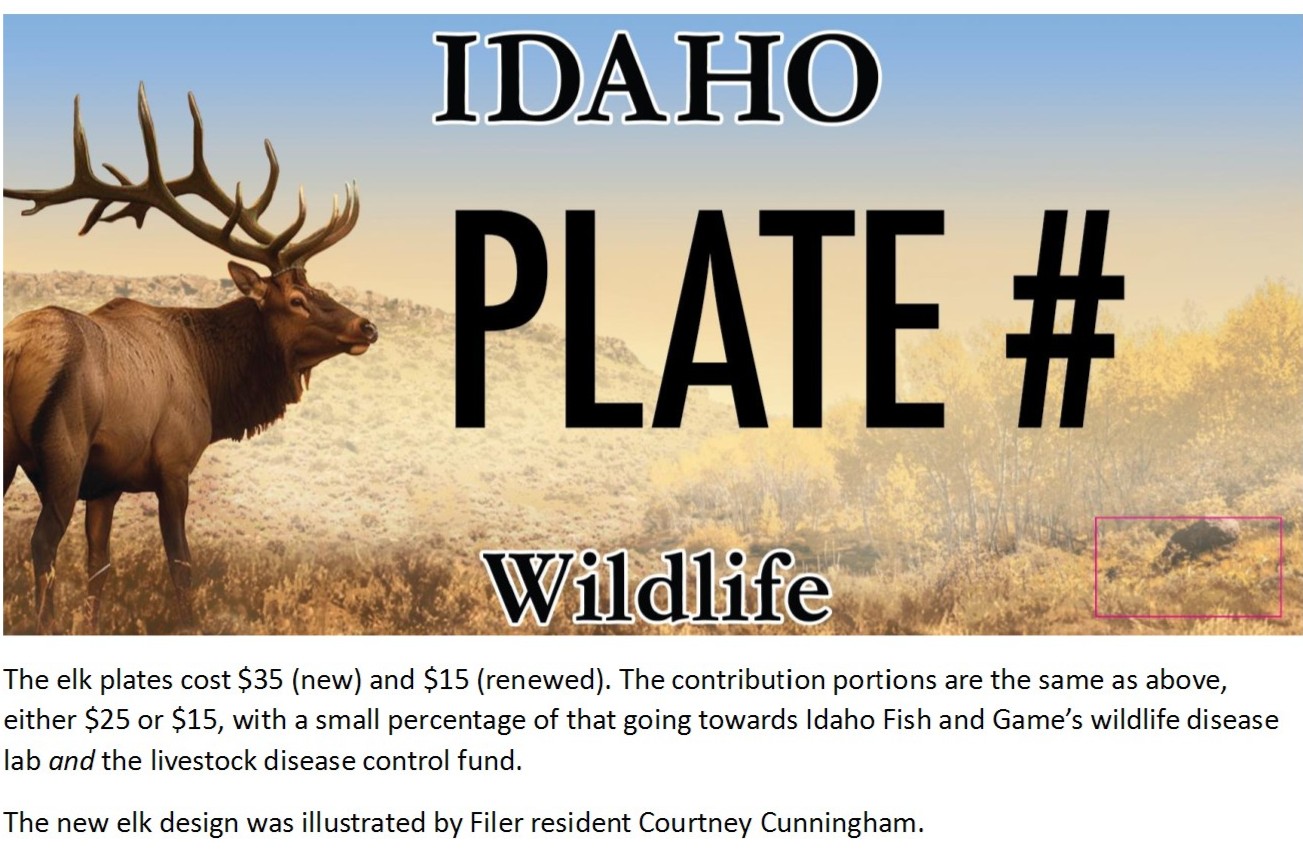
Great news! as of 2024, there are three NEW designs for license plates. They still are bluebird, cutthroat trout and elk, but they are beautiful.
Idaho Wildlife license plates provide essential funding that benefits the great diversity of native plants and wildlife that are not hunted, fished or trapped—over 10,000 species or 98% of Idaho’s species diversity. Game species that share the same habitats (such as elk, deer, antelope, sage-grouse, salmon, trout) also benefit from these specialty plates.
No state tax dollars are provided for wildlife diversity, conservation education and recreation programs. Neither are any revenues from the sale of hunting or fishing licenses spent on nongame species. Instead, these species depend on direct donations, federal grants, fundraising initiatives—and the Idaho Wildlife license plates.
Both my vehicles have Bluebird Plates. I prefer the bluebird because the nongame program gets 70 percent of the money from bluebird plates, but only 60 percent of the money from elk and trout plates - 10 percent of the money from elk plates supports wildlife disease monitoring and testing programs (to benefit the livestock industry) and 10 percent from cutthroat plates supports non-motorized boat access.
Incidentally, in 2014, the Idaho Legislature denied the Department of Fish and Game the ability to add new plates or even to change the name of the elk and cutthroat plates (very specific) to wildlife and fish plates, a move that would have allowed for changing images occasionally and generating more revenue. It would seem that they believe that we Idahoans don't want a well funded wildlife program.
I think it is time we let the Legislature know that Idahoan support wildlife funding and that we would like to see these generic plates come to fruition.
"WOW. What a phenomenal piece you wrote. You are amazing." Jennifer Jackson
That is embarrassing, but actually a fairly typical response to my nature essays. Since The Best of Nature is created from the very best of 16 years of these nature essays published weekly in the Idaho Falls Post Register (online readership 70,000), it is a fine read. It covers a wide variety of topics including humorous glimpses of nature, philosophy, natural history, and conservation. Readers praise the style, breadth of subject matter and my ability to communicate complex and emotional topics in a relaxed and understandable manner.
Everyone can find something to love in this book. From teenagers to octogenarians, from the coffee shop to the school room, these nature essays are widely read and enjoyed.
Some of the essays here are my personal favorites, others seemed to strike a chord with readers. Most have an important message or lesson that will resonate with you. They are written with a goal to simultaneously entertain and educate about the wonderful workings of nature. Some will make you laugh out loud and others will bring a tear to the eye and warm your heart.
Readers Write:
"You hit a home run with your article on, Big Questions in Nature. It should be required reading for everyone who has lost touch with nature...great job!" Joe Chapman
"We enjoyed your column, Bloom Where Planted. Some of the best writing yet. The Post Register is fortunate to have your weekly columns." Lou Griffin.
To read more and to order a copy, click here or get the Kindle version
Copies are also available at:
Post Register
Island Park Builders Supply (upstairs)
Barnes and Noble in Idaho Falls
Harriman State Park, Island Park
Museum of Idaho
Valley Books, Jackson Wyoming
Avocet Corner Bookstore, Bear River National Wildlife Refuge, Brigham City, Utah
Craters of the Moon National Monument Bookstore, Arco, Idaho