If Great Salt Lake Fails Part 2
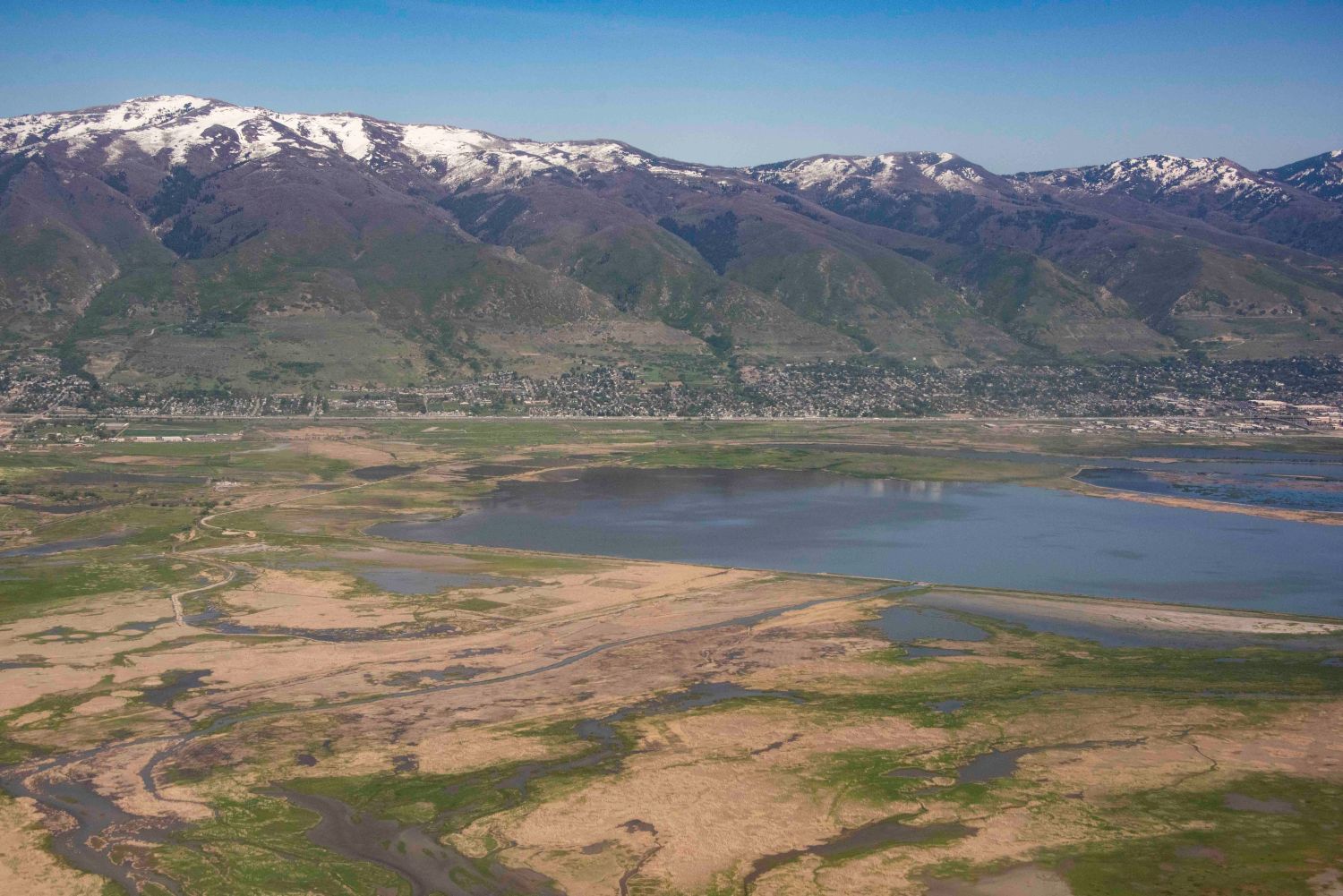
©Terry R. Thomas/www.nature-track.com
Great Salt Lake is quickly turning into a series of puddles and mudflats. This is a serious problem, not just for Utah, but worldwide.
Forty years ago, the conversation about the Great Salt Lake was very different than it is today. The winter of 82-83 saw record snowfall of 800 inches, 400 percent of the average, that melted in a rush with ample spring rains. State Street in Salt Lake City turned into a river, and the Great Salt Lake began to rise quickly. As a shallow terminal lake, every gallon that arrived at the lake increased its size. A one-foot rise in this lake adds about 20,000-30,000 acres (30-45 square miles) of lake surface area and between 1982 and 1986, the lake rose 20 feet, covering between 600 and 900 more square miles and expanding the lake surface to 2,300 square miles, a historic high.
A cool wet summer followed, reducing evaporation from the lake. Then September saw ten times the rain it normally receives, with 3.5 inches hitting the ground. And this was all complicated by the fact that at the time, Utah was not in a drought and hadn’t been for years. Reservoirs were full, soils were saturated and the only place the extra water could go was into the Great Salt Lake.
This ultimately prompted then Utah Governor Norm Bangerter to authorize the construction of an infrastructure to carry excess water into the West Desert. This system, which cost $60 million in 1986 dollars, consisted of canals and three huge 21-foot long by 17-foot tall pumps that together could move 1.3 million gallons of water (about four-acre feet) per minute. These pumps were used for two years and then moth-balled.
In those years, it was all about, “What are we going to do with all this water?” Now, we are wishing we could go back and bank some of that as the situation is exactly the opposite and 2022 was the record low for the lake at 890 square miles. Since pioneers settled in the Salt Lake Valley in the mid-1800s, the lake’s water volume has dropped by more than two-thirds. There was one bright spot of hope in spring of 2023, when another record snowfall year of 800 inches promised some relief. But that came at the historical low of the lake, and while the lake did rise about six feet from 4,189 to 4,195 feet elevation (it is currently at 4,191 asl), it was not even close to enough to reverse the trend of a failing lake system, it just bought a little time.
Time. That is what we just don’t have anymore. The 2023 report on the state of the Great Salt Lake, authored by two dozen scientists from a wide variety of disciplines, concluded that the lake may have as little as five years before the collapse of the ecosystem would begin. And, they concluded, once it begins, it may not be easily turned around. There is plenty of precedent for this. There are around 80 saline terminal lakes around the world. Almost all of them are failing, and to date, reversing the collapse has not been achieved on any of them. So, this isn’t a hypothetical or far in the future kind of thing. It is imminent, requiring action NOW.
If we could just speak and make it so, this would be a simple fix. Get more water, about an extra million acre-feet annually. But, where will it come from and who will pay for it? More on that next time.
Help Idaho Wildlife
When we traveled across the state in October 2017, we visited most of the Idaho Department of Fish and Game wildlife management areas. Most of the vehicles we saw using the wildlife management areas did not have wildlife plates. Buying wildlife plates is a great way for non-hunters and hunters alike to support wildlife-based recreation like birding.
C'mon folks, let's help Idaho's wildlife by proudly buying and displaying a wildlife license plate on each of our vehicles!
See below for information on Idaho plates. Most states have wildlife plates so if you live outside Idaho, check with your state's wildlife department or vehicle licensing division for availability of state wildlife plates where you live.
And tell them that you heard about it from Nature-track.com!
Wildlife License Plates
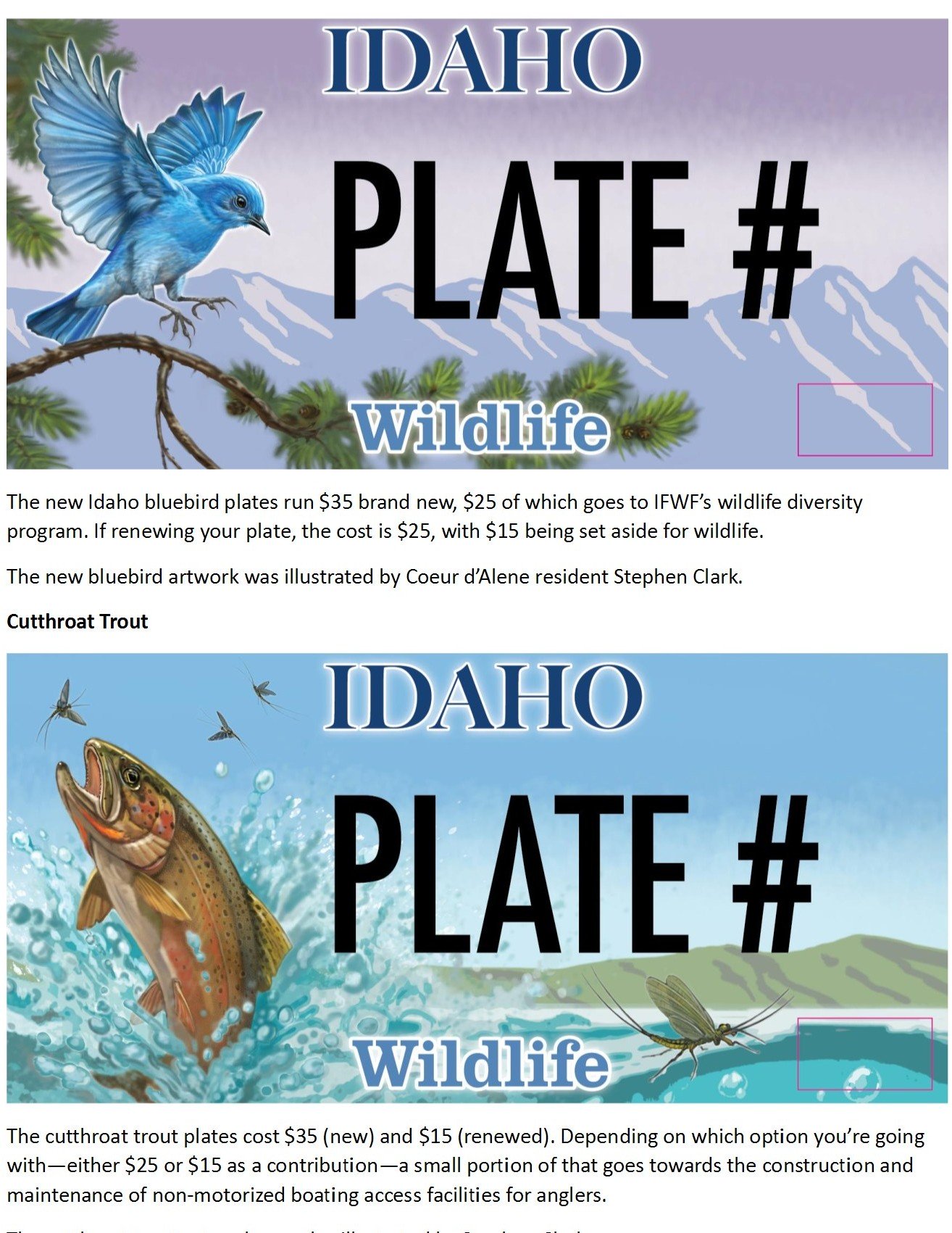
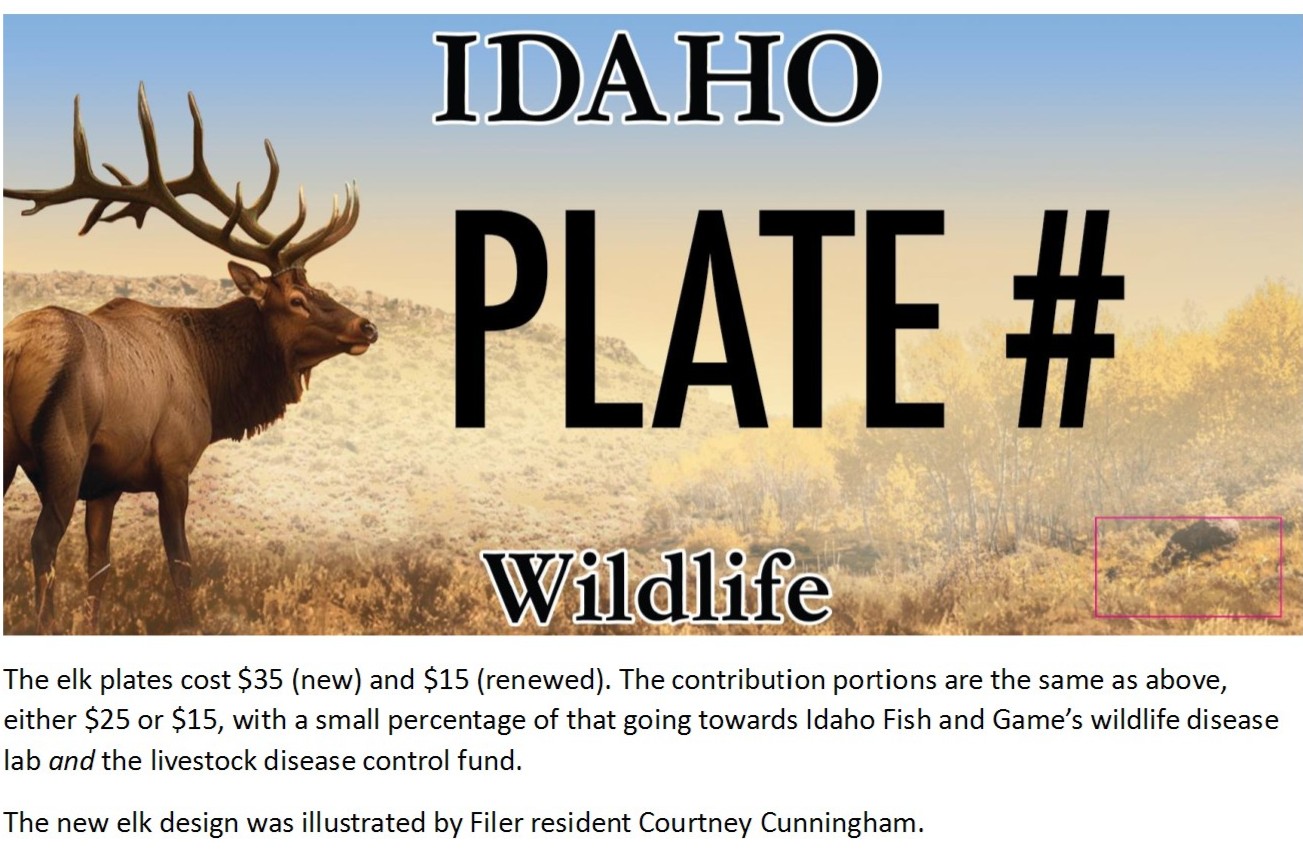
Great news! as of 2024, there are three NEW designs for license plates. They still are bluebird, cutthroat trout and elk, but they are beautiful.
Idaho Wildlife license plates provide essential funding that benefits the great diversity of native plants and wildlife that are not hunted, fished or trapped—over 10,000 species or 98% of Idaho’s species diversity. Game species that share the same habitats (such as elk, deer, antelope, sage-grouse, salmon, trout) also benefit from these specialty plates.
No state tax dollars are provided for wildlife diversity, conservation education and recreation programs. Neither are any revenues from the sale of hunting or fishing licenses spent on nongame species. Instead, these species depend on direct donations, federal grants, fundraising initiatives—and the Idaho Wildlife license plates.
Both my vehicles have Bluebird Plates. I prefer the bluebird because the nongame program gets 70 percent of the money from bluebird plates, but only 60 percent of the money from elk and trout plates - 10 percent of the money from elk plates supports wildlife disease monitoring and testing programs (to benefit the livestock industry) and 10 percent from cutthroat plates supports non-motorized boat access.
Incidentally, in 2014, the Idaho Legislature denied the Department of Fish and Game the ability to add new plates or even to change the name of the elk and cutthroat plates (very specific) to wildlife and fish plates, a move that would have allowed for changing images occasionally and generating more revenue. It would seem that they believe that we Idahoans don't want a well funded wildlife program.
I think it is time we let the Legislature know that Idahoan support wildlife funding and that we would like to see these generic plates come to fruition.
"WOW. What a phenomenal piece you wrote. You are amazing." Jennifer Jackson
That is embarrassing, but actually a fairly typical response to my nature essays. Since The Best of Nature is created from the very best of 16 years of these nature essays published weekly in the Idaho Falls Post Register (online readership 70,000), it is a fine read. It covers a wide variety of topics including humorous glimpses of nature, philosophy, natural history, and conservation. Readers praise the style, breadth of subject matter and my ability to communicate complex and emotional topics in a relaxed and understandable manner.
Everyone can find something to love in this book. From teenagers to octogenarians, from the coffee shop to the school room, these nature essays are widely read and enjoyed.
Some of the essays here are my personal favorites, others seemed to strike a chord with readers. Most have an important message or lesson that will resonate with you. They are written with a goal to simultaneously entertain and educate about the wonderful workings of nature. Some will make you laugh out loud and others will bring a tear to the eye and warm your heart.
Readers Write:
"You hit a home run with your article on, Big Questions in Nature. It should be required reading for everyone who has lost touch with nature...great job!" Joe Chapman
"We enjoyed your column, Bloom Where Planted. Some of the best writing yet. The Post Register is fortunate to have your weekly columns." Lou Griffin.
To read more and to order a copy, click here or get the Kindle version
Copies are also available at:
Post Register
Island Park Builders Supply (upstairs)
Barnes and Noble in Idaho Falls
Harriman State Park, Island Park
Museum of Idaho
Valley Books, Jackson Wyoming
Avocet Corner Bookstore, Bear River National Wildlife Refuge, Brigham City, Utah
Craters of the Moon National Monument Bookstore, Arco, Idaho