If the Great Salt Lake Fails
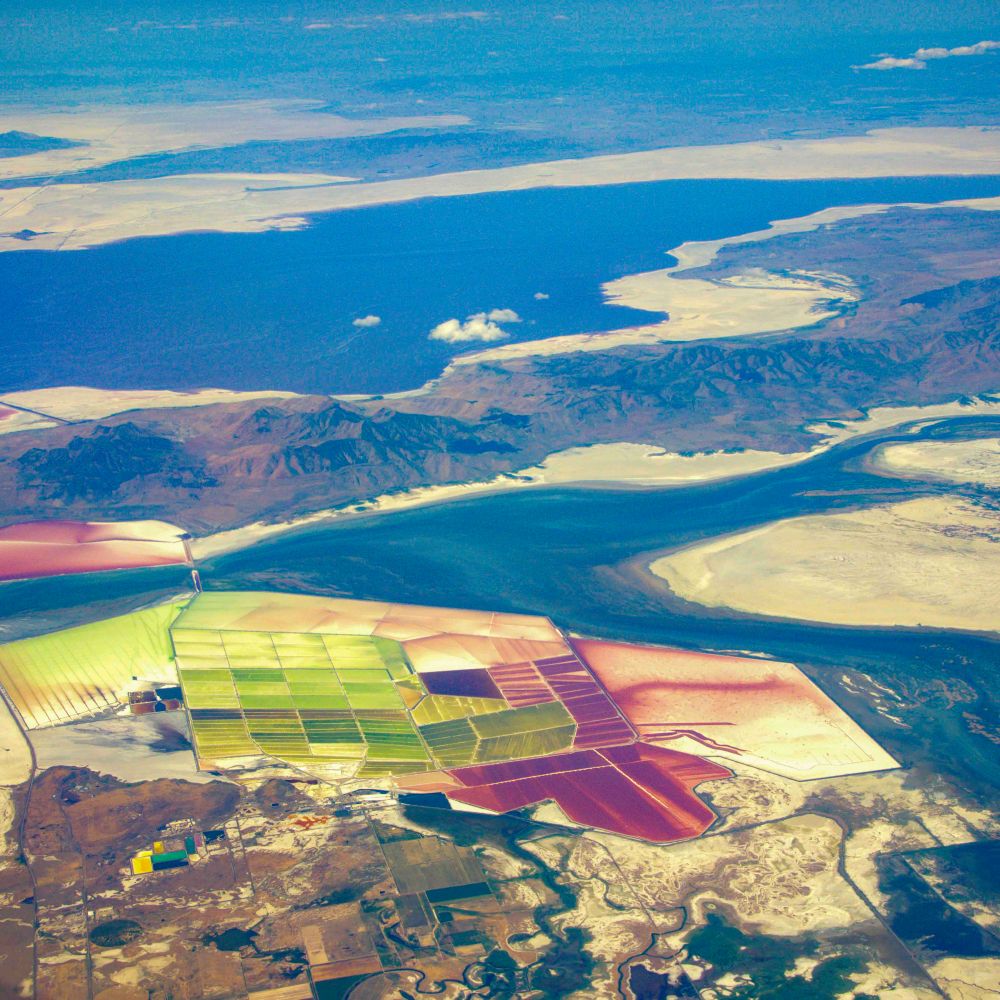
©Terry R. Thomas/www.nature-track.com
Distilling salt and other minerals from the waters of the Great Salt Lake is a $2.5 billion industry in Utah.
As they say, a billion here and a billion there and pretty soon you are talking about real money. And real money, up to ten billion dollars, is what experts estimate it will cost to recover the Great Salt Lake. Wow, that is a lot of money. Is it really worth it to save that stale old salty lake? Should we just let this final puddle of Lake Bonneville follow its predecessor into oblivion and move on?
According to a podcast on Deseret Voices that I listened to last week, not saving the lake is not an option, even if it costs more than the highest estimate. That sounds extreme, but the two experts on the podcast made quite a case for the absolutely critical need to recover the lake and soon.
This is so urgent that President Trump has pledged to ask Congress for $1 billion for GSL restoration. Utah’s Governor Cox has a lofty goal of having a recovered lake by the time the Winter Olympics return to Salt Lake City, eight years from now. The two experts doubt that recovery can be achieved by that time but believe it could be substantially on its way.
The Great Salt Lake is the bottom of a drainage basin of 22,060 square miles (23 million acres) that includes parts of Nevada, Idaho, and Wyoming as well as Utah. As a terminal lake with no outlet, it collects about 1.1 million tons of salt annually and is of course, salty. Very salty to say the least (the north end of the lake can be 25 percent salt in solution), a fact that has been known to European colonizers for several hundred years. John C. Fremont reported in his 1843-44 journal: “Today we remained at this camp, in order to obtain some further observations and to boil down the water which had been brought from workers with wheelbarrows on the salt beds (of the) Great Salt Lake, for a supply of salt. Roughly evaporated over the fire, the five gallons of water yielded fourteen pints of very fine-grained and very white salt, of which the whole lake may be regarded as a saturated solution.”
This is common salt, sodium chloride, that we use on our tables, in industrial processes, water softening, and more. Five commercial enterprises operate in the area, collectively removing about 2.3 million tons of salt annually, most of which is sodium chloride.
However, there are other chemicals that are extracted including sodium sulfate used in making glass, potassium sulfate which is used worldwide as a fertilizer, and magnesium chloride which is converted into the metal, magnesium with chlorine gas as a by-product. All in all, mineral extraction accounts for 2.5 billion dollars to the Utah economy annually and supports over 9,000 jobs.
Ecologically, the lake makes that pale in comparison. This lake is a vital stopover in the Pacific Flyway, providing for more than 10 million migrating birds. “Almost 350 bird species depend on Great Salt Lake habitats, including globally significant numbers of Eared Grebes, Tundra Swans, Snowy Plovers, American Avocets, and multiple species of ducks, phalaropes, owls, and blackbirds (Great Salt Lake Report 2023)”. Should this lake fail, some of these birds might find habitat elsewhere (that is how white-faced ibises found Market Lake near Roberts when Great Salt Lake rose and flooded Bear River Migratory Bird Refuge in the 1980’s), but habitat “elsewhere” is shrinking fast and there is not likely room in the system to absorb that many birds.
The Great Salt Lake produces another commodity, brine shrimp. Brine shrimp are fed to farmed shrimp and fish in many parts of the world and the Great Salt Lake produces nearly half of the total brine shrimp market. “Great Salt Lake’s brine shrimp is not just a regional industry, but a critical node in the global aquaculture food network, with potential ripple effects worldwide if its supply is disrupted (Utah State University, 2023).”
Finally, the Great Salt Lake is a major driver for moisture in the area, called the lake effect, including snow in the ski resorts. Loss of rain/snow would impact every segment of society from recreation to farming in a large area with trickledown impacts over a much larger landscape.
Hopefully, that makes the case for the need to preserve the Great Salt Lake. But why is the lake failing and can anything actually be done to save it? I will discuss that next time.
Help Idaho Wildlife
When we traveled across the state in October 2017, we visited most of the Idaho Department of Fish and Game wildlife management areas. Most of the vehicles we saw using the wildlife management areas did not have wildlife plates. Buying wildlife plates is a great way for non-hunters and hunters alike to support wildlife-based recreation like birding.
C'mon folks, let's help Idaho's wildlife by proudly buying and displaying a wildlife license plate on each of our vehicles!
See below for information on Idaho plates. Most states have wildlife plates so if you live outside Idaho, check with your state's wildlife department or vehicle licensing division for availability of state wildlife plates where you live.
And tell them that you heard about it from Nature-track.com!
Wildlife License Plates
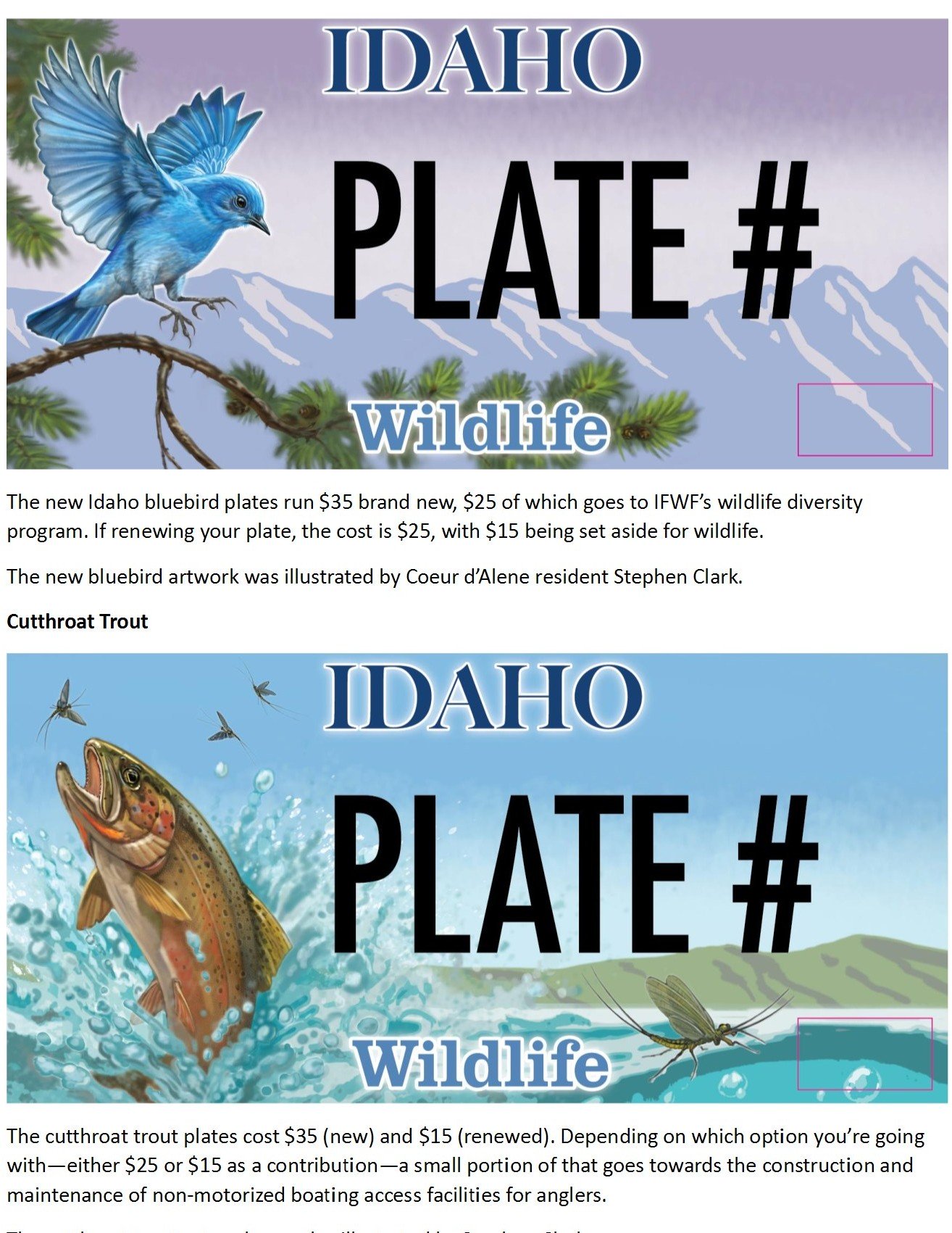
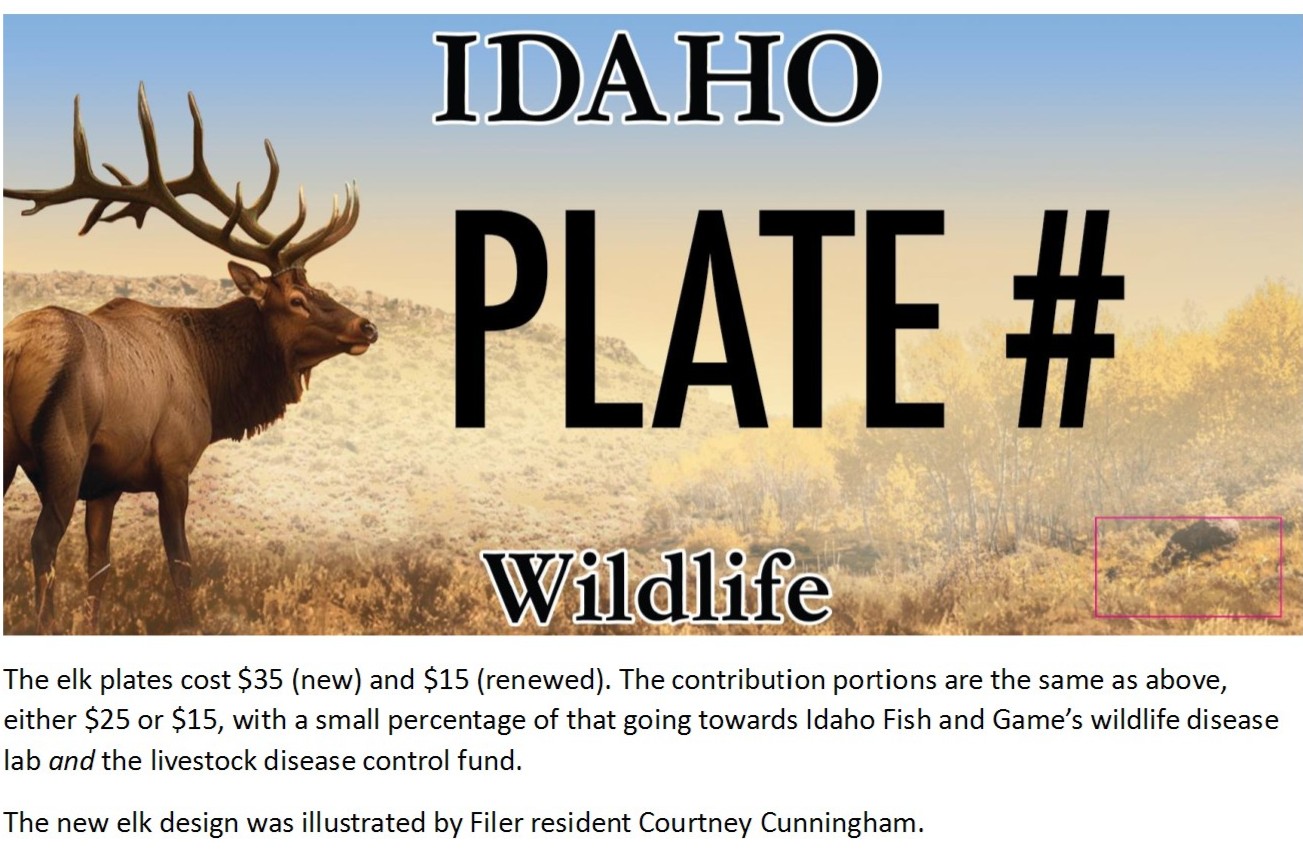
Great news! as of 2024, there are three NEW designs for license plates. They still are bluebird, cutthroat trout and elk, but they are beautiful.
Idaho Wildlife license plates provide essential funding that benefits the great diversity of native plants and wildlife that are not hunted, fished or trapped—over 10,000 species or 98% of Idaho’s species diversity. Game species that share the same habitats (such as elk, deer, antelope, sage-grouse, salmon, trout) also benefit from these specialty plates.
No state tax dollars are provided for wildlife diversity, conservation education and recreation programs. Neither are any revenues from the sale of hunting or fishing licenses spent on nongame species. Instead, these species depend on direct donations, federal grants, fundraising initiatives—and the Idaho Wildlife license plates.
Both my vehicles have Bluebird Plates. I prefer the bluebird because the nongame program gets 70 percent of the money from bluebird plates, but only 60 percent of the money from elk and trout plates - 10 percent of the money from elk plates supports wildlife disease monitoring and testing programs (to benefit the livestock industry) and 10 percent from cutthroat plates supports non-motorized boat access.
Incidentally, in 2014, the Idaho Legislature denied the Department of Fish and Game the ability to add new plates or even to change the name of the elk and cutthroat plates (very specific) to wildlife and fish plates, a move that would have allowed for changing images occasionally and generating more revenue. It would seem that they believe that we Idahoans don't want a well funded wildlife program.
I think it is time we let the Legislature know that Idahoan support wildlife funding and that we would like to see these generic plates come to fruition.
"WOW. What a phenomenal piece you wrote. You are amazing." Jennifer Jackson
That is embarrassing, but actually a fairly typical response to my nature essays. Since The Best of Nature is created from the very best of 16 years of these nature essays published weekly in the Idaho Falls Post Register (online readership 70,000), it is a fine read. It covers a wide variety of topics including humorous glimpses of nature, philosophy, natural history, and conservation. Readers praise the style, breadth of subject matter and my ability to communicate complex and emotional topics in a relaxed and understandable manner.
Everyone can find something to love in this book. From teenagers to octogenarians, from the coffee shop to the school room, these nature essays are widely read and enjoyed.
Some of the essays here are my personal favorites, others seemed to strike a chord with readers. Most have an important message or lesson that will resonate with you. They are written with a goal to simultaneously entertain and educate about the wonderful workings of nature. Some will make you laugh out loud and others will bring a tear to the eye and warm your heart.
Readers Write:
"You hit a home run with your article on, Big Questions in Nature. It should be required reading for everyone who has lost touch with nature...great job!" Joe Chapman
"We enjoyed your column, Bloom Where Planted. Some of the best writing yet. The Post Register is fortunate to have your weekly columns." Lou Griffin.
To read more and to order a copy, click here or get the Kindle version
Copies are also available at:
Post Register
Island Park Builders Supply (upstairs)
Barnes and Noble in Idaho Falls
Harriman State Park, Island Park
Museum of Idaho
Valley Books, Jackson Wyoming
Avocet Corner Bookstore, Bear River National Wildlife Refuge, Brigham City, Utah
Craters of the Moon National Monument Bookstore, Arco, Idaho