Chronic Wasting Disease
©Terry R. Thomas/www.nature-track.com
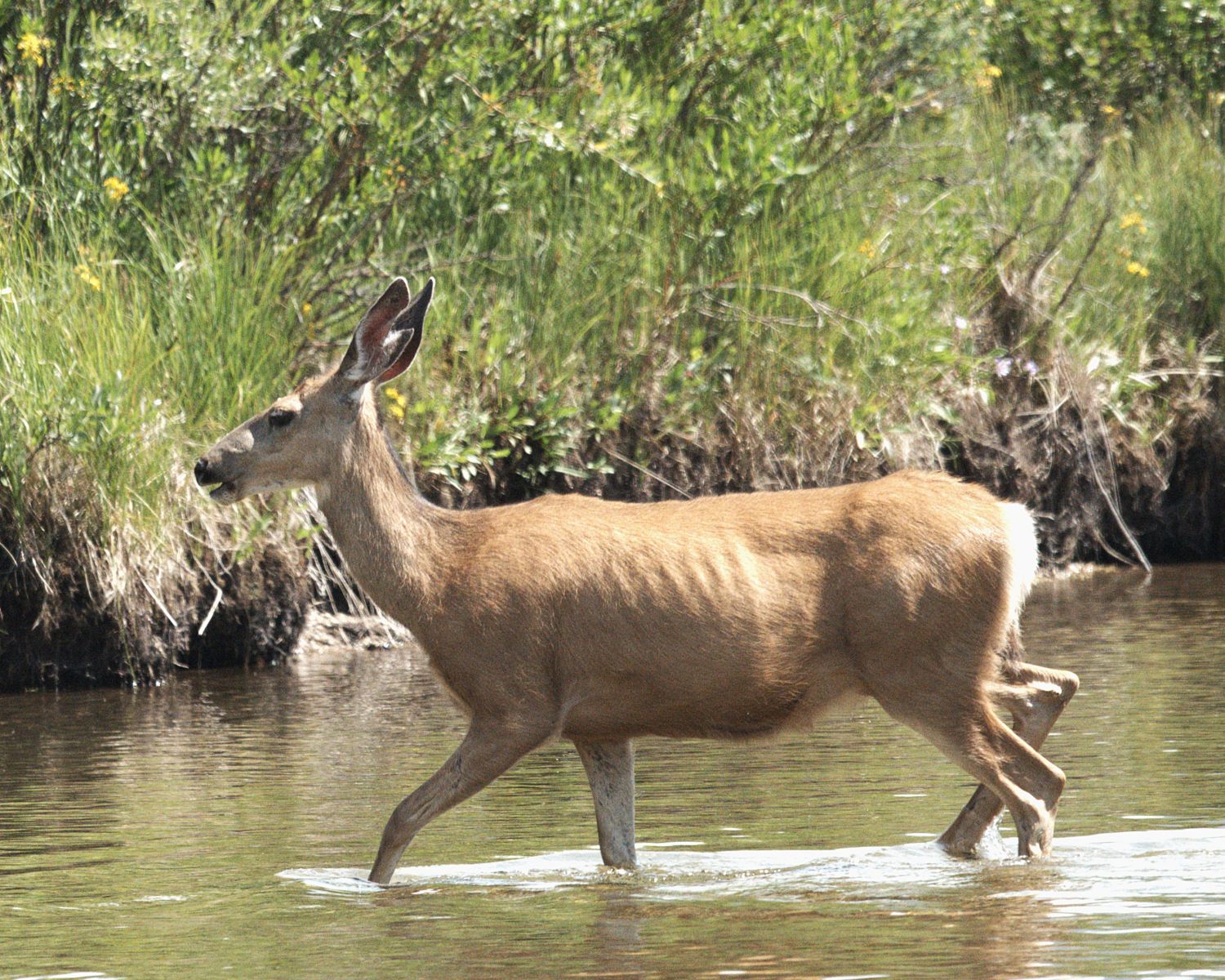
Not all skinny deer have chronic wasting disease, but all deer with CWD eventually become emaciated, hence the name, chronic wasting.
Some social media circles are abuzz with complaints about how state and federal agencies are handling incidents of chronic wasting disease (CWD). A few vociferous sportsmen are wondering if CWD is really that big of a deal. Many are outraged when large areas are depopulated of deer because of the disease, believing that the efforts are heavy-handed or even draconian. Why, they wonder, can’t sportsmen harvest those animals? After all, there have been no incidents of CWD crossing over to a human so the danger to us is minimal they reason.
I’ve been out of active wildlife management for awhile now, so I wondered if I was missing something. Had research on CWD indicated that it wasn’t as dangerous and deadly as once thought? I needed to study this a bit more.
Chronic Wasting Disease is not caused by a bacterial or viral or even fungal infection. It is not an infestation of nematodes like brainworm nor is it any other type of parasite. This disease is caused by a misfolded protein called a prion. It affects mainly members of the Cervidae family which includes deer, elk, moose, and caribou. It is spread through contact with bodily fluids and seems to have a substantial half-life in the soil. As a disease, it plays a long game where symptoms may not appear for several years after infection allowing affected animals to infect others. Once symptoms start though, it is untreatable and fatal.
In the United States, CWD was first detected in a mule deer in 1967 in Colorado. Since that time, it has steadily expanded its range and now 32 states, three European countries, Canada, and South Korea have all reported CWD. Much of this has occurred in private herds. For instance, in Texas, 87 percent of all reported CWD cases were from captive animals. Some may argue that we are seeing more cases of CWD because everyone is now looking for it. That is really not the case though. In Idaho, monitoring for CWD occurred for years before the first case was detected, indicating that the disease was not present in the past but now it is.
So, rather than having a lessening impact, CWD has become a far worse problem than it was 30, 20, or 10 years ago and some states have had to resort to depopulation of deer from large areas to stop the spread of the disease. That is because CWD has the potential to cause long-term population declines or even extirpation. So, a short-term removal of a population is actually a forward-thinking strategy to preserve deer, elk, and moose long-term. It is unfortunate that armchair biologists don’t get that.
As for CWD not affecting people, here is what the Centers for Disease Control (CDC) have to say:
“Though there have been no cases of CWD in people, experts think it may be possible because CWD is related to BSE, which has caused disease in people. If CWD could spread to people, hunters and people who eat meat from CWD-infected animals would likely be most at risk.”
You might remember that BSE stands for Bovine Spongiform Encephalopathy, a.k.a., mad cow disease, the same disease that caused the slaughter and incineration of 4.5 million cattle in the United Kingdom in the late 1980s and early 1990s. A variant of this “cow” disease killed 178 people who ate infected meat in the same time period. Who is to say that a variant of CWD isn’t already out there, just waiting for someone to consume it?
It seems to me that the critics who are saying that since it hasn’t happened it cannot happen are wildly short-sighted. Agencies that manage wildlife cannot have so cavalier an attitude toward a potential human disease. And we should remember that CWD can take years to manifest itself, so there could be hundreds or even thousands of dormant cases already. We just don’t know and that requires extra caution.
So, my take is that CWD is still one of the most serious threats to our deer, elk, and moose herds. Sometimes control efforts are going to be painful and may seem “wasteful”, but in the long run, doing whatever it takes to stop the spread of this disease will be worth the cost. Sportsmen need to recognize that effective management is the highest priority.
Help Idaho Wildlife
When we traveled across the state in October 2017, we visited most of the Idaho Department of Fish and Game wildlife management areas. Most of the vehicles we saw using the wildlife management areas did not have wildlife plates. Buying wildlife plates is a great way for non-hunters and hunters alike to support wildlife-based recreation like birding.
C'mon folks, let's help Idaho's wildlife by proudly buying and displaying a wildlife license plate on each of our vehicles!
See below for information on Idaho plates. Most states have wildlife plates so if you live outside Idaho, check with your state's wildlife department or vehicle licensing division for availability of state wildlife plates where you live.
And tell them that you heard about it from Nature-track.com!
Wildlife License Plates
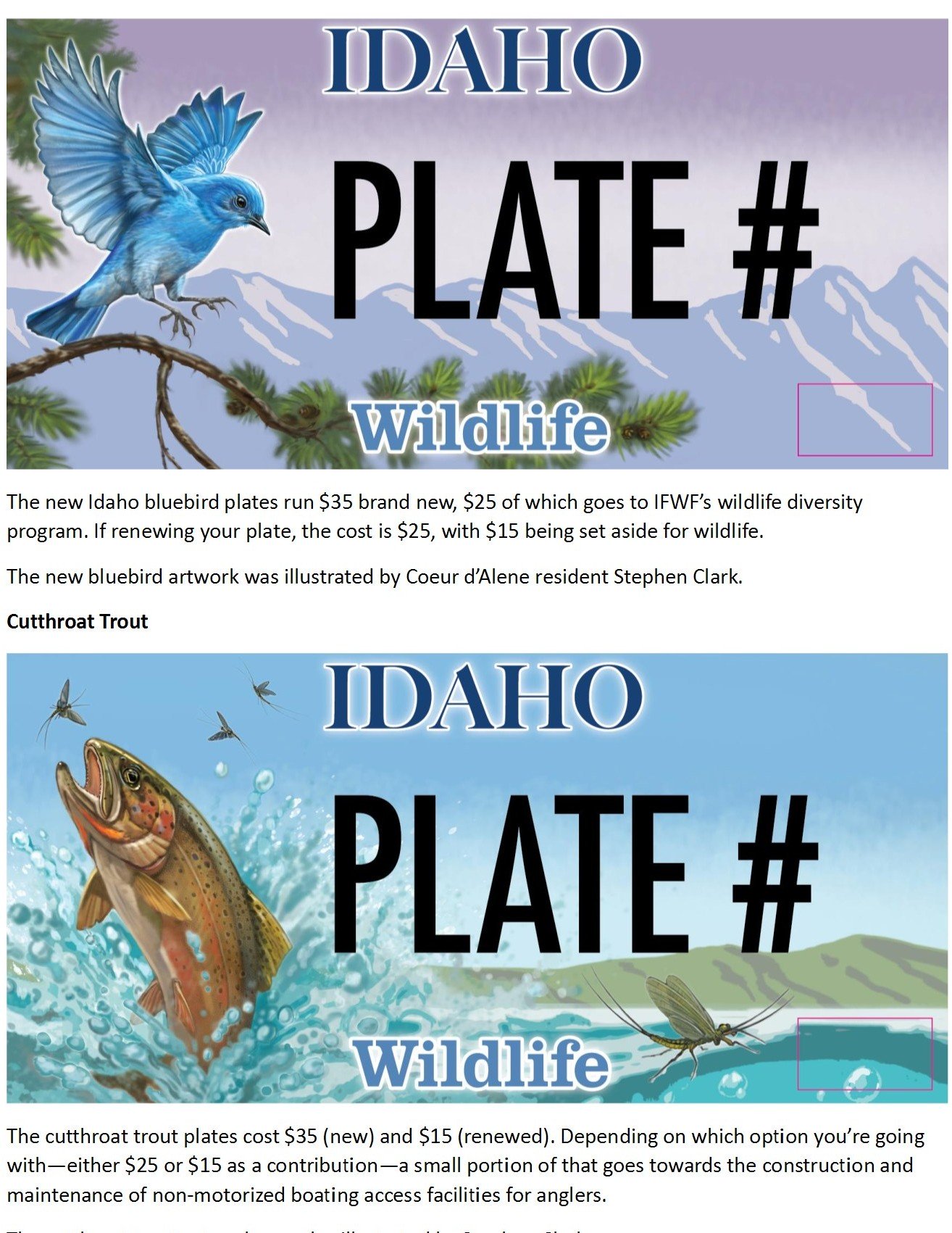
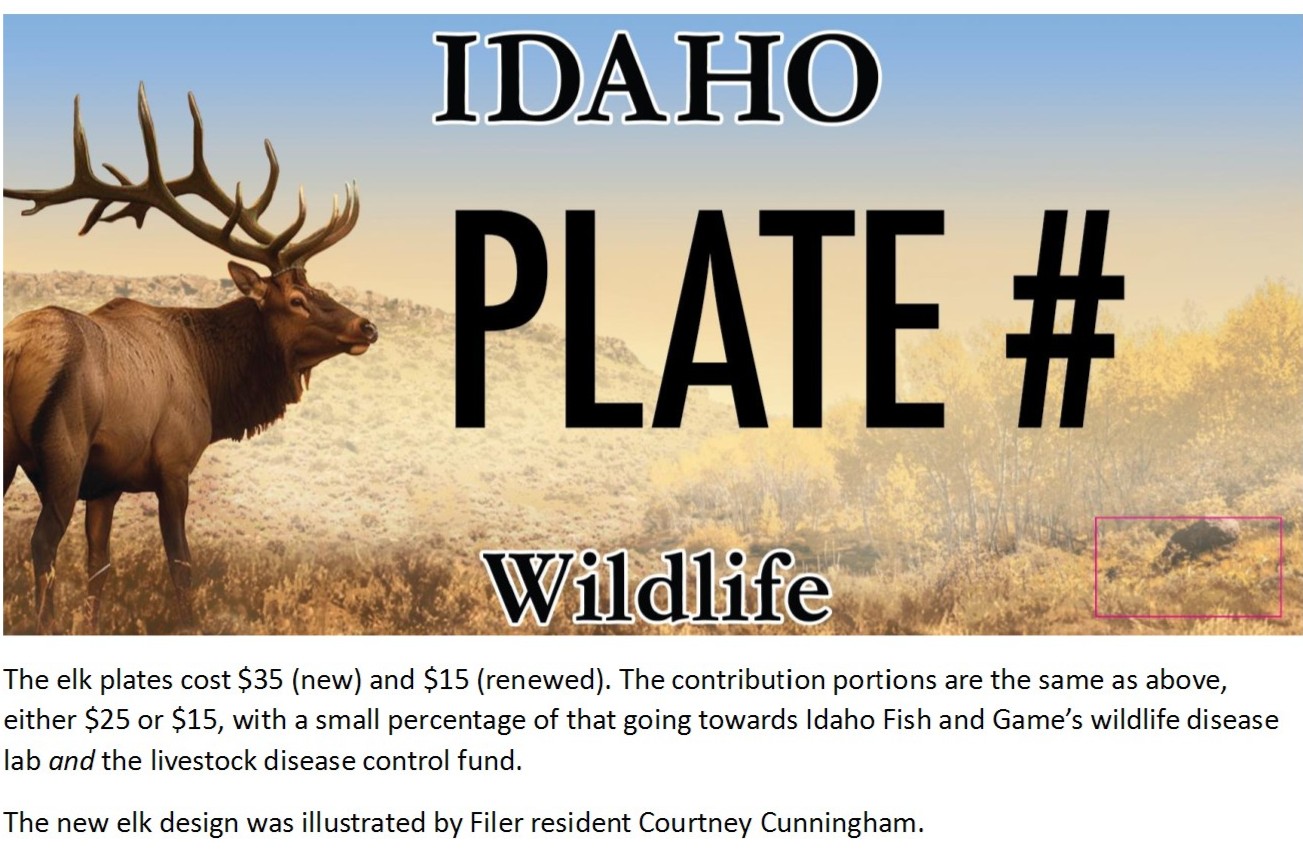
Great news! as of 2024, there are three NEW designs for license plates. They still are bluebird, cutthroat trout and elk, but they are beautiful.
Idaho Wildlife license plates provide essential funding that benefits the great diversity of native plants and wildlife that are not hunted, fished or trapped—over 10,000 species or 98% of Idaho’s species diversity. Game species that share the same habitats (such as elk, deer, antelope, sage-grouse, salmon, trout) also benefit from these specialty plates.
No state tax dollars are provided for wildlife diversity, conservation education and recreation programs. Neither are any revenues from the sale of hunting or fishing licenses spent on nongame species. Instead, these species depend on direct donations, federal grants, fundraising initiatives—and the Idaho Wildlife license plates.
Both my vehicles have Bluebird Plates. I prefer the bluebird because the nongame program gets 70 percent of the money from bluebird plates, but only 60 percent of the money from elk and trout plates - 10 percent of the money from elk plates supports wildlife disease monitoring and testing programs (to benefit the livestock industry) and 10 percent from cutthroat plates supports non-motorized boat access.
Incidentally, in 2014, the Idaho Legislature denied the Department of Fish and Game the ability to add new plates or even to change the name of the elk and cutthroat plates (very specific) to wildlife and fish plates, a move that would have allowed for changing images occasionally and generating more revenue. It would seem that they believe that we Idahoans don't want a well funded wildlife program.
I think it is time we let the Legislature know that Idahoan support wildlife funding and that we would like to see these generic plates come to fruition.
"WOW. What a phenomenal piece you wrote. You are amazing." Jennifer Jackson
That is embarrassing, but actually a fairly typical response to my nature essays. Since The Best of Nature is created from the very best of 16 years of these nature essays published weekly in the Idaho Falls Post Register (online readership 70,000), it is a fine read. It covers a wide variety of topics including humorous glimpses of nature, philosophy, natural history, and conservation. Readers praise the style, breadth of subject matter and my ability to communicate complex and emotional topics in a relaxed and understandable manner.
Everyone can find something to love in this book. From teenagers to octogenarians, from the coffee shop to the school room, these nature essays are widely read and enjoyed.
Some of the essays here are my personal favorites, others seemed to strike a chord with readers. Most have an important message or lesson that will resonate with you. They are written with a goal to simultaneously entertain and educate about the wonderful workings of nature. Some will make you laugh out loud and others will bring a tear to the eye and warm your heart.
Readers Write:
"You hit a home run with your article on, Big Questions in Nature. It should be required reading for everyone who has lost touch with nature...great job!" Joe Chapman
"We enjoyed your column, Bloom Where Planted. Some of the best writing yet. The Post Register is fortunate to have your weekly columns." Lou Griffin.
To read more and to order a copy, click here or get the Kindle version
Copies are also available at:
Post Register
Island Park Builders Supply (upstairs)
Barnes and Noble in Idaho Falls
Harriman State Park, Island Park
Museum of Idaho
Valley Books, Jackson Wyoming
Avocet Corner Bookstore, Bear River National Wildlife Refuge, Brigham City, Utah
Craters of the Moon National Monument Bookstore, Arco, Idaho