Carbon Monoxide
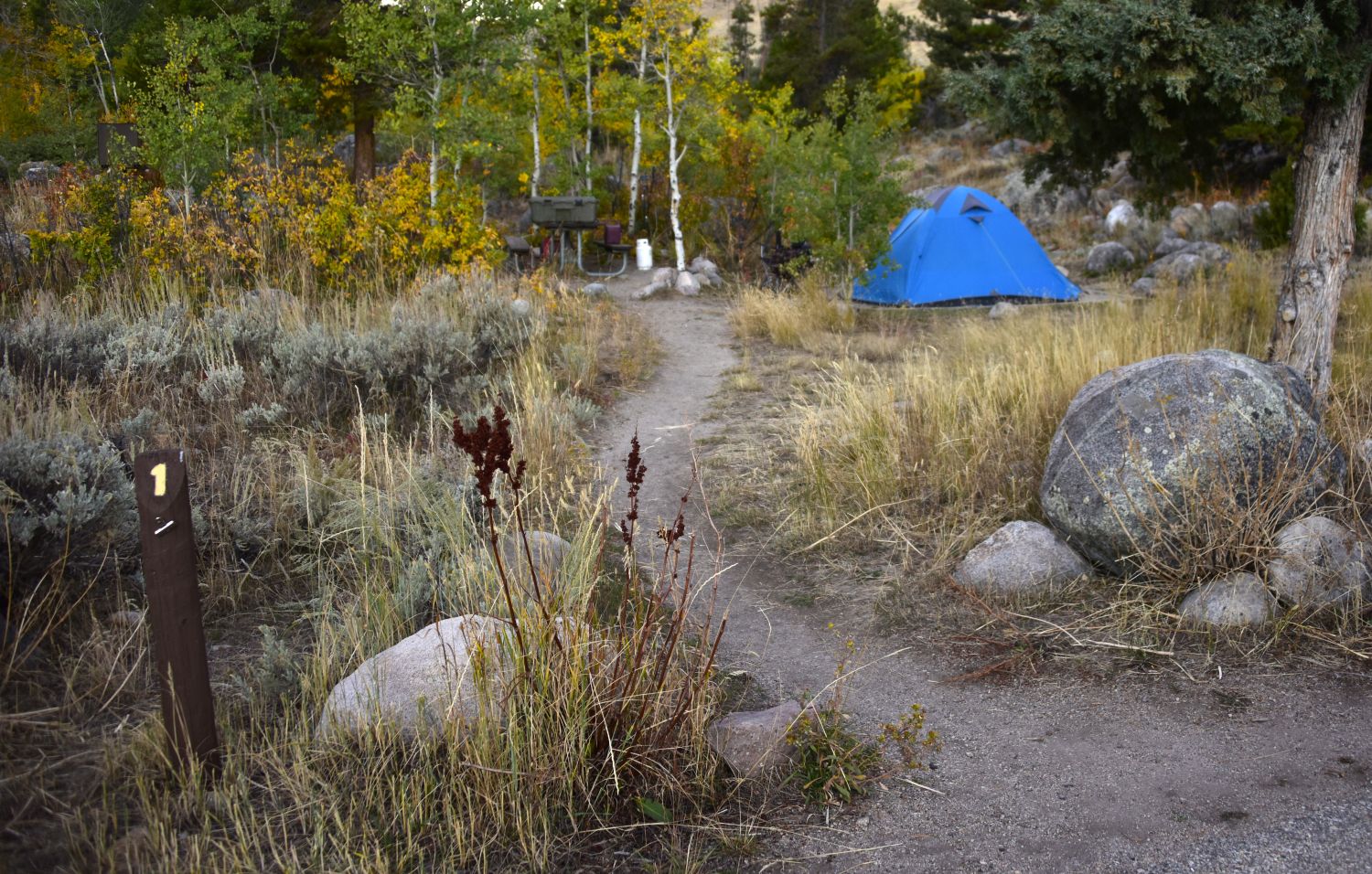
©Terry R. Thomas/www.nature-track.com
Could this tent turn into a killing ground? It could if we don’t exercise caution when using carbon-based fuels.
One of the saddest events of my life occurred almost 50 years ago. Two young brothers, both former members of my Sunday School class, decided to go deer hunting in the snowy mountains of Utah. As I heard the story, when they did not return on schedule, their father went up to the cabin where they were staying. He found both sons dead, one in bed and the other on the floor near the door as if he were trying to reach it. In the middle of the cabin sat the charcoal barbeque with the cold ash of a bag of charcoal in it. Both boys had died of carbon monoxide (CO) poisoning, a tragic lesson that has stayed with me through the years.
You might be saying, yeah, but that was 50 years ago. That does not happen these days. Not so. According to the Centers for Disease Control (CDC), carbon monoxide is “a leading cause of unintentional poisoning deaths in the United State[TT1]s.” Consider these four stories from 2025:
Great Britain: The initial cause of death for a couple found dead in a campervan following a cider festival in the New Forest has been given as carbon monoxide toxicity, a coroner has said.
Alberta, Canada: Two men found dead Saturday inside an ice fishing tent on Crow Lake in northern Alberta likely perished from carbon monoxide poisoning, say Boyle RCMP.
Saudi Arabia: A Saudi couple was found dead inside their tent after succumbing to carbon monoxide poisoning from burning charcoal used for warmth.
Scotland: A couple found dead in their tent on the banks of a loch are believed to have died from carbon monoxide poisoning.
These are just a few examples, all connected to the outdoors. There are many other heart-breaking stories from hotel rooms, apartments, remodels, trailer homes, and more across the world. The CDC estimates that in the United States alone, there are 100,000 emergency room visits and 14,000 hospitalizations due to carbon monoxide poisoning each year and the number of unintentional deaths steadily increased from 2014 to 2022. Causes? Again, according to the CDC (2007), “heating systems were associated with the largest percentage of non-fire CO poisoning fatalities at 38 percent (estimated 70 deaths); Engine-Driven Tools-related CO fatalities were also associated with 38 percent (69 deaths), and the remaining six product categories [Charcoal Grills or Charcoal (7 deaths); Ranges, Ovens (7 deaths); Water Heaters (3 deaths); Grills, Camp Stoves (3 deaths); Other Products (1 death); and Multiple Products (24 deaths)] combined were associated with a total of 25 percent.”
This is the time of year when most (84 percent) carbon monoxide incidents occur. People are using generators, charcoal, camp stoves and more in an attempt to keep warm, not recognizing the danger. However, carbon monoxide poisoning can occur any time of year. A friend once told me of renting a houseboat on Lake Powell. The small gas generator was located outside the living area, but underneath an overhanging canopy. He was quick to act when he saw his son, who was standing under the overhang, lose consciousness and nearly fall off the moving boat, a near victim of CO poisoning.
Make no mistake, carbon monoxide is a killer and can strike in unlikely places. Using unapproved devices for heat is likely the biggest threat during outdoor activities, but our homes can be at risk too. How to fight back against this monster next time.
Help Idaho Wildlife
When we traveled across the state in October 2017, we visited most of the Idaho Department of Fish and Game wildlife management areas. Most of the vehicles we saw using the wildlife management areas did not have wildlife plates. Buying wildlife plates is a great way for non-hunters and hunters alike to support wildlife-based recreation like birding.
C'mon folks, let's help Idaho's wildlife by proudly buying and displaying a wildlife license plate on each of our vehicles!
See below for information on Idaho plates. Most states have wildlife plates so if you live outside Idaho, check with your state's wildlife department or vehicle licensing division for availability of state wildlife plates where you live.
And tell them that you heard about it from Nature-track.com!
Wildlife License Plates
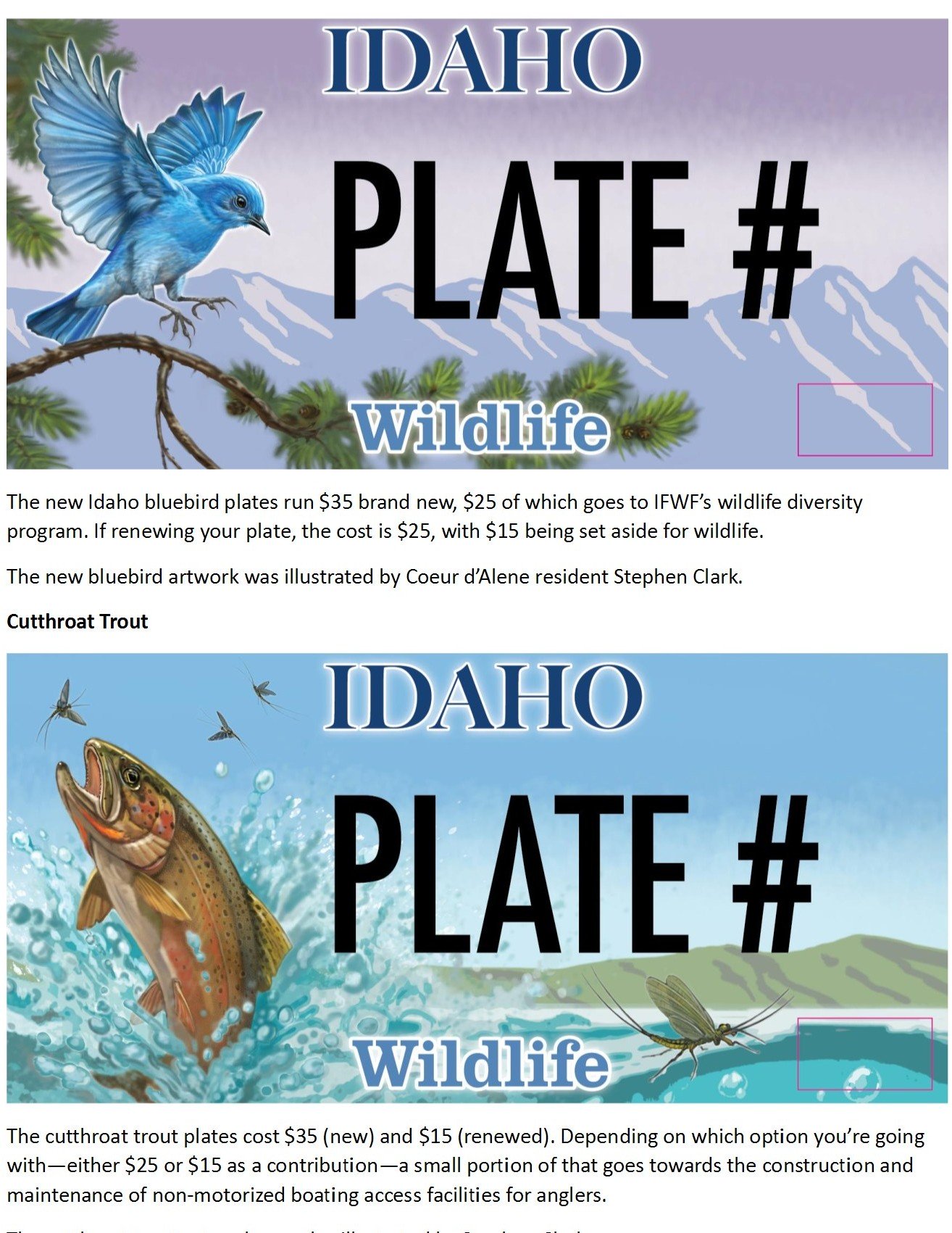
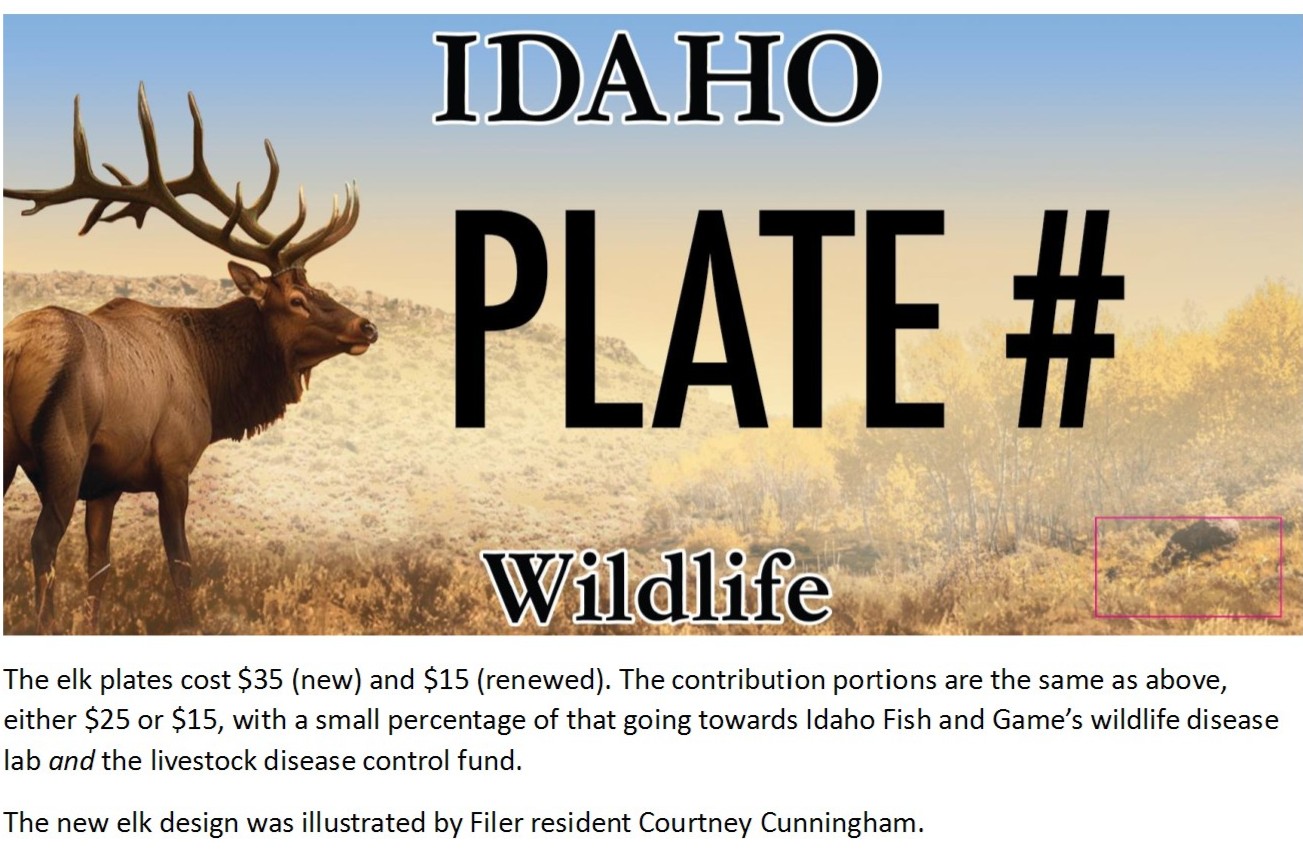
Great news! as of 2024, there are three NEW designs for license plates. They still are bluebird, cutthroat trout and elk, but they are beautiful.
Idaho Wildlife license plates provide essential funding that benefits the great diversity of native plants and wildlife that are not hunted, fished or trapped—over 10,000 species or 98% of Idaho’s species diversity. Game species that share the same habitats (such as elk, deer, antelope, sage-grouse, salmon, trout) also benefit from these specialty plates.
No state tax dollars are provided for wildlife diversity, conservation education and recreation programs. Neither are any revenues from the sale of hunting or fishing licenses spent on nongame species. Instead, these species depend on direct donations, federal grants, fundraising initiatives—and the Idaho Wildlife license plates.
Both my vehicles have Bluebird Plates. I prefer the bluebird because the nongame program gets 70 percent of the money from bluebird plates, but only 60 percent of the money from elk and trout plates - 10 percent of the money from elk plates supports wildlife disease monitoring and testing programs (to benefit the livestock industry) and 10 percent from cutthroat plates supports non-motorized boat access.
Incidentally, in 2014, the Idaho Legislature denied the Department of Fish and Game the ability to add new plates or even to change the name of the elk and cutthroat plates (very specific) to wildlife and fish plates, a move that would have allowed for changing images occasionally and generating more revenue. It would seem that they believe that we Idahoans don't want a well funded wildlife program.
I think it is time we let the Legislature know that Idahoan support wildlife funding and that we would like to see these generic plates come to fruition.
"WOW. What a phenomenal piece you wrote. You are amazing." Jennifer Jackson
That is embarrassing, but actually a fairly typical response to my nature essays. Since The Best of Nature is created from the very best of 16 years of these nature essays published weekly in the Idaho Falls Post Register (online readership 70,000), it is a fine read. It covers a wide variety of topics including humorous glimpses of nature, philosophy, natural history, and conservation. Readers praise the style, breadth of subject matter and my ability to communicate complex and emotional topics in a relaxed and understandable manner.
Everyone can find something to love in this book. From teenagers to octogenarians, from the coffee shop to the school room, these nature essays are widely read and enjoyed.
Some of the essays here are my personal favorites, others seemed to strike a chord with readers. Most have an important message or lesson that will resonate with you. They are written with a goal to simultaneously entertain and educate about the wonderful workings of nature. Some will make you laugh out loud and others will bring a tear to the eye and warm your heart.
Readers Write:
"You hit a home run with your article on, Big Questions in Nature. It should be required reading for everyone who has lost touch with nature...great job!" Joe Chapman
"We enjoyed your column, Bloom Where Planted. Some of the best writing yet. The Post Register is fortunate to have your weekly columns." Lou Griffin.
To read more and to order a copy, click here or get the Kindle version
Copies are also available at:
Post Register
Island Park Builders Supply (upstairs)
Barnes and Noble in Idaho Falls
Harriman State Park, Island Park
Museum of Idaho
Valley Books, Jackson Wyoming
Avocet Corner Bookstore, Bear River National Wildlife Refuge, Brigham City, Utah
Craters of the Moon National Monument Bookstore, Arco, Idaho