Symbiotic Relationships
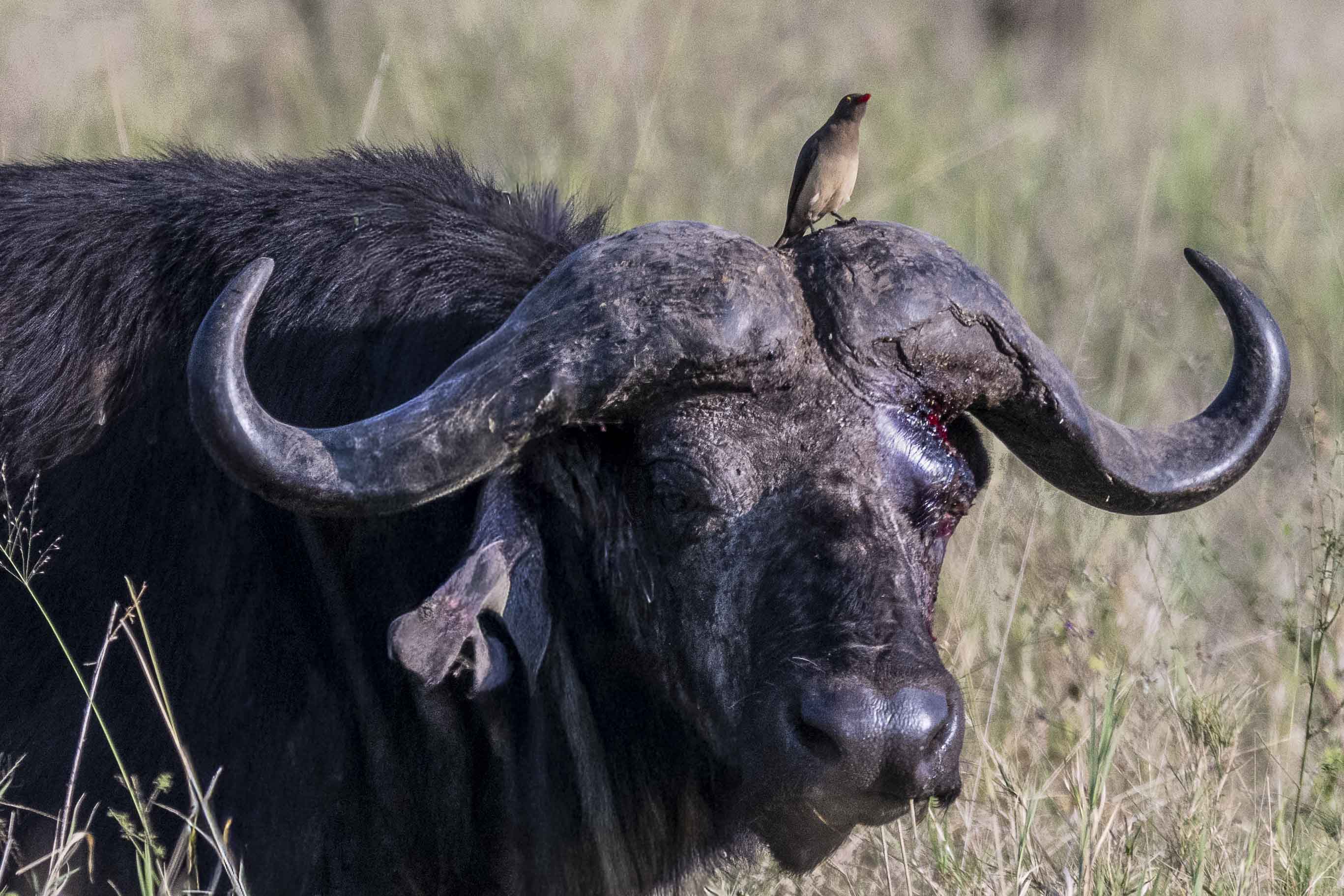
©Terry R. Thomas/www.nature-track.com
Oxpeckers catch free rides on the backs of large African animals. They glean insects and ticks from their temporary steeds. Is this an example of commensalism or mutualism?
In Tanzania, we watched on many occasions when small flocks of red-billed birds descended upon the backs of giraffes, cape buffalo, elephants, and hippopotamuses, prancing around like they owned them. These birds, called oxpeckers, were hunting for insects, ticks, and other invertebrates that were trying to make a living on the backs of these huge mammals as well.
It seemed like a perfect example of mutualism, a form of symbiosis (the living together in more or less intimate [and long-term] association or close union of two dissimilar organisms, as in parasitism or commensalism. Merriam-Webster Dictionary), but most references I checked called it commensalism. We learned both terms in high school biology, but now I was confused. What was the difference? What other forms of symbiosis are there?
Commensalism is a Latin word meaning, ‘to eat at the same table.’ In biology this refers to a close relationship between two different species where one species, known as the commensal species, extracts a resource/fitness benefit from the other species without harming or benefitting it.
If both species benefit from the interaction, then it is considered mutualism. And that is where I was getting confused. I would suggest that both the oxpeckers and the African mega-fauna benefitted. The oxpeckers got to eat and the mammals were divested of annoying and potentially dangerous arthropods. This is quite different from another common example of commensalism where a cattle egret uses the back of an animal as a perch from which to hunt critters on the ground. This one clearly benefits the egret without benefitting or harming the perched upon animal. Maybe the critters the oxpeckers eat are no big deal to the mega mammals so it is not a benefit to remove them.
Some references state that the relationship woodpeckers have with trees is commensal. I would disagree. When things poke holes into trees, they open avenues of infection, and the trees respond by filling the holes with sap. If a woodpecker makes a nest in a tree (a quite large hole), inner decay can start from that point. That seems clearly detrimental to the tree, an example of parasitism—one species benefits and the other is harmed.
Perhaps a better example of commensalism, and one often used in reference materials, is a bird nesting on a tree. The bird gets the benefit of protection from the tree without significantly harming the tree. If trees could talk, they might tell you that having bird nests most commonly is no big deal, not changing their ability to survive for the good or the bad. There is a key word here, though, and that is significantly. There may be a slight impact, but it may not be measurable—unless the nest is that of a bald eagle and finally weighs enough to break off a branch under a ton or more of weight.
Barnacles, immovable crustaceans, attach themselves to whales, gaining access to nutrient rich waters as the whale moves around yet do not seem to affect the whales, clearly commensalism. However, we know that barnacles on ship hulls can amplify drag and significantly increase energy costs. Would not the same be true for whales? Perhaps this is a matter of scale—a few barnacles may not interfere, but lots of barnacles could, changing the relationship from commensal to parasitic.
This symbiosis stuff is not as clear cut as we were taught. As one reference stated, “interactions between mutualism, commensalism, and parasitism are not as neatly delineated as the textbooks might suggest…in practice commensals are indistinguishable from parasites that cause their host comparatively low levels of pathology and mutualists that exert such a heavy price for their service that it is barely compensated by the benefits of the association.” So, when do mosquitoes and ticks cross the line from being inconsequential irritations (commensalism) to becoming dangerous parasites? Is one barnacle on a whale commensal, but a thousand are parasitic? Where is the line between the two? When does an impact move from negligible to significant, and how do we measure that?
We all learned these things in high school biology, but we were taught simplified versions, as if biology were a cookie cutter science. The deeper we peer into scientific processes the more complex relationships become.
Help Idaho Wildlife
When we traveled across the state in October 2017, we visited most of the Idaho Department of Fish and Game wildlife management areas. Most of the vehicles we saw using the wildlife management areas did not have wildlife plates. Buying wildlife plates is a great way for non-hunters and hunters alike to support wildlife-based recreation like birding.
C'mon folks, let's help Idaho's wildlife by proudly buying and displaying a wildlife license plate on each of our vehicles!
See below for information on Idaho plates. Most states have wildlife plates so if you live outside Idaho, check with your state's wildlife department or vehicle licensing division for availability of state wildlife plates where you live.
And tell them that you heard about it from Nature-track.com!
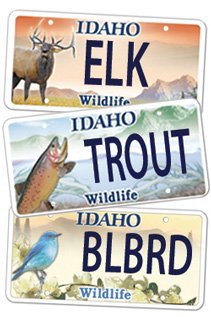
Wildlife License Plates
Great news! as of 2024, there are three NEW designs for license plates. They still are bluebird, cutthroat trout and elk, but they are beautiful.
Idaho Wildlife license plates provide essential funding that benefits the great diversity of native plants and wildlife that are not hunted, fished or trapped—over 10,000 species or 98% of Idaho’s species diversity. Game species that share the same habitats (such as elk, deer, antelope, sage-grouse, salmon, trout) also benefit from these specialty plates.
No state tax dollars are provided for wildlife diversity, conservation education and recreation programs. Neither are any revenues from the sale of hunting or fishing licenses spent on nongame species. Instead, these species depend on direct donations, federal grants, fundraising initiatives—and the Idaho Wildlife license plates.
Both my vehicles have Bluebird Plates. I prefer the bluebird because the nongame program gets 70 percent of the money from bluebird plates, but only 60 percent of the money from elk and trout plates - 10 percent of the money from elk plates supports wildlife disease monitoring and testing programs (to benefit the livestock industry) and 10 percent from cutthroat plates supports non-motorized boat access.
Incidentally, in 2014, the Idaho Legislature denied the Department of Fish and Game the ability to add new plates or even to change the name of the elk and cutthroat plates (very specific) to wildlife and fish plates, a move that would have allowed for changing images occasionally and generating more revenue. It would seem that they believe that we Idahoans don't want a well funded wildlife program.
I think it is time we let the Legislature know that Idahoan support wildlife funding and that we would like to see these generic plates come to fruition.
"WOW. What a phenomenal piece you wrote. You are amazing." Jennifer Jackson
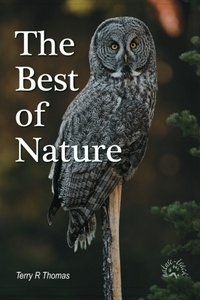
That is embarrassing, but actually a fairly typical response to my nature essays. Since The Best of Nature is created from the very best of 16 years of these nature essays published weekly in the Idaho Falls Post Register (online readership 70,000), it is a fine read. It covers a wide variety of topics including humorous glimpses of nature, philosophy, natural history, and conservation. Readers praise the style, breadth of subject matter and my ability to communicate complex and emotional topics in a relaxed and understandable manner.
Everyone can find something to love in this book. From teenagers to octogenarians, from the coffee shop to the school room, these nature essays are widely read and enjoyed.
Some of the essays here are my personal favorites, others seemed to strike a chord with readers. Most have an important message or lesson that will resonate with you. They are written with a goal to simultaneously entertain and educate about the wonderful workings of nature. Some will make you laugh out loud and others will bring a tear to the eye and warm your heart.
Readers Write:
"You hit a home run with your article on, Big Questions in Nature. It should be required reading for everyone who has lost touch with nature...great job!" Joe Chapman
"We enjoyed your column, Bloom Where Planted. Some of the best writing yet. The Post Register is fortunate to have your weekly columns." Lou Griffin.
To read more and to order a copy, click here or get the Kindle version
Copies are also available at:
Post Register
Island Park Builders Supply (upstairs)
Barnes and Noble in Idaho Falls
Harriman State Park, Island Park
Museum of Idaho
Valley Books, Jackson Wyoming
Avocet Corner Bookstore, Bear River National Wildlife Refuge, Brigham City, Utah
Craters of the Moon National Monument Bookstore, Arco, Idaho