Mutualism
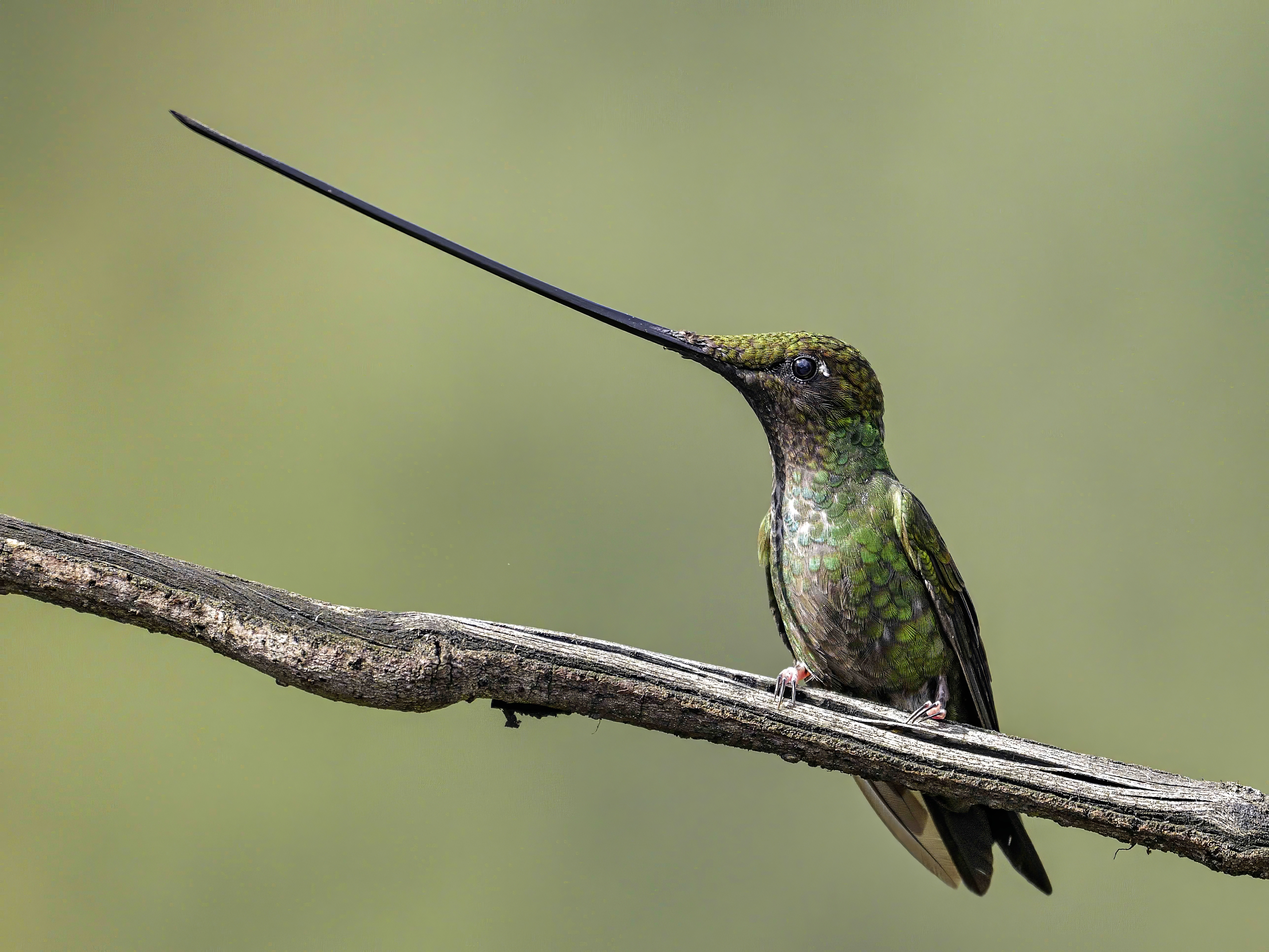
©Terry R. Thomas/www.nature-track.com
This sword-billed hummingbird lives in the Andes mountains and co-evolved with a particular plant. Both need each other to survive.
Of the symbiotic relationships, mutualism, where both species benefit from the relationship, is the most exciting form. How two disparate species can form a cooperative where both benefit, seems like the pinnacle of evolution. Pollinators and plants are perhaps the best and most classic example. Not only is this relationship, where the pollinator gets a nectar reward for distributing the plant’s pollen, a benefit to both to be sure, but to the rest of the world’s inhabitants as well. According to the USDA, “Three-fourths of the world’s flowering plants and about 35 percent of the world’s food crops depend on animal pollinators to reproduce. That is one out of every three bites of food you eat.” That is pretty dang significant.
Another huge example is the relationship between fungi and plants. “Mycorrhizal fungi attach to the plant’s roots and provide it with nutrients such as phosphorus and nitrogen to help them grow. In return, the plant provides the fungi with a source of carbohydrates.” Eighty percent of the world’s plants have this relationship with a variety of fungi and it strengthens the plants and their productivity. Trying to re-introduce mycorrhizal fungi to soils that have lost them due to intensive farming or other reasons is a big business.
Something to remember about symbiotic relationships such as mutualism, is that the relationship must be long-term and somewhat obligate, part of the particular animal or plant’s survival strategy or at least helpful. Also, symbiosis occurs between different species. Within a species, say a colony of meerkats, any beneficial interactions are called cooperation. The same might be true for activities such as cooperative hunting where badgers and coyotes team up. Both can benefit, but the interaction isn’t obligatory or long-term.
So, with this idea in mind, not all pollinator-plant interactions are examples of mutualism. If plants can easily be pollinated by the wind for example, pollinators may just be an additional source of pollination, not necessarily required for its success. However, there are pollinator relationships that are extreme. For instance, the sword-billed hummingbird and the passionflower, Passiflora mixta, co-evolved together, each driving the other’s extremism. It is difficult for any other insect or bird to pollinate this deep-tubed flower, yet the sword-bill, pictured above, has an exceptionally long bill (compared to body size it is the longest bill in the bird world) that is exactly the right length for just this purpose. The swordbill must feed on other long tubular flowers as the passionflower isn’t always blooming, but the passionflower really depends upon the sword-bill.
There are many examples of totally obligate mutualism. For instance, intestinal flagellated protozoans and termites exhibit a strict interdependency. The termites ingest wood, but the protozoans digest it. Neither partner can survive under natural conditions without the other. Within the gut of most animals there are actual ecosystems, sometimes compared to busy cities, of microbes, bacteria, archaea, and fungi that depend not just upon the host to provide the nutrients, but also upon each other. In return, they help digest difficult foods, supply amino acids and vitamins that the host could not otherwise obtain, and exchange nutrients like lactate and acetate, helping each other in the process. This is a huge topic and I will delve into it at a later date.
It would be great to think that species are cooperating intelligently and for mutual benefit. However, “No species behaves altruistically to promote the good of another species. Mutualisms evolve as species that come in contact manipulate each other for their own benefit… Mutualism results whenever the selfish activities of species happen to benefit each of them (Britannica).”
Humans cannot have mutualistic interactions with other humans—those would be examples of cooperation. But the concept is still sound—looking for win-win opportunities where both parties can happily benefit. In my mind, this should be our standard response, especially during the holiday season. Cutting each other a little slack while driving, shopping, and at work and home will make life simpler and better in every way. If microbes can do it, we should be able to as well.
Help Idaho Wildlife
When we traveled across the state in October 2017, we visited most of the Idaho Department of Fish and Game wildlife management areas. Most of the vehicles we saw using the wildlife management areas did not have wildlife plates. Buying wildlife plates is a great way for non-hunters and hunters alike to support wildlife-based recreation like birding.
C'mon folks, let's help Idaho's wildlife by proudly buying and displaying a wildlife license plate on each of our vehicles!
See below for information on Idaho plates. Most states have wildlife plates so if you live outside Idaho, check with your state's wildlife department or vehicle licensing division for availability of state wildlife plates where you live.
And tell them that you heard about it from Nature-track.com!
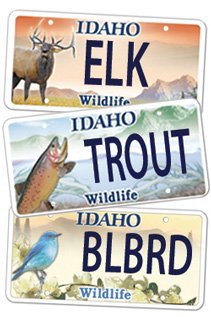
Wildlife License Plates
Great news! as of 2024, there are three NEW designs for license plates. They still are bluebird, cutthroat trout and elk, but they are beautiful.
Idaho Wildlife license plates provide essential funding that benefits the great diversity of native plants and wildlife that are not hunted, fished or trapped—over 10,000 species or 98% of Idaho’s species diversity. Game species that share the same habitats (such as elk, deer, antelope, sage-grouse, salmon, trout) also benefit from these specialty plates.
No state tax dollars are provided for wildlife diversity, conservation education and recreation programs. Neither are any revenues from the sale of hunting or fishing licenses spent on nongame species. Instead, these species depend on direct donations, federal grants, fundraising initiatives—and the Idaho Wildlife license plates.
Both my vehicles have Bluebird Plates. I prefer the bluebird because the nongame program gets 70 percent of the money from bluebird plates, but only 60 percent of the money from elk and trout plates - 10 percent of the money from elk plates supports wildlife disease monitoring and testing programs (to benefit the livestock industry) and 10 percent from cutthroat plates supports non-motorized boat access.
Incidentally, in 2014, the Idaho Legislature denied the Department of Fish and Game the ability to add new plates or even to change the name of the elk and cutthroat plates (very specific) to wildlife and fish plates, a move that would have allowed for changing images occasionally and generating more revenue. It would seem that they believe that we Idahoans don't want a well funded wildlife program.
I think it is time we let the Legislature know that Idahoan support wildlife funding and that we would like to see these generic plates come to fruition.
"WOW. What a phenomenal piece you wrote. You are amazing." Jennifer Jackson
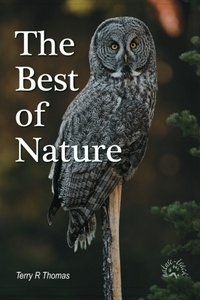
That is embarrassing, but actually a fairly typical response to my nature essays. Since The Best of Nature is created from the very best of 16 years of these nature essays published weekly in the Idaho Falls Post Register (online readership 70,000), it is a fine read. It covers a wide variety of topics including humorous glimpses of nature, philosophy, natural history, and conservation. Readers praise the style, breadth of subject matter and my ability to communicate complex and emotional topics in a relaxed and understandable manner.
Everyone can find something to love in this book. From teenagers to octogenarians, from the coffee shop to the school room, these nature essays are widely read and enjoyed.
Some of the essays here are my personal favorites, others seemed to strike a chord with readers. Most have an important message or lesson that will resonate with you. They are written with a goal to simultaneously entertain and educate about the wonderful workings of nature. Some will make you laugh out loud and others will bring a tear to the eye and warm your heart.
Readers Write:
"You hit a home run with your article on, Big Questions in Nature. It should be required reading for everyone who has lost touch with nature...great job!" Joe Chapman
"We enjoyed your column, Bloom Where Planted. Some of the best writing yet. The Post Register is fortunate to have your weekly columns." Lou Griffin.
To read more and to order a copy, click here or get the Kindle version
Copies are also available at:
Post Register
Island Park Builders Supply (upstairs)
Barnes and Noble in Idaho Falls
Harriman State Park, Island Park
Museum of Idaho
Valley Books, Jackson Wyoming
Avocet Corner Bookstore, Bear River National Wildlife Refuge, Brigham City, Utah
Craters of the Moon National Monument Bookstore, Arco, Idaho