Mormon Crickets
©Terry R. Thomas/www.nature-track.com
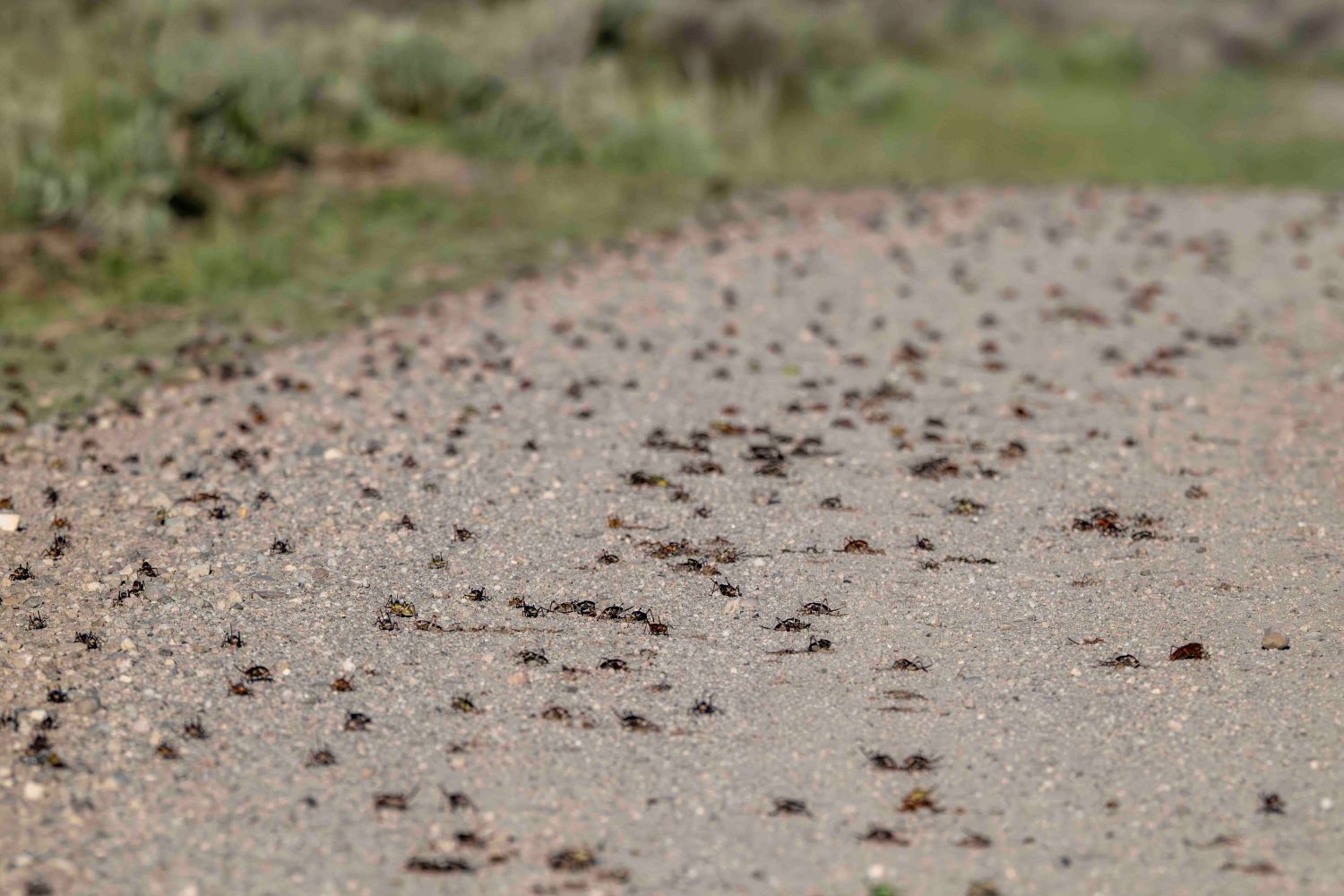
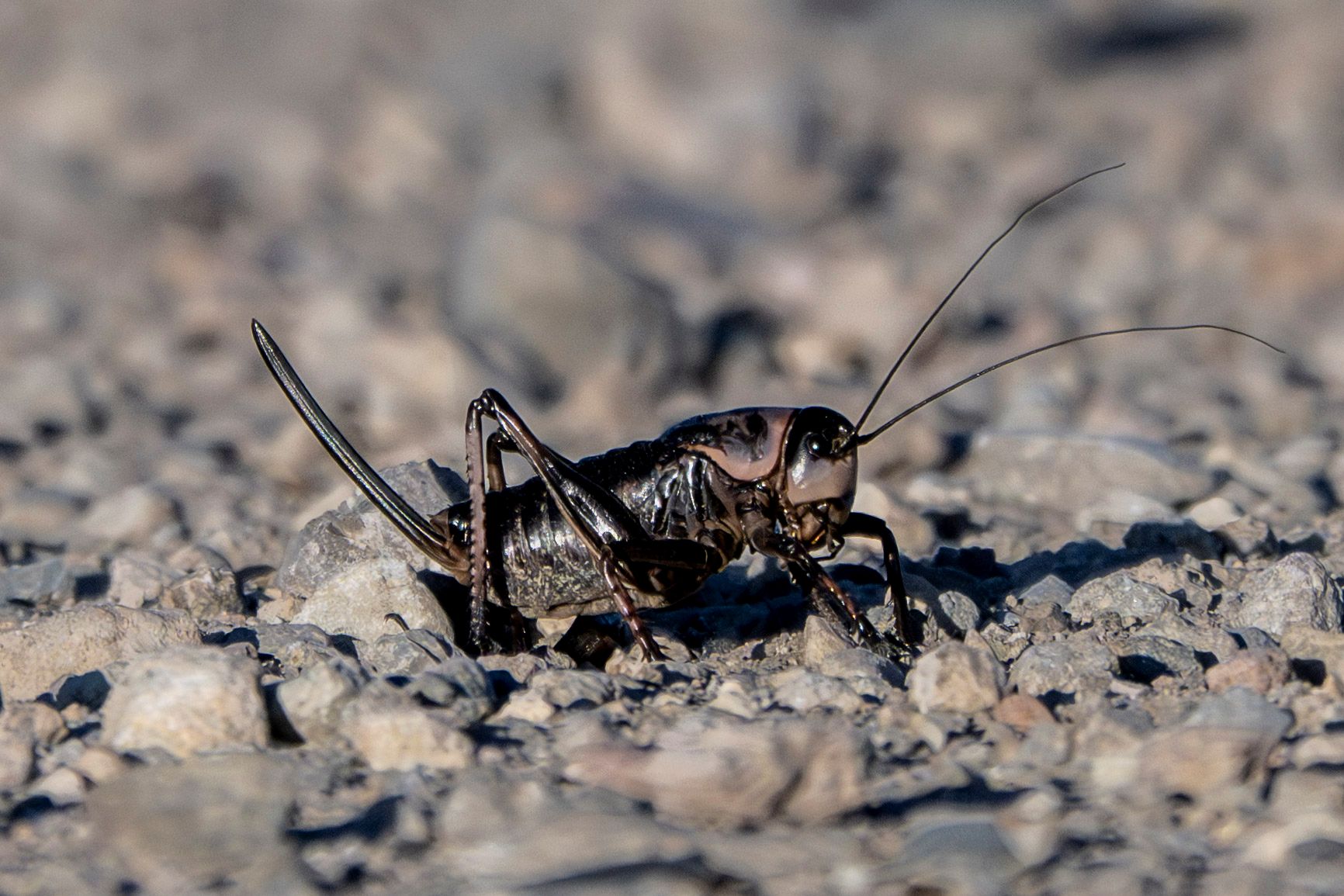
Migratory horde of Mormon crickets crosses a road in Island Park. Close up of a female. That wicked thing at her rear is an ovipositor, not a stinger.
Highway 20 up Ashton Hill advances into Island Park through a steep climb, so flashing highway signs suggesting that the road could be slippery seem appropriate—in the winter. But slick roads in July? That is absurd when temperatures do not even dip below 50 degrees Fahrenheit at night. But these slick roads are not caused by ice or even rain, but rather by insects whose crushed bodies can build up so deeply that the highway becomes slick with their goo.
The insects in question are called Mormon crickets. They are not actually crickets at all, but rather, shield-backed katydids, usually dark brown, plump, flightless, and with a body about the size of a ladies’ thumb.
That seems like an interesting name for an insect and it dates back to an event in May of 1848 when Utah settlers were faced with literally hordes of these insects that threatened the second season of crops that they were depending upon. In what were called the “Cricket War of 1848,” every household fought for their gardens and crops for weeks. Finally, in what is known in Latter-day Saint history as the “Miracle of the Gulls,” California gulls arrived by the thousands and devoured the crickets and saved what was left of the crops.
This year in Fremont and Twin Falls counties, Mormon cricket numbers have been nothing short of spectacular, or if you are a farmer, terrifying although not record setting. One of the most dramatic infestations on record occurred between the years 1998 and 2012 and occurred across seven Western states with a dramatic surge in 2003 and 2004. I recall driving between Mountain Home and Fairfield, ironically past Mormon Reservoir, and having the insects completely covering the road and sounding like popping bubble wrap when driven on. They were so thick that the counties used road graders to scrap them off.
The biology of this insect is interesting. The adult females have long ovipositors that some mistake for stingers, but they are used to deposit up to 80 eggs, one at a time. Over the last 20 years, scientists have discovered that these eggs can lie inert for up to 11 years, waiting for favorable hatching conditions. Populations slowly build until they reach critical mass with densities reaching 100 individuals per square meter. Then they begin to move, millions and millions of them heading in a single direction. They consume just about any plant in their path but also eat each other. It is thought that this cannibalistic behavior fuels the move forward as they must move to keep from being eaten.
Economically, the pioneer experience is still typical. A single Mormon cricket can consume 38 pounds of groceries in its lifetime, which typically lasts 60-90 days. These swarms may cover a mile a day and 50 miles in a season and can completely denude a field of alfalfa, potatoes, or sugar beets. In 2003, Mormon crickets were part of the reason Utah’s governor, Mike Leavitt, declared an agricultural emergency, with the katydids costing the state many millions in agricultural damage.
That’s all bad news if you are a farmer or gardener in the path of a horde of Mormon crickets. Is there a bright side? Well, if you are a gull, this is a boon of protein not to be missed. We have witnessed California, ring-billed, and Franklin gulls feasting on them in Island Park. It is also great news if you are a coyote, kestrel, or even a rodent like a chipmunk. Free abundant protein doesn’t get much better.
Before dismissing them as simply another plague, I should point out that humans have been consuming them for thousands of years and for good reason. They are a complete protein with all nine essential amino acids, containing 55–65 grams of protein per 100 grams of dry weight, more than many traditional meats like beef or chicken, are a good source of fat and fiber as well as minerals such as iron, zinc, calcium, and magnesium and B vitamins. They are reported to have a nutty pleasant flavor and can be used in a variety of ways.
Most important though, a pound of Mormon cricket protein requires vastly less resources to raise than a pound of beef, poultry, or pork. With a growing human population, it is only a matter of time before humans embrace the consumption of insects. And when first-world countries finally turn that corner, we might start hoping for another infestation of Mormon crickets so we can fill our larders with this excellent nutritional source. Too bad the pioneers didn’t realize that they had a potential goldmine of food getting fat on their crops. Then the gulls might not have seemed like such a blessing!
Help Idaho Wildlife
When we traveled across the state in October 2017, we visited most of the Idaho Department of Fish and Game wildlife management areas. Most of the vehicles we saw using the wildlife management areas did not have wildlife plates. Buying wildlife plates is a great way for non-hunters and hunters alike to support wildlife-based recreation like birding.
C'mon folks, let's help Idaho's wildlife by proudly buying and displaying a wildlife license plate on each of our vehicles!
See below for information on Idaho plates. Most states have wildlife plates so if you live outside Idaho, check with your state's wildlife department or vehicle licensing division for availability of state wildlife plates where you live.
And tell them that you heard about it from Nature-track.com!
Wildlife License Plates
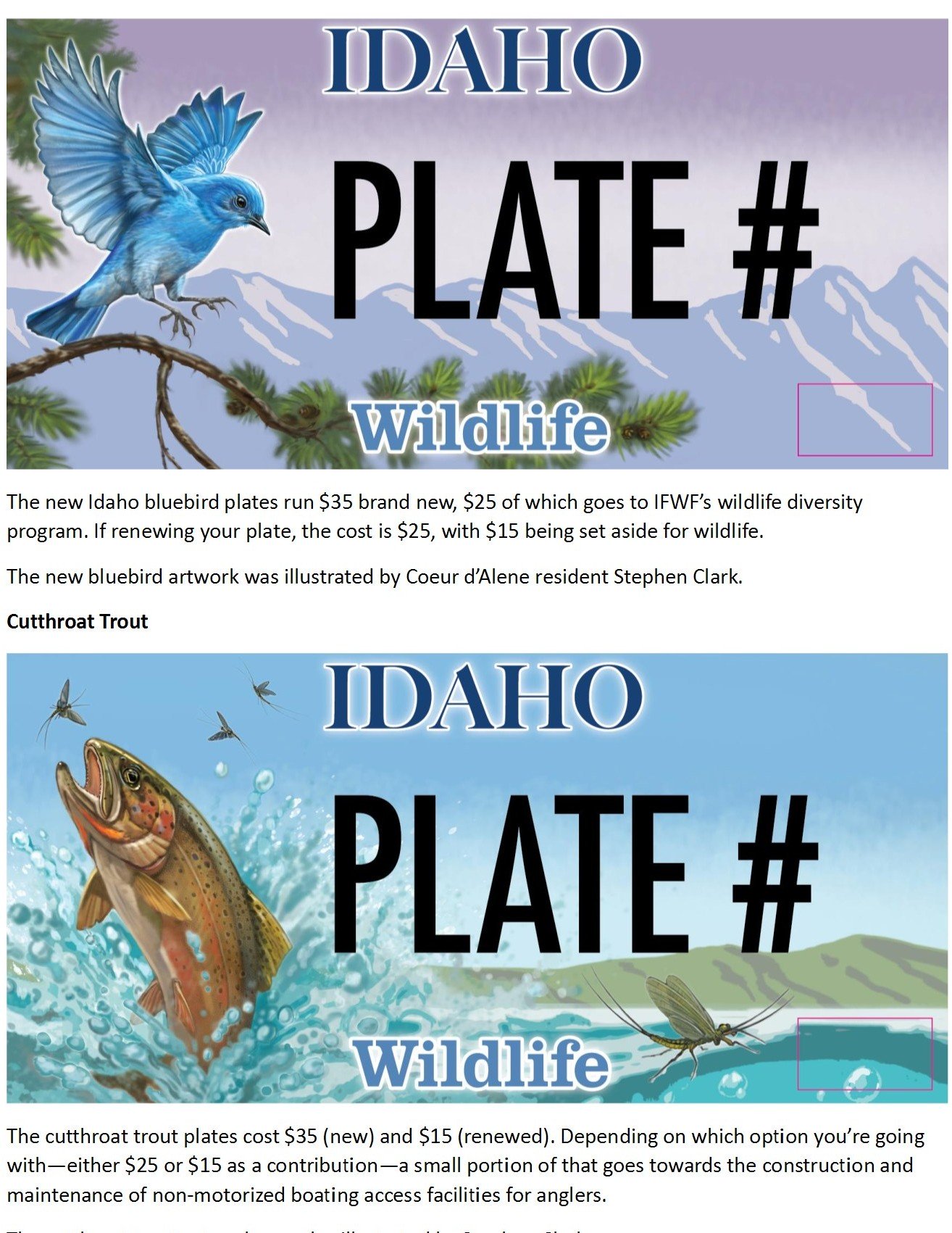
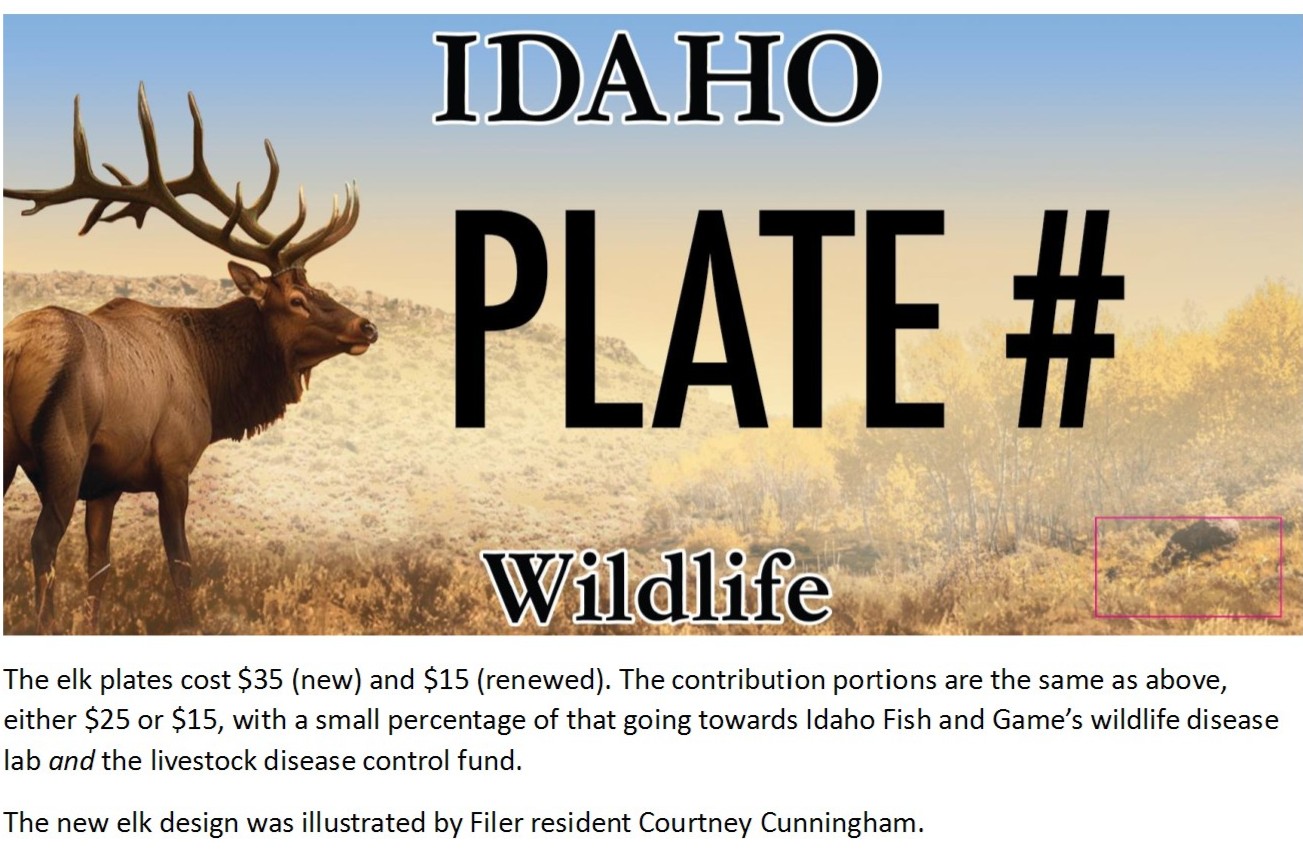
Great news! as of 2024, there are three NEW designs for license plates. They still are bluebird, cutthroat trout and elk, but they are beautiful.
Idaho Wildlife license plates provide essential funding that benefits the great diversity of native plants and wildlife that are not hunted, fished or trapped—over 10,000 species or 98% of Idaho’s species diversity. Game species that share the same habitats (such as elk, deer, antelope, sage-grouse, salmon, trout) also benefit from these specialty plates.
No state tax dollars are provided for wildlife diversity, conservation education and recreation programs. Neither are any revenues from the sale of hunting or fishing licenses spent on nongame species. Instead, these species depend on direct donations, federal grants, fundraising initiatives—and the Idaho Wildlife license plates.
Both my vehicles have Bluebird Plates. I prefer the bluebird because the nongame program gets 70 percent of the money from bluebird plates, but only 60 percent of the money from elk and trout plates - 10 percent of the money from elk plates supports wildlife disease monitoring and testing programs (to benefit the livestock industry) and 10 percent from cutthroat plates supports non-motorized boat access.
Incidentally, in 2014, the Idaho Legislature denied the Department of Fish and Game the ability to add new plates or even to change the name of the elk and cutthroat plates (very specific) to wildlife and fish plates, a move that would have allowed for changing images occasionally and generating more revenue. It would seem that they believe that we Idahoans don't want a well funded wildlife program.
I think it is time we let the Legislature know that Idahoan support wildlife funding and that we would like to see these generic plates come to fruition.
"WOW. What a phenomenal piece you wrote. You are amazing." Jennifer Jackson
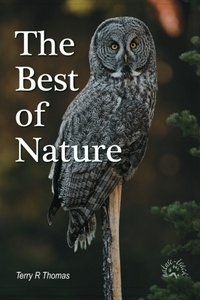
That is embarrassing, but actually a fairly typical response to my nature essays. Since The Best of Nature is created from the very best of 16 years of these nature essays published weekly in the Idaho Falls Post Register (online readership 70,000), it is a fine read. It covers a wide variety of topics including humorous glimpses of nature, philosophy, natural history, and conservation. Readers praise the style, breadth of subject matter and my ability to communicate complex and emotional topics in a relaxed and understandable manner.
Everyone can find something to love in this book. From teenagers to octogenarians, from the coffee shop to the school room, these nature essays are widely read and enjoyed.
Some of the essays here are my personal favorites, others seemed to strike a chord with readers. Most have an important message or lesson that will resonate with you. They are written with a goal to simultaneously entertain and educate about the wonderful workings of nature. Some will make you laugh out loud and others will bring a tear to the eye and warm your heart.
Readers Write:
"You hit a home run with your article on, Big Questions in Nature. It should be required reading for everyone who has lost touch with nature...great job!" Joe Chapman
"We enjoyed your column, Bloom Where Planted. Some of the best writing yet. The Post Register is fortunate to have your weekly columns." Lou Griffin.
To read more and to order a copy, click here or get the Kindle version
Copies are also available at:
Post Register
Island Park Builders Supply (upstairs)
Barnes and Noble in Idaho Falls
Harriman State Park, Island Park
Museum of Idaho
Valley Books, Jackson Wyoming
Avocet Corner Bookstore, Bear River National Wildlife Refuge, Brigham City, Utah
Craters of the Moon National Monument Bookstore, Arco, Idaho