Comets
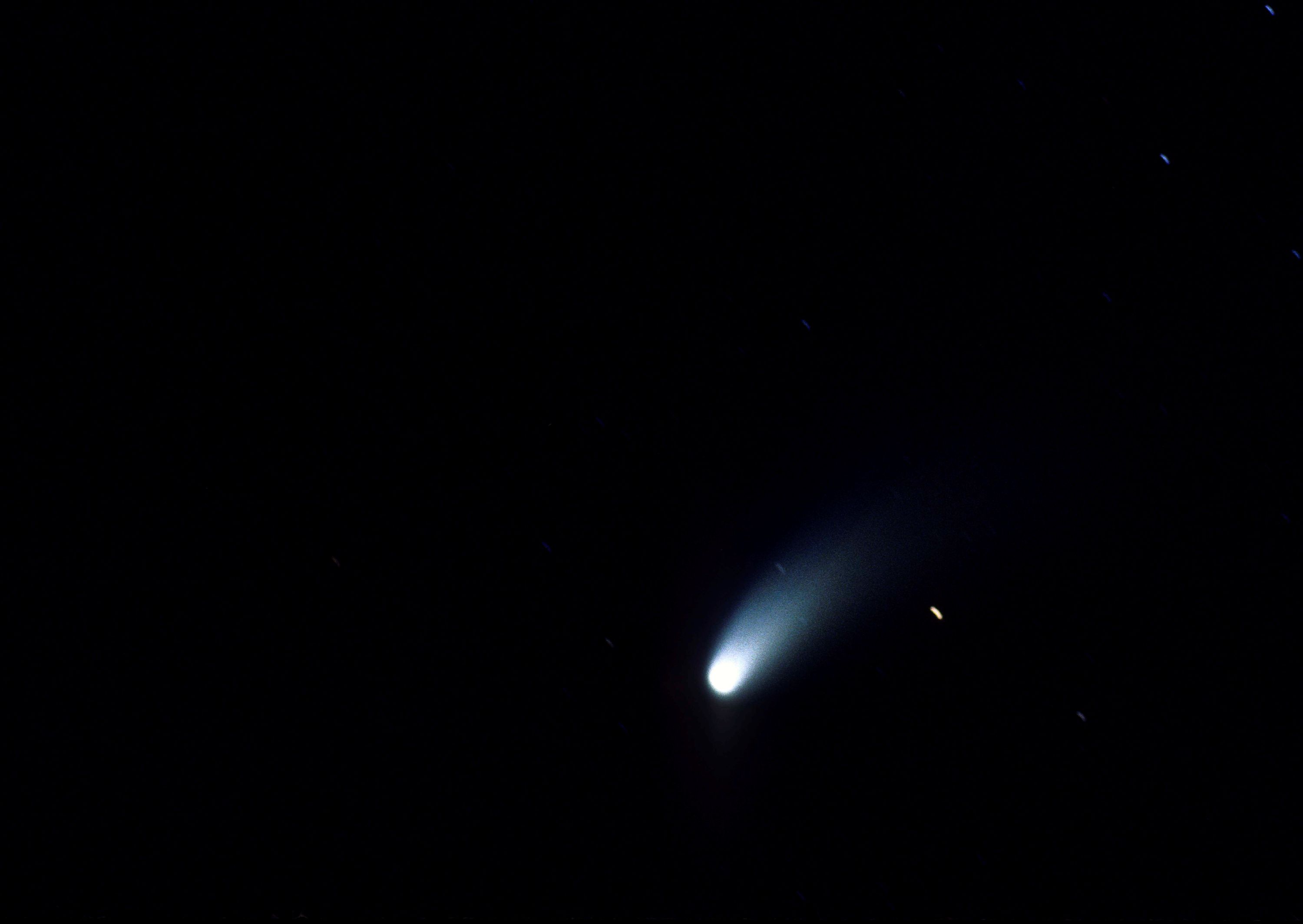
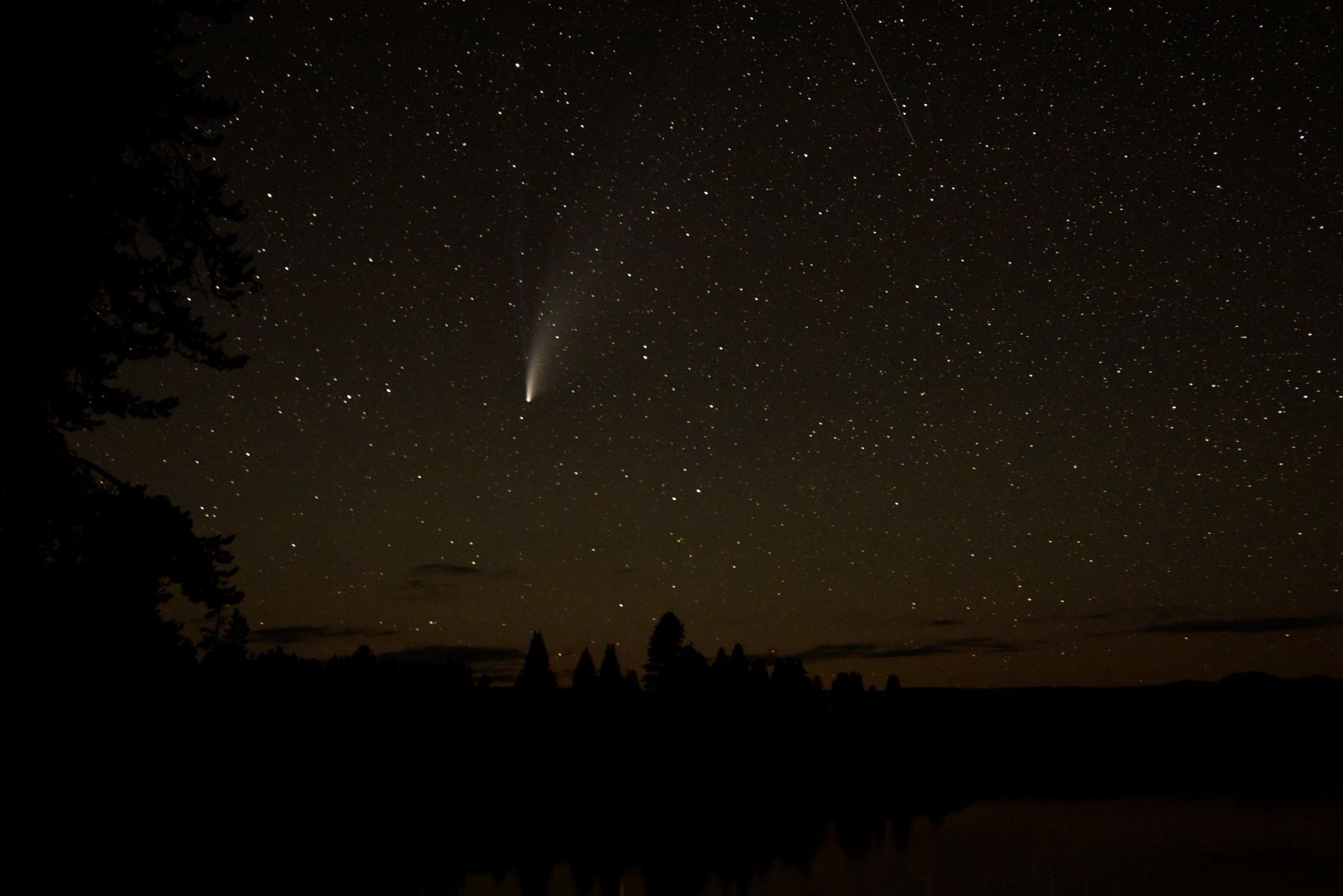
©Terry R. Thomas/www.nature-track.com
Comet Hale-Bopp in 1997 (left) and Comet Neowise in 2020. Neither one will be seen again by humans for a long, long time.
In my lifetime, I have seen a few spectacular comets starting with Halley’s Comet in 1987. Ten years later, it was Hale-Bopp Comet which blessed our skies for nearly 18 months. More recently (2020), we witnessed Comet Neowise, which while it was visible, showed with a brightness of one, which is as bright as a comet can be.
This is all relevant because starting yesterday, what was dubbed as possibly the brightest comet of 2026, the newly discovered, Comet C/2025 R3 (catchy, I know) may be visible to the naked eye. “May be” is important here as it is very difficult to predict just how bright a comet will be (Neowise started out with a magnitude of 17 and increased to 1). It will actually be closest to the Earth on April 27th (about 44 million miles away, 180 times further than the moon) but will be more visible now because of the new moon, Friday April 18th. According to Space.com, it will be in the constellation, Pisces, just below the great square of constellation Pegasus. This will be in the northwest sky and it will be a race against daylight starting around 0400 hours.
This all leads me to wonder, just what is a comet and why do we keep discovering new ones?
A comet is a large loose ball of ice, dust, and possibly some rock and often referred to as a dirty snowball. As astronomical objects go, they aren’t all that big. Halley’s Comet has a nucleus of about nine miles long, five miles wide, and five miles thick. However, a curious thing happens when a comet flies past the sun. The sun’s rays heat it up and through a process called outgassing, an unbounded atmosphere, called a coma is created around the nucleus. This ball of gas can become huge, up to 15 times the diameter of the Earth and a tail of gas and dust forms that can be one astronomical unit (the distance from the Earth to the sun) in length. It is also interesting to note that even though we may think of comets as glowing hot, they are actually extremely cold, as is most of space.
Comets are thought to originate in two different locations, the Kuiper belt outside the orbit of Neptune or the vastly more distant Oort cloud that extends to about halfway to our nearest neighboring star. That origin makes all the difference as far as discovering and seeing comets.
Take Halley’s Comet for instance. Sir Edmond Halley realized that the same comet had appeared in 1531, 1607, and 1682, and correctly predicted its return in 1758 (but has been in orbit for at least 16,000 years). For the first time, astronomers realized that comets were repeat visitors.
Halley’s Comet is a short-period comet with a periodic return of 76 years, and it originates in the Kuiper belt. Halley’s is one of the very few comets where a human has a chance to see it twice in a lifetime. This won’t happen for me unless I live to 104, but three of my kids were old enough to see it (possibly not remember it though) in 1986 and hopefully will still be kicking when it shows up again in 2061.
Most of the comets we see are long-period comets defined as having a return period of at least 1,000 years and originate in the Oort cloud. They are in an orbit, but it is a big one. While Earth has seen them in the past, there is no record. For instance, the best prediction for seeing Comet Hale-Bopp again is around the year, 4383-4387. And if you missed Comet Neowise, you would have a 7,000 year wait. I’m not that patient. And this is all because they started their orbits so dang far away.
There is one other type of comet, the hyperbolic comet. A hyperbolic comet is not on an orbital pathway and shoots past us and then on into outer space to never return.
If you are itching for a once-in-a-lifetime experience, getting out and looking for Comet C/2025 R3 may be just the thing. It hasn’t been around for 170,000 years and won’t be back for that long either.
Help Idaho Wildlife
When we traveled across the state in October 2017, we visited most of the Idaho Department of Fish and Game wildlife management areas. Most of the vehicles we saw using the wildlife management areas did not have wildlife plates. Buying wildlife plates is a great way for non-hunters and hunters alike to support wildlife-based recreation like birding.
C'mon folks, let's help Idaho's wildlife by proudly buying and displaying a wildlife license plate on each of our vehicles!
See below for information on Idaho plates. Most states have wildlife plates so if you live outside Idaho, check with your state's wildlife department or vehicle licensing division for availability of state wildlife plates where you live.
And tell them that you heard about it from Nature-track.com!
Wildlife License Plates
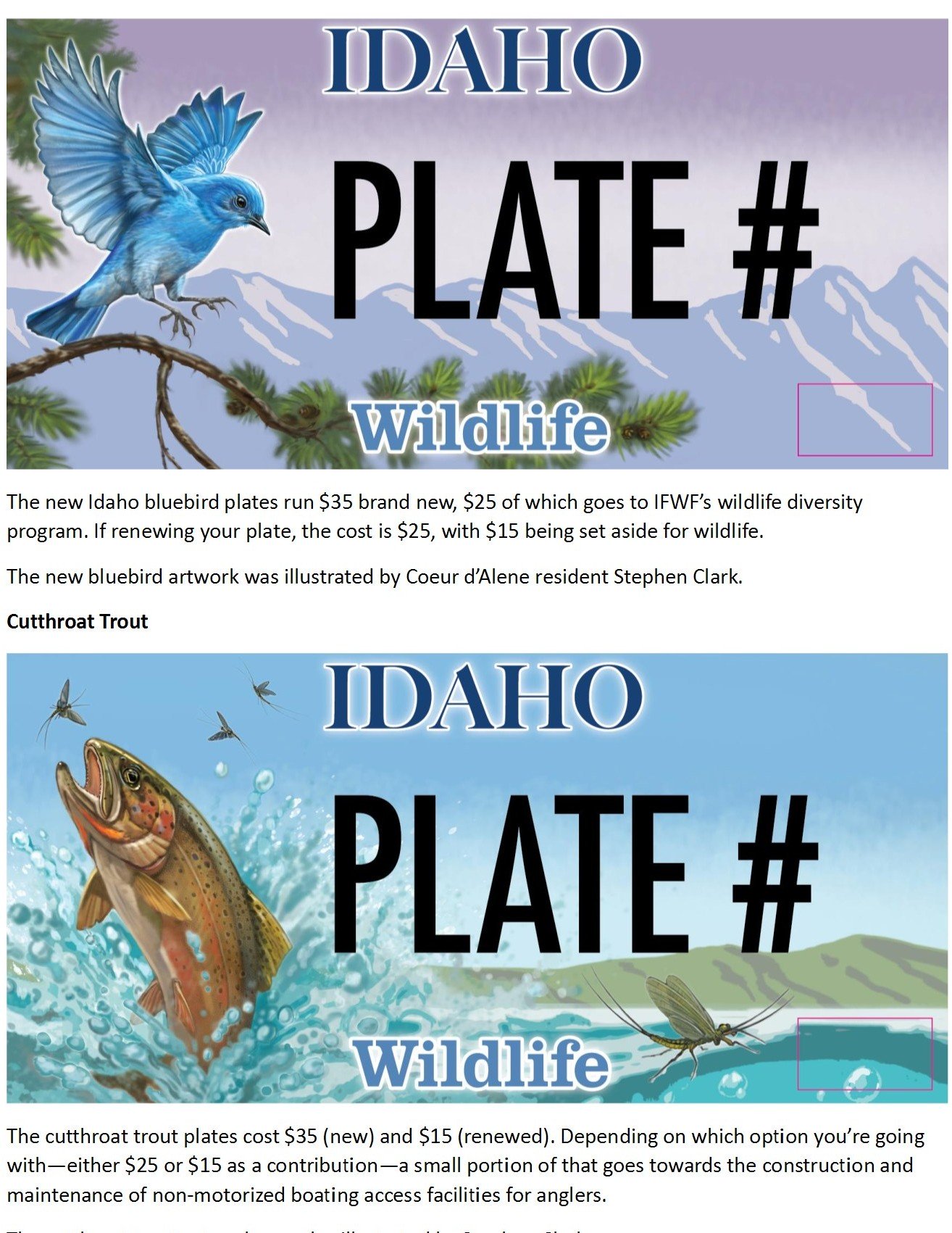
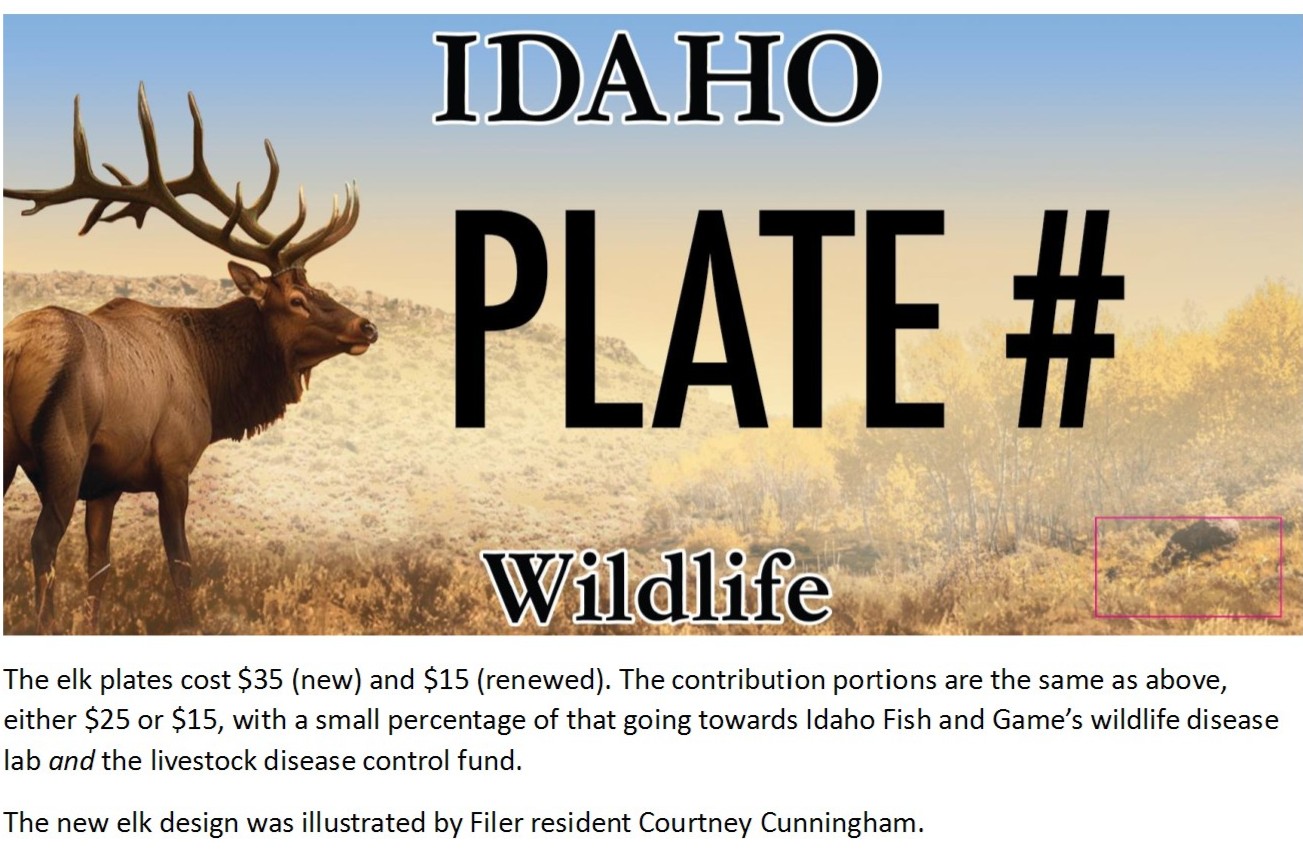
Great news! as of 2024, there are three NEW designs for license plates. They still are bluebird, cutthroat trout and elk, but they are beautiful.
Idaho Wildlife license plates provide essential funding that benefits the great diversity of native plants and wildlife that are not hunted, fished or trapped—over 10,000 species or 98% of Idaho’s species diversity. Game species that share the same habitats (such as elk, deer, antelope, sage-grouse, salmon, trout) also benefit from these specialty plates.
No state tax dollars are provided for wildlife diversity, conservation education and recreation programs. Neither are any revenues from the sale of hunting or fishing licenses spent on nongame species. Instead, these species depend on direct donations, federal grants, fundraising initiatives—and the Idaho Wildlife license plates.
Both my vehicles have Bluebird Plates. I prefer the bluebird because the nongame program gets 70 percent of the money from bluebird plates, but only 60 percent of the money from elk and trout plates - 10 percent of the money from elk plates supports wildlife disease monitoring and testing programs (to benefit the livestock industry) and 10 percent from cutthroat plates supports non-motorized boat access.
Incidentally, in 2014, the Idaho Legislature denied the Department of Fish and Game the ability to add new plates or even to change the name of the elk and cutthroat plates (very specific) to wildlife and fish plates, a move that would have allowed for changing images occasionally and generating more revenue. It would seem that they believe that we Idahoans don't want a well funded wildlife program.
I think it is time we let the Legislature know that Idahoan support wildlife funding and that we would like to see these generic plates come to fruition.
"WOW. What a phenomenal piece you wrote. You are amazing." Jennifer Jackson
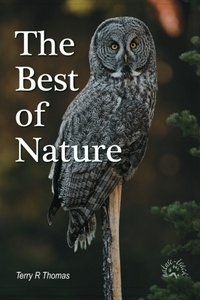
That is embarrassing, but actually a fairly typical response to my nature essays. Since The Best of Nature is created from the very best of 16 years of these nature essays published weekly in the Idaho Falls Post Register (online readership 70,000), it is a fine read. It covers a wide variety of topics including humorous glimpses of nature, philosophy, natural history, and conservation. Readers praise the style, breadth of subject matter and my ability to communicate complex and emotional topics in a relaxed and understandable manner.
Everyone can find something to love in this book. From teenagers to octogenarians, from the coffee shop to the school room, these nature essays are widely read and enjoyed.
Some of the essays here are my personal favorites, others seemed to strike a chord with readers. Most have an important message or lesson that will resonate with you. They are written with a goal to simultaneously entertain and educate about the wonderful workings of nature. Some will make you laugh out loud and others will bring a tear to the eye and warm your heart.
Readers Write:
"You hit a home run with your article on, Big Questions in Nature. It should be required reading for everyone who has lost touch with nature...great job!" Joe Chapman
"We enjoyed your column, Bloom Where Planted. Some of the best writing yet. The Post Register is fortunate to have your weekly columns." Lou Griffin.
To read more and to order a copy, click here or get the Kindle version
Copies are also available at:
Post Register
Island Park Builders Supply (upstairs)
Barnes and Noble in Idaho Falls
Harriman State Park, Island Park
Museum of Idaho
Valley Books, Jackson Wyoming
Avocet Corner Bookstore, Bear River National Wildlife Refuge, Brigham City, Utah
Craters of the Moon National Monument Bookstore, Arco, Idaho